Showing posts with label tests. Show all posts

Friday, December 24, 2021

GROUND TEMPERATURE --Cultivated vs Uncultivated ground

 I'm redoing a study I did back in 2015-2016 on temperature differences in different ground conditions.  Those earlier findings can be seen by clicking on "tests" in the labels section and scrolling to the bottom to "HOBO Temperature Sensors" posting.

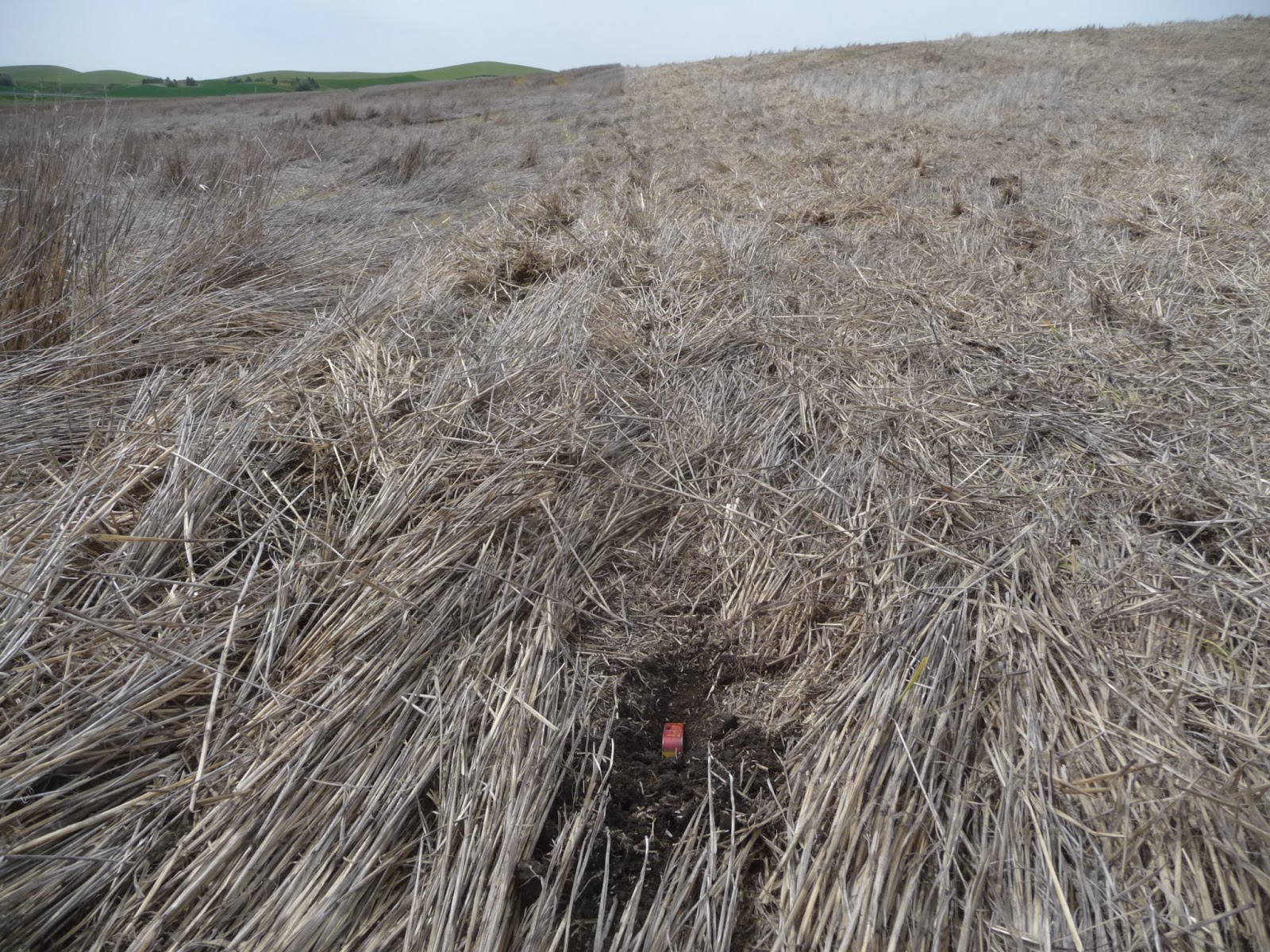
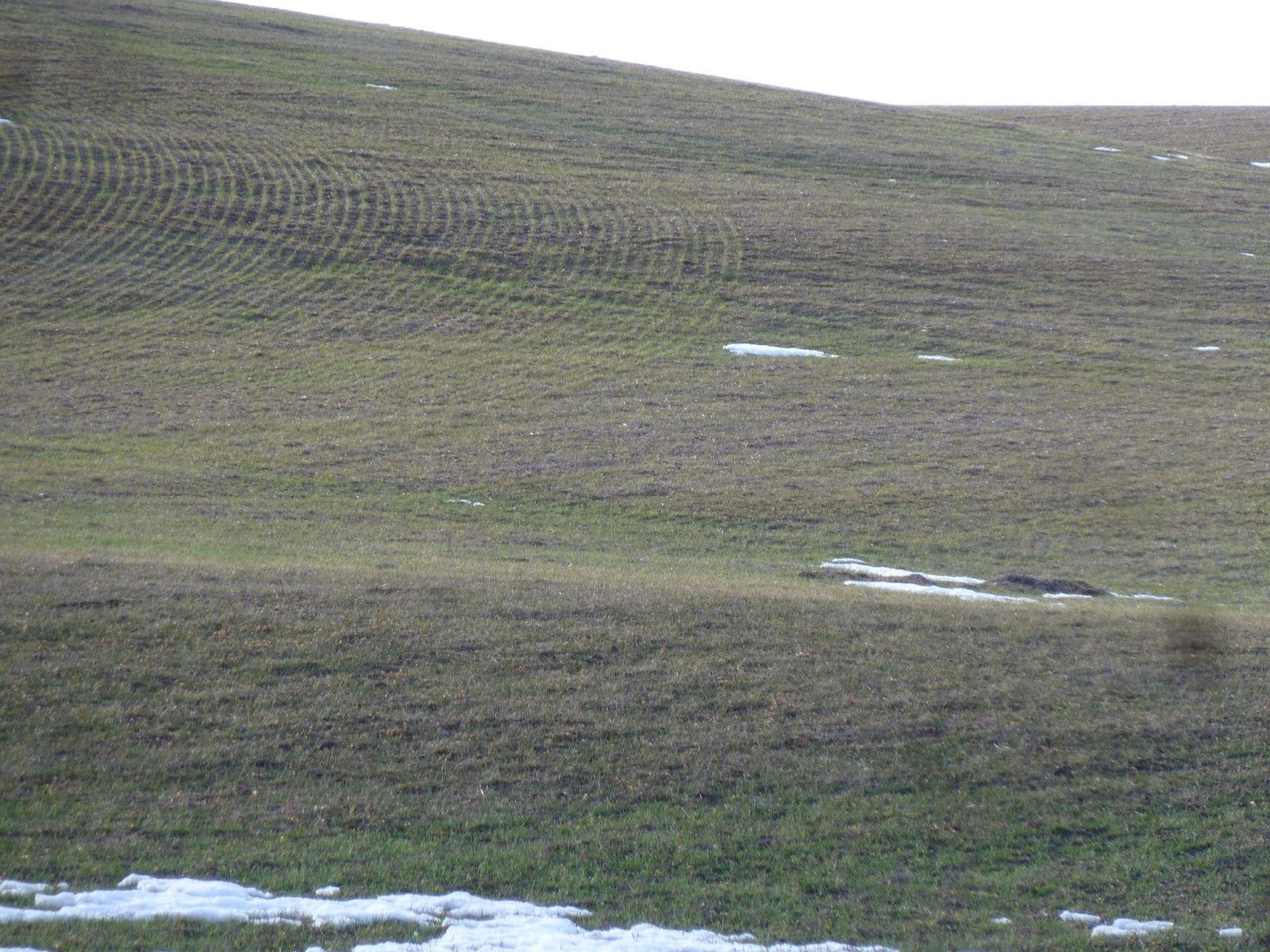
This current study is starting on 12/24/21 in near freezing, snowing conditions. Temperature readings will be taken every 2hrs until we start seeding the spring crop in spring of 2022, around April.  There will be an update to this posting after seeding.  I started this study by spading and working up two areas to replicate a cultivated field with little surface residue.  I'm comparing this with field conditions where there is surface residue left undisturbed.  All the sites are within throwing distances of one another, one in long term CRP ground and the other in ultra low disturbed no-till crop ground.  We have had some variable weather ranging from freezing to thawing, and mixtures of rain and snow for the past week.  The field aspects are similar from one site to the other.  One difference showed immediately.  The worked CRP field had no sign of frost(pic upper left showing a lot of living roots), where the cropped field showed frozen soil about an inch deep (pic lower left showing some non-living roots).
These observed conditions support the idea that there is more biological activity in the CRP field where the grass roots are living, hence a warmer microclimate in the root zone, compared the the cropped field where there has not been living roots to stimulate biological activity for five months.  Biological activity creates heat.
    HOBO temperature/light sensors (model UA-002-08) will be placed on the surface and at the 2" depth in the cropland sites.  This is my primary interest, to see if there is a temperature difference between cultivated and uncultivated ground, both surface and subsurface locations.  The inclusion of CRP ground is to see how ground temperatures differ between cropped ground with it's limited time supporting living roots, and ground that continuously supports living roots. 
     Once put in place, these sensors will stay until recovery in early spring.  They don't support remote monitoring or downloading. 

The pic to the left shows a typical plot from the data collected with the HOBO (UA-002-08) sensor for temperature and light. A (HOBO) sensor and the "reader" is shown above the wireless keyboard and trackpad.

Monday, December 7, 2020

RUSLE2 -- Explanation of Use

RUSLE2 is used by USDA to evaluate a farm operation for various programs offered by the USDA.  It also can be used by individuals to evaluate practices for the purpose of improving soil health.  Following, is the link to this 1:03:34 presentation explaining the variables that make up  RUSLE2.  [ RUSLE2 explained ]   This is a very good and thorough understandable explanation of what goes into the evaluation.  It's a much better tool than I ever thought.  I knew that it was under constant research to improve its accuracy.

Friday, November 23, 2018

Glyphosate

        Roundup is back in the news.  The jury verdict this past spring was surprising.  To me this looked like an easy win for Monsanto with the plaintiff being a groundskeeper with only two years history using Roundup, while there is a American Health Study (AHS) on farmers and farm families  that summarizes: --In this large, prospective cohort study (#1 link), no association was apparent between glyphosate and any solid tumors or lymphoid malignancies overall, including NHL(Non-Hodgkin lymphoma) and its subtypes. There was some evidence of increased risk of AML(Acute myeloid leukemia) among the highest exposed group that requires confirmation.  This study was revisited and updated in 2018 with no change in the summary.  Links #2 & 3, describes why it is so difficult to predict an outcome with a jury trial.  The facts are so ambiguous and they can be blurred by how a question is framed/phrased/developed.   I am slowly coming to the conclusion that there is no conclusive science surrounding this subject, and that public perception, emotion, and political correctness will rule the day on the use of Glyphosate, --or any other subject that catches the publics attention.
      I'm including a link (#4) to an AHS site showing increased risk for farmers and farm families to certain diseases/conditions.  This is not a comprehensive list, but recent determinations.  It's a bit sobering.  I think I am a typical farmer in that safety frequently takes second place to expediency when it comes to working with agriculture chemistry.  An Antidote: (recently we took old, and in some cases unidentifiable (lost label) agricultural chemistry to a state sponsored collection area. Every year the Dept of Ag sponsors these collections as encouragement for  farmers to not dump this chemistry on the ground when it's determined to be unusable for their crops.  The collection "professionals" were all dressed in hazmat suits, and the farmers were delivering their jugs and other containers wearing normal working clothing of leather boots, cotton pants, shirts, bill caps and no gloves.)  After viewing PBS's documentary on "9 Months That Made Me", I have become more aware of how life style effects our health and life expectancy and general quality of life.   It's a little late for me; however, the younger generation should pay more attention to personal protection when using Ag Chemistry.  The AHS studies show that we not only have elevated levels of these chemistry's in our bodies, but we expose our families to the effects of these chemistry's when we wear contaminated clothing around them.
1)  Farmer Health study :  (This is an abstract of the AHS mentioned above on Glyphosate.)
2)  Popular Science on Jury's & Science :  (A short article on dilemma associated with Juries reconciling legal and Science evidence.)
3  SNOPES: Juries & Science :  (A long article explaining the difficulty in reconciling legal and science evidence.)
4  News & Findings (on Farmers Health)  (A list of findings on increased risks for farmers.)

Wednesday, November 14, 2018

SOIL TESTING - Simple/Useful/DIY tests

    Through a Twitter post, I discovered the following website that gave 20 various tests for evaluating soil health.  Most are useful for both pasture and cropland, with visual observation tips and evaluation sheets/parameters to track progress to improved soil health.  Many only require taking a spade depth and width plug of soil (I use a trenching shovel for it's long narrow blade), and a number of these tests/observations can be made with the same sample. [ variety of useful DIY tests soil health ]

Thursday, April 5, 2018

SOME BASICS OF SOIL HEALTH


       Soil health is such a multifaceted subject that it's easy to get lost in the rhetoric.  My intention here is to summarize what I have sifted out of a lot of material to be important for soil health, along with the reasoning for these statements.
      In general, strive to minimize erosion, and maximize soil biota.  To achieve these two goals five criteria emerge
       1 ---Manage the farm operation to maximize soil surface residue: 
If you see dirt you are short residue!  Every primer on soil health will include a section on the need to protect the soil's surface 24/7, 365 days a year.  This means, keep it covered!  A farming operation does this with crop residue.  Residue resists erosion, feeds soil biota, moderates soil temperature, maximizes moisture capture, reduces weed emergence.
<---this pic shows cover with  >20,000#/ac.  Although this volume is preferable, rotations that include low residue crops will not likely retain this much protection.  This pic also shows seed placement of spring wheat in the lower center.

          2---Strive for less disturbance of the soil profile:
Use a ULD (ultra-low-disturbance) cropping system.  It will maximize residue retention, minimize destruction of soil aggregates, maximize retention of channels made by roots and macro soil biota for water infiltration and gas exchange, minimize weed competition by leaving weed seed high and dry.
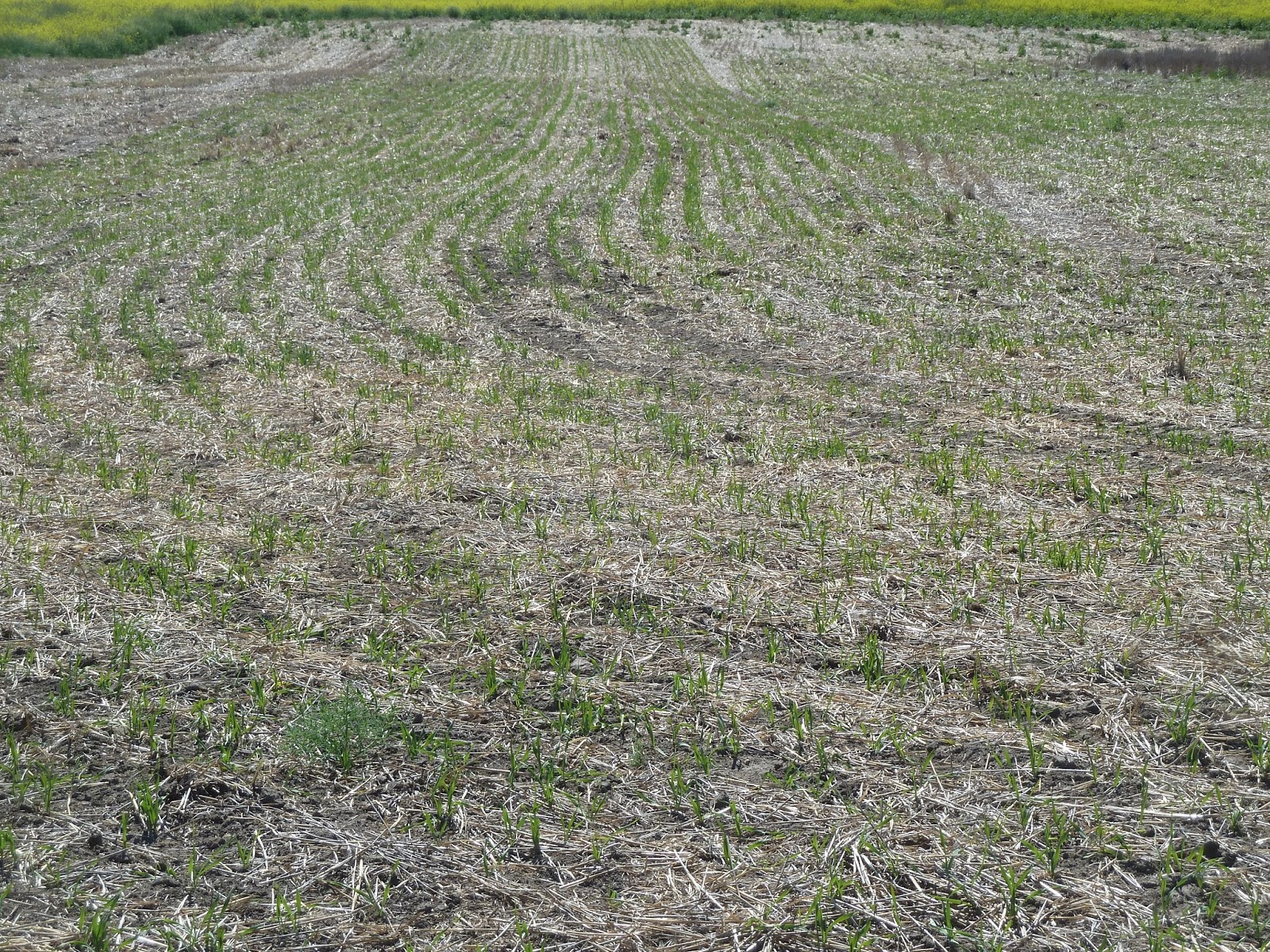
<---this field is seeded to mustard that is starting to emerge.


          3---Develop a diverse crop rotation:
Soil biota need a diversity of plant cultivar exudates.  These exudates are derived from warm and cool season broadleaf cultivars, and warm and cool season grass cultivars.  Wheat is King in our region.  Basically we are a mono culture.   Although other crops haven't given the return like winter wheat, we need to develop crop diversity if there is any hope of recovering the natural productivity our soils.
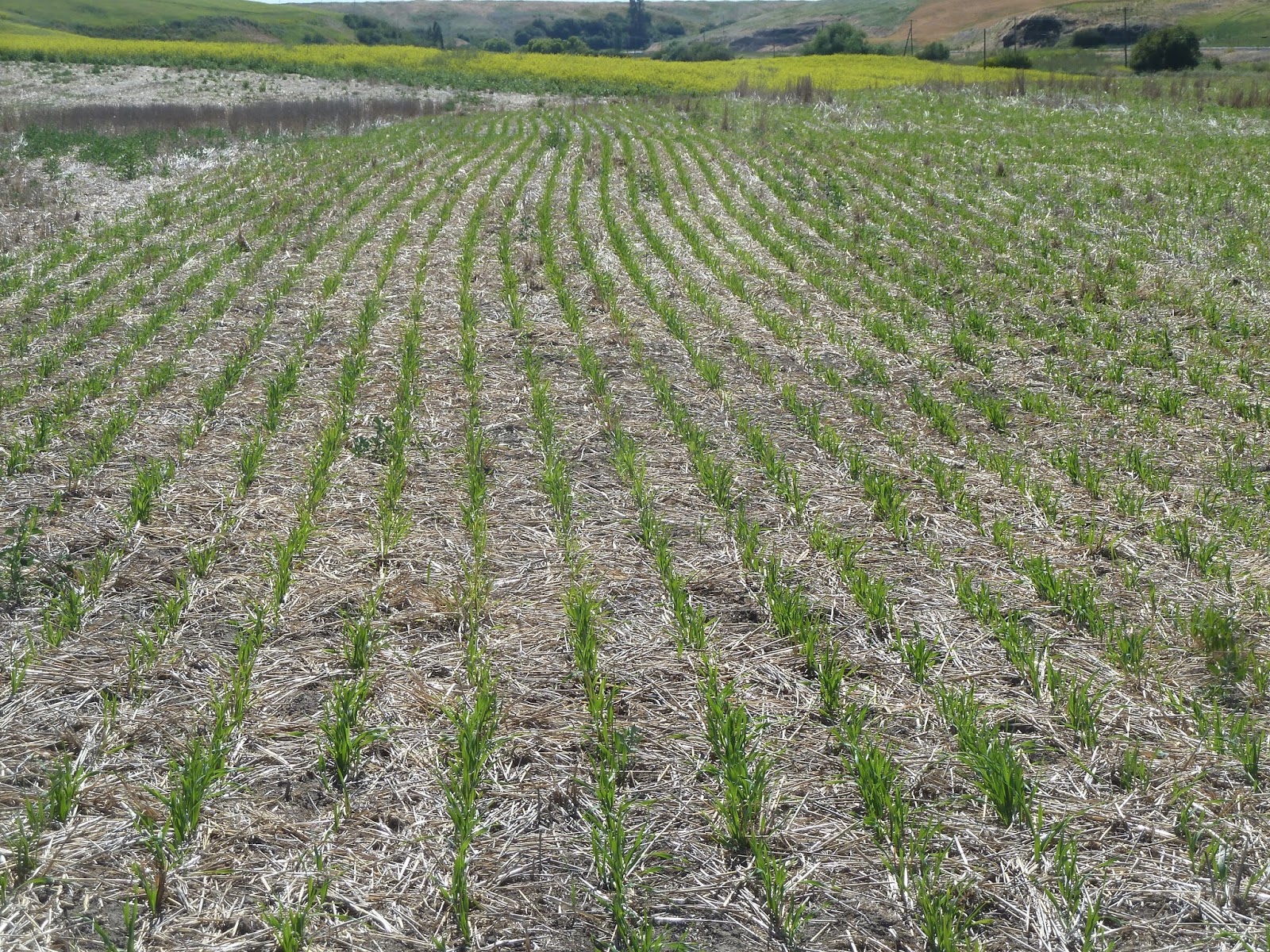
<---pic of spring peas no-tilled into winter wheat stubble.


          4---Plant cover crops to replace fallow:
We need to replace traditional fallow with green fallow(GF). Green fallow is the opportunity to increase cultivar diversity beyond the normal crop diversity.  Research is pretty clear that, in our region, fallow is counter productive to building soil health. More SOM is lost during the fallow year than is gained during the cropping period.
<---pic shows a GF field seeded with 9 cultivars, including three radish, one cabbage, one triticale, one pea, two mustard, one winter canola.

        5---Measuring progress:

Testing is obvious, but what tests?   Unless you understand each test's limitations, they can be quite misleading.  There are a number of tests available to measure progress, --chemical soil tests, leaf tests, biological tests using soil, Haney, or Solvita, and also microscopy.  Rely on leaf tests to discover crop deficiencies.  Every five years or so sample for a soil biological test to determine long term changes.  These tests are expensive and also limited to information for a very small area.  Because our soils vary greatly from one footstep to another, analyzing any soil sample has limited value.  Chemical analysis of soil is good at determining the total quantity of a nutrient but not so good about determining the plant availability of that nutrient.  Frequently, leaf tests will show a deficiency when the chemical analysis of the soil shows an abundance of that particular nutrient.  As the agricultural industry learns more about plant nutrition, more elements are needing to be tested.

    In recent years I have become aware of the importance of soil biology.  Soil biology sounds like a very old discipline, and it is; however, the first comprehensive publication on the subject was not printed until the mid 1980's (that absolutely astounded me).  Since then we have learned that plants communicate, and that symbiotic systems can develop in the soil that interact with plants.  Although a novice, I am convinced that we can rebuild the natural productivity our soils once contained.  To do this, we will need multiple field checks to determine what organisms are present, or may need to be added, and food (plant cultivars grown, or amendments applied) provided to grow their population.  That is the purpose for buying a microscope, and online classes to learn the basics of soil biology.  Armed with these tools one can identify and manage for the different soil biota at a relatively low cost.  My equipment and education cost the equivalent of six biological tests.  These six tests would give me detailed information on six small areas of a field, and takes a week or two for the results.  With the microscope, I can get a general idea of conditions, and get that information in a half hour allowing the opportunity to correct a deficiency in a timely manner.

         STILL UNANSWERED TO MY SATISFACTION:  The following two subjects have a lot of literature expressing diverse opinions.
--What depth should you draw your sample for biological and chemical tests?  In the literature I discover no consistency on depth from which to pull a sample, when it is even mentioned.  It comes down to what you have a question about.  An example would be, do you want the nutrient analysis in the top 2" or the top 12"???  So, since most of the plant roots are in the top 12-18", and most of my sampling in the past has been done at 12", I'm going to continue using 12" depth for sampling and comparison.  At least I will be able to salvage some useful data from the past.  Any real gain in SOM will have to reflect more than 3" profile, so, 12" it is.
This pic shows a soil pit from the Aeschliman farm south of Colfax, WA.  The top of the pic just catches the soil surface.  The bottom of the pic shows the washed out color of residue on the near bank of the pit.  Notice the dark streaks going down into the pit which is ≥ 6' deep.  These dark streaks are carbon enriched soils that are left behind in the root channels and worm burrows. As can be seen, these channel sources are important in moving carbon deep into the soil profile.  The color variation in this pic goes a long ways in explaining the potential for variability of our soil.  Think about coring down a dark area and then a foot or two away coring down a light area.  Is the chemical or biological analysis going to come out the same, --no way!

--What species and number of cultivars should be included in a cover crop?   The most consistent advise I hear is, plant cultivars that support your "goal", or needs of the cash crop that follows, --such as, will you need N, or do you need more biomass, or do you need to improve soil structure?  My thinking follows along the line of:   Include as many different cultivars as economically possible in the cc mix, --at least five with one of them being a radish, and another a legume (unless the next crop is a legume). Radish are good bio-drillers, and the taproot (not the tuber) goes deep and scavenges nutrients, bringing them back near the surface. Caution:--make sure all brassica's in the cc mix is certified disease free.  Canola is going to be an important crop for us and we want to avoid  bringing in soil borne diseases on brassica seed stock.  Another caution is to not include a cultivar that will be hard to remove from the following crop.

      WHAT THE FUTURE HOLDS:
Our farming methods will change to more closely mirror nature, simply because the forces that impact agriculture will move the industry in that direction.  Input costs of equipment, chemistry, and plant nutrition along with increasing regulation and legal liability associated with farming will force agriculture to be more holistic in nature.  I fully expect, not too long in the future there will be a requirement to be "licensed" to farm.  With the world political, and climate change implications, food security issues will draw more political attention. I expect this to be a slow transition that will come through the metamorphosis of the current required "private applicators license".   All it would take is a tweak in the current law to include current soil conservation and biology information.  If this becomes the trend of the future I heartily support it.  Farmers need to be a highly trained professionals, and that requires a continuing education program.  Those of us that regularly attend university research seminars, and direct seed conferences are already exceeding any probable requirement that a law would require.
       As a Sanskrit text written in about 1500BC noted: “Upon this handful of soil our survival depends. Husband it and it will grow our food, our fuel and our shelter and surround us with beauty. Abuse it and the soil will collapse and die, taking humanity with it.”
 
    The No-Till Farmer features an article:  < Building Resilient Soil System >


Saturday, February 11, 2017

2017 Spring Runoff --> ULD-DS vs Tillage

      This last week we have been losing our snow.  It started out with light freezing rain, turning to light rain, then, temperatures going to the mid 40's during the day and down to 29 at night.
      A couple of weeks ago, it was predicted that we were going to get 1.5-2" of rain.  I fully expected massive runoff from our fields.  It didn't happen.  We are losing some water during the latter part of the day, but no huge amounts.  The creek in front of our house has risen to < 1/2 it's capacity.
     Our ULD-DS fields are handling the thaw quite well.  Nothing seems to be displaced on our stubble ground.  We have two WW fields west of St. John.  One is seeded on CC ground that included radish, mustard, canola and other cultivars (see earlier post).  I could not determine whether we were losing water or not.  There was definitely displacement, but runoff from a cultivated field was going through our field, and I could not determine if we were adding to that flow.  It appeared that the displacement wasn't more than 20-30' before the water disappeared.  There are exceptions, --seeding vertically.  I don't think you can stop water movement seeding vertically on a slope.  Even as narrow as our slot is with the cross-slot (pic on the right).  Maybe an exception would be where stubble was plentiful enough to hairpin it into the slot to slow the velocity.  Our CC or WP ground definitely did not have that condition.  The WW on WP ground was losing some water.  There were no deep rooted, fast deteriorating radish plants in that field.
      The jar on the right was taken at our WW on WP field border.  It is nearly clear and I see no sediment showing on the bottom.   I will be sending a sample to a lab to see what polluting elements may be present.  Obviously sediment is not one of them.
      The jar on the left was taken at the outflow of a conventional tilled field, and sediment does settle out.


      At Thornton, the WW seeded into SP residue looks terrific.  Except for the drifts, which are large, the snow has pretty well disappeared.  Again, without vertical blockage snow is displaced and drifts form.   This condition is yield robbing, even if the water doesn't leave the field.  There are areas that are short ≈2"moisture, and areas that have excess moisture but losing sunlight energy.


      The pic on the left shows disappearing snow and a good WW crop exposed.  The pic on the right is Thorn Creek.  Our property is not contributing to this flow.  Our property scores very well on the Slake test which is helping us with moisture infiltration.
       I'm including a 7min (YouTube) video by Ray Archuleta explaining the Slake Test and it's meaning.

Sunday, September 11, 2016

Mixing DS and CT

     In recent years there has been a lot of money available to farm operators encouraging the use of direct seeding in the Palouse.  I am seeing more direct seeding, DS drills are being bought, but many of those operations are still including cultivation as a farming practice.  Why? --are they continuing to compare DS with CT? --are they expecting to use DS as another practice in the toolbox?
     I'm not a proponent for either, --if either are the reason.   The more I learn about building healthy soils, the more apparent that DS is only the starting point, and ULD has to be employed to reach that level.  DS may stop the bleeding from water and wind events depending on the amount of surface cover, and disturbance done by the seeding operation, but building soil health requires more.  We all know how destructive CT can be from water and wind events, but, I'm finding out that there is a real lack of understanding among farmers about the destruction that tillage does to the soil without any water and wind events.  Every tillage operation degrades soil structure by breaking soil aggregates into ever finer particles.   Tillage accelerates OM loss, reducing moisture holding capability of the soil.   Every tillage operation slices and dices the environment that supports the biological life that makes soil out of dirt.  The effect can be somewhat compared to a bulldozer being run through your home.   Every chemical application, every fertilizer application, every tillage operation, fire or other natural event that denudes or moves soil degrades the biological life of that soil.  So, everything we normally do to raise our crops has a negative impact.  The more we add, or do, the worse the damage.   Our various technologies allow increasing  yields even though our soils continually degrade through current cropping practices, --that includes most DS operations.  As our soils degrade to dirt, it's ability to partially support our yields is also reduced.  It doesn't take soil to raise crops.  Proof is the thriving business of hydroponics where all plant nutrition is supplied by applied chemistry.  As our soils degrade we will find ourselves applying more plant nutrients with their associated cost.  This needs to change!  The challenge for us is to learn how to reduce these negative impacts, and promote an environment that builds soil structure and soil biological communities, and still maintain reasonable yields during the transition.  At this point in time, that means reducing soil disturbance, increase crop diversity, use covers for our specific soil needs, and probably apply compost or teas to jump start the soil biology.  Don't bother adding compost or teas that don't have the specific elements needed by your soil.  They will be a waste of money.  Soil biological tests from Earthfort in Oregon will give you the information you need about the condition of your soils, though finding compost that will meet your specific soil needs may not exist at this point in time.  I'm looking into that now to see if any composting facility can analysis the compost for bacteria, fungi and protozoa, nematodes, and if they can make compost to a specific proportion of these elements.
      Dr. Elaine Ingham, a soil microbiologist, will be a featured speaker at the 2017 Pacific Northwest Direct Seed Conference in January.  She has an interesting message that will blow your mind about soil health and what healthy soils are capable of producing on their own without commercial inputs.  She is the lead scientist at the Rodale Institute and has a consulting business "The Soil Food Web".  She is featured on several Utube videos.   Dr. Ingham's website


Sunday, June 26, 2016

2016 - PRLCD - Drill Demonstation Video


This post is an extension of the June 13th post on the drill demonstration:  Spray Center Electronics brought a 4 prop drone, the Typhoon Q500 4K, by Yuneec ElectricAviation, and videoed the demonstration.  This is a 12:53 minute aerial view of the demonstration showing  all 7 units doing their thing.   < video of 2016 high residue drill demonstration>
     The test area was WW from the 2015 crop that had ≈100bu stubble, but not grain.  Approximately  300 feet of residue was left standing from a 32' Shelbourne Stripper Header.  At Each end, ≈100ft of stubble was mowed cross ways to the header travel with a 26 foot Schultz mower.  Between harvest, spraying and mowing, there were a lot of tracks that laid down the tall stubble.  There was basically solid  ground cover prior to any mowing.  Conditions were tough for any drill regardless of disc or hoe.
     The smoke is from a Case 4994 WT with an inexperienced operator not releasing the parking brake.  There was fire dropping onto the residue that was quickly extinguished along with fire on the oil/dirt deposits around the brake.  Unfortunate, but that is part of life at these events on occasion.
     Below are five pics from the five drill types demonstrated taken 17 days after the event.  All pics facing west from bldgs.  None of the drills were tuned for barley or had fertilizer.  One drill used a garb roll.  The operators just made sure they had barley coming out the tubes.  These pics were showing all level ground except the AgPro which was seeding on the hillside.  That was an additional complication.

 Horsch Anderson (all mowed area)
CrossSlot Drill (both areas)
JD 1890 (two pass in both areas)

Case 400 w 2280 cart (both areas)
AgPro with Bourgault point (both areas)


Tuesday, June 14, 2016

THE LONG & SHORT OF THE STRIPPER HEADER


IT'S ALL ABOUT MOISTURE  ---->  FARM TO SAVE IT OR LOSE IT
       Fact: --there is a layer at the soil surface, even though it looks dry, that is at 100% humidity.  This layer may be only 1-2micro's thick.  This layer is maintained until the soil profile can no longer draw on it's reserves.   How you manage this soil surface environment has a big impact on evaporation and the moisture available for the crop.
       Fact: --residue modifies soil temperature.  Soils are warmer through the winter and cooler during the summer with surface residue either standing or flat.
      83% of rainfall over a two year wheat/fallow rotation is lost off the soil surface through evaporation.  (see post of 9/19/2012)-- conclusion was to keep soils as cool as possible and air velocity across the soil surface as low as possible.  This translates to, --maintain as much cover as possible over the soil, and keep the cover as tall as possible, for as long as possible, to maximize moisture available for crop production.
      Our observations over 4 years indicates considerably fewer weed cultivars germinate and compete with the crop on ground that is not disturbed.  The more residue, the less disturbance, including disturbance from tracks/wheels, the better.
   
THE LONG:

       1-- Removing the straw row of a poor residue managing combine, is a major plus.  It gives new life to older machines and increases capacity by 10-20%.
      ---There is much less material being processed.  This has resulted in significant savings for us in combine repairs.

       2--Potential increase in moisture available to the crop by:  
      ---increasing snow catch (when we get it) over the standard cut or mowed height.  This resists snow drifting, leaving more even snow (water) distribution over the field.
      ---Accompanied with solar energy which warms the stems, the snow melts and enters the soil at the base of the plants in a slow controlled manner.
       ---reduced weed competition when used as part of the ULD system.  Fewer weeds, leaves more moisture for the crop.  Less surface disturbance including wheel tracks, the fewer the weeds.
       ---reducing air velocity over soil surface. Studies are showing reduced evaporation from tall stubble.  This means more moisture for the crop.
        ---reducing soil temperatures in the warm season.  Several studies, including our  own measurements with HOBO sensors show significant drop in summer surface temperatures compared to bare soil.  Studies concur, that lower soil temperatures conserves moisture for the crop.
       3--Modifies winter soil temperatures.  Our HOBO sensors are showing that tall stubble insulates the soil, not only in the summer to reduced soil temperatures, but also insulates the soil from the cold winter temperatures.
       4--The Shelbourne is a low maintenance header for us.
       5--The Shelbourne, being a sealed unit, reduces harvest dust around the combine cab.

THE SHORT:
       1--Is not useable for all the crops we grow.
              ---spring standup peas:  grade reduction from cracked/skinned seed coats.
              --mustard/canola:  problematic if stems carry seed pods extending more than 24 inches along the plants vertical axis.
              ---crops with seeds forming around a central stem like sorghum.
       2--Not all drills will successfully seed behind the stripper header.  Type and density of residue needs to be considered.
               

Friday, January 29, 2016

?? HOW TO USE A COVER CROP ??

 This is a cleaned up version of an earlier post that will be deleted.  I've concluded that the first step in using cover crops is to know what your soil needs, and that means, take, and develop an understanding of the biological test for the field.  This will satisfy the first rule of cover cropping, --know your objective.  I've also learned that with "new" fields, take the complete test, --there are options given by the lab.  Following, --I will go section by section with comments relating my current understanding of the test  (example pic below).  The test result from Earthfort has basically three sections: top-middle-bottom.
--Description area:  When submitting your sample, give complete info on your applied fertilizer, farming method, cultivar to be grown.  Follow the sampling instructions, and don't delay sending them, after they have been bagged.  Failure to name a crop will result in a default category of perennial grass, and this can skew the result.
--Top Section:  Dry Weight, -- can indicate several things about a soil like structure, and location.  A high number (low water content) may indicate soil structure issues.
         Bacteria/Fungi/Hyphal dia., --best when Bacteria and Fungi are high in both total and active, and they are somewhat balanced in numbers.  Hyphen dia. less than 2.5 may indicate harmful or problematic conditions.
--Center Section: Protozoa/Nematodes/ Mycorrhiza.  Protozoa, --best with high numbers for Flagellates and Amoebae and a balance between the two. Flagellates move fast and like large pore spaces.  Amoebae are slow and like small pore spaces.  Balance with high numbers indicates your soil structure is probably good.  Ciliates are anaerobic.  High number indicates water logged soil, --zero is best.
           Nematodes are mostly good.  Root feeders are the problem.  The following numbers are best.   Bacteria/fungal feeder numbers (>4), fungal/root feeder numbers (<2), root feeder numbers (<1), predatory feeder numbers (1-2, they eat root feeders).
           Mycorrhizal Colonization can be measured if a plant root ( > 10") is included in the sample.  I'm confused as to what crops can benefit form mycorrhiza.  There is conflicting information.  My understanding is that Brassica's don't use mycorrhiza, and our wheats have had the benefit bred out of them, --mostly from lack of understanding of it's importance.
--Bottom Section: Organism Ratios, --indicate the relative balance between the organisms.
       Nitrogen Cycling Potential, -- calculated mostly from the numbers and balance of Flagellates and Amoebae.  These both eat bacteria and fungi and convert their nutrients to plant usable form.  Nematodes do a little of this also but play a minor role.  This potential is calculated for three months activity.
       All the above statements are subject to interpretation and an understanding of interacting properties.   I have attended four, one hour webinars, and I will attend more in the future to develop a better understanding of what is going on in the soil biosphere, and how we can exploit it.
       The lab provided me with a summary or their findings on twelve points of this test.  This soil has been cropped more than 100 years, mostly with wheat, barley, and fallow.  This test indicates that the field is in poor condition:  It needs organic matter.  The fauna is starving, they need food.  Nematode numbers are low, but diversity is OK.  Total fungi/bacteria ratio is too low for most plants.  Active fungi to bacteria ration indicates soil is dominated by bacteria and becoming more bacterial.
        This field is capable of 100b/a of wheat when moisture is available.  There is a lot of potential for the future.


                                    SO, TODAY, HOW DO WE PROCEED??
       ---All the literature recommends that you select cc cultivars for a specific goal you wish to reach. There seems to be mixed opinions on the number of cultivars needed in a mix from 5 - up.  With each cultivar having it's own signature about the exudes it leaks, and the depth it roots, in my opinion you ought to plant as many different cultivars as you can find and afford. 
      In 2015 we planted two different mixes.  One was a (10 cultivar) mix for biomass, nitrogen, and nutrient recovery as a goal.  The second mix (5 cultivars) was a recommendation to us for what goal (?).  We planted cultivars with a mix of seed from very small (cabbage) to very large (pea).  All was seeded with the CrossSlot and emerged, so that was a favorable outcome.  The large seed was planted through one rank and the small seed through the other rank.  Is it important to do it this way, --probably not, at least with a CrossSlot!  We had great emergence of tiny seed placed many times deeper than recommended.  That is one of the benefits of the CrossSlot, --it's ability to bring up a crop in adverse conditions.
      ---The bio. tests last year identified: --tight soil, no mycorrhiza, poor balance between bacteria, fungus, protozoa.  That was surprising to me considering the top 4" of soil was made up of worm castings.  Hopefully we addressed the tight soil this year with the radish, cabbage, and mustard cultivars in the cc mix.
       ---This spring we'll take three biological tests.  One from the 10 cultivar cc mix, and one from the 5 cultivar mix area to see if differences can be identified, along with one from the adjoining CF field that was part of the original CRP field.  This, hopefully, will show some differences that we can react to.
       ---Since these fields are planted to WW for 2016, options are limited, but not stopped, in the attempt to improve soil health.  We're looking  at slow developing and low growing legumes to inter-seed that possibly will thrive after harvest of the cereal grain (ww) and leave a live root growing after the cash crop is matured. 
       ---If weather cooperates, after harvest, consider planting radish, cabbage,+, into the legume cultivars.  We'll try to matchup cc cultivars to match the soil needs identified in the biological tests.
       ---Late fall 2015, there was a huge emergence of radish.  What to do about them this spring,--if anything?  There are a lot of large Graza radish plants surviving to this point in time after some cold temperatures.  Our biggest problem is Rush Skeleton Weed.  If the crop and cc stand doesn't compete it out, we'll have to rethink it's management.
       I'll be updating this post from time to time as the 2016 crop develops and differences express themselves.

Saturday, January 16, 2016

2016 CROPPING SYSTEMS CONFERENCE (PNDSA)

      The Pacific Northwest Direct Seed Association has just pulled off another fantastic conference at the Three Rivers Convention Center in Kennewick, WA.  The facility is top drawer for a gathering of this type, and with the new Marriott Hotel connected to it, it's even better.  Gabe Brown, a farmer/rancher from Bismarck North Dakota, gave a compelling presentation for introducing Cover Crops into our cropping system to rebuild soil health.  He was well received, and the leadership had to move his breakout session to the main auditorium to accommodate everyone who had expressed an interest in hearing more.  The breakout sessions were five meeting rooms where different subjects were presented and discussed at two different time periods each day in the two day session.
      In one of these rooms several farmers gave presentations on how they managed their direct seed operations.  It was very interesting for me this year to hear all the different ideas presented for why they are doing what they are doing.  In prior years I have struggled with these farmer to farmer exchanges.  I have viewed these presentations as methods to survive while removing cultivation from the cropping system.  I had been there, done that, and know these were short term fixes.  Many will view successful direct seeding as the goal, but I have come to the realization that direct seeding is only a step to a higher goal of restoring the natural productivity of the soil.  Our operation is now beyond successful direct seeding.  We can now concentrate on improving soil health, on our way to the ultimate goal of sustainable crop production without chemical inputs.
       Recognizing for several years that surface residue, on undisturbed soil was key to protecting soil and retaining moisture (the goal at the time), we struggled to successfully seed into that environment.  For years we did not seed a spring crop because of seeding difficulties that resulted in poor yields.   Now, that is all behind us, --what a relief!  The stripper header allows us to keep our high residue producing grain stubble long and intact to reduce air movement which helps preserve moisture, and the CrossSlot drill allows us to successfully seed and emerge our cash crops (spring or fall) in the most adverse seeding conditions we are, or likely will be, faced with.


                32 foot stripper head harvesting barley.


 24 foot CrossSlot seeding spring wheat into a tangle of heavy (23,000#/ac) winter wheat residue that was stripper headed.  This amount of residue was developed from winter wheat on fallow averaging over 100 bu, followed by winter wheat on winter wheat averaging 85bu.  Wind and winter snow flattened much of the residue in which we are seeding soft white spring wheat.


Friday, July 25, 2014

HOBO Temperature Sensors

[Update 4/8/16] --Removed sensors so Kye could drill the field yesterday and replaced them today at 1:30pm.  I'm down to 5 sensors in two locations.  The heavy mowed residue site has three (#6@ 3", #9@1", #4 in the air near surface).  The bare earth site has #7@1",  #8 in the air near surface. [#8 was in tall stubble but drilling dragged all material away.
[Update 2/24/16] --Launched two sensors for air temperature just above the soil surface, --#8 in the tall stubble, --#4 in mowed area.  Should have thought of this earlier, but the thought never surfaced until a farmer suggested that tall stubble may have trapped cold temperature to the point of reducing the survival of his winter canola.  I have my doubts but there is no reason not to check it out.  Another sensor (#11) was carried off by some animal.  I found it about 30' from its flagged location (that was luck).  I have no idea of how long it was on  the surface but I have put it back in the ground in the tall stubble, --which is mostly been flattened from winter weather of wind and a little snow.  The roots are rotting, or being eaten off and allowing the plant to tip over when the forces of wind, water, snow engulf them.  This sensor in the tall stubble has not been bothered in the past as those out in the open have.  Now that it is exposed it is experiencing similar attention from critters.  I'm going to have to stake and tie these sensors more securely in the future.
[Update 1/8/16] -- Relaunched sensors from being pulled out in November.  The sensors were set for readings every 2hrs instead of 1hr.  --#1 is located under #7(bare grnd) for temperature reading ≈3" deep.  # 8 was not relaunched (couldn't locate plank).  #6 is under #9 (under heavy mowed residue).  #3 under #10 (standing residue w light surface residue).  Replaced snow cover.  Soft frost found at (bare grnd) site.
[Update 7/27/15] -- #11 HOBO has disappeared.  It is being replaced today with #E7.  It appears that the crows/ravens are drawn by the bright fluttering flags used to mark the location of the HOBO's.  They haven't bothered the flag in the tall stubble, but all flags in the mowed areas are decimated, and I can only assume they packed off the small HOBO sensor.
[Update 6/14/15] -- placed four HOBO's (#8-9-10-11) (8am, 6/14/15), in Ee field.  #8 is placed under white board on grnd that had been bared.  #9 is placed in very heavy residue that was mowed.  #10 is placed in standing residue with little surface cover.  #11 is placed in bare grnd that had been scraped clean of residue.  All the sensors are placed near each other, and vertical at the surface.
     Intention is to pull them for readings on the 22nd prior to the drill demo,  then again this fall when the field is seeded.  We'll take moisture samples at that time as well.
[Update 6/4/15] -- pulled #1 through 7 to download.  No data was recovered.  A wasted 6m.
[Update 10/30/14] -- pulled and downloaded sensors ≈ Oct. 23 and replaced them on Oct 30th.  Units #6&7 were switched when placed back in the soil.
This past year I have been playing with temperature sensors with the intent of quantifying the impact that the stripper header, and residue on the soil surface has on seed zone temperatures.  Last year I played around with them to get an idea of what they were capable of.  These units can be left in the field to collect data for a lengthy period of time.  You can down-load the data on a computer and graph in many different ways.   This summer I'm starting over with all the HOBO's positioned vertically with the top of the unit at the soil surface.  Seven total.  At the time of placement I took the soil temperature of each location as a start point.  I will update this post when something of interest pops up or at season end.
    ------[field Es]-- Two units are in a chemical fallow field with heavy residue that is totally flat to the ground. One of these units is placed in an area of heavy residue(#7) where no dirt can be seen.  At 2" my soil thermometer indicated 82 degrees.  The other one was place where dirt could be seen at the surface(#6).  The temperature at that spot was 90 degrees. This field location has a slight slope to the north.
     ------[field Ee]--Three units were placed in a chemical fallow field that was stripper headed.  There is heavy residue with stubble standing approximately 36" tall.  One unit was placed in a combine wheel track where there was some dirt showing and the residue was pressed flat to the ground (#3).  The combine had duels mounted close together, so the track is wide.  The temperature at that site was 96 degrees.  A second unit was located in an area with tall standing stubble and no residue covering the ground surface (#1).  The temperature at that site was 80 degrees.  The third unit was placed in a location that had tall standing stubble and also had the ground surface covered with residue (#4).  The temperature at that site was 72 degrees.  This field location is flat
     ----- [field En]--Two units were placed in a growing spring barley field.  The barley is only around 22" tall and fairly thin.  One unit place in heavy residue (#2).  The temperature at that site was 82 degrees.  The other unit was placed whee there was no ground surface cover (#5).  The temperature at that site was 84 degrees.  This field location has a slight slope to the south.
        SUMMARY:
     --- In field Es I was surprised that there was so little difference in the temperature between the two sites.  Did the flattened residue have an impact???
     ---In field Ee I was surprised that the wheel track showed such a high temperature compared to the other two sites.  The wheel track was more compacted.  Did that influence the temperature???  The tall stubble seems to be impacting the temperature compared to the field with the flattened residue.
     ---In field En I was surprised that the temperature was so similar between the two sites.  Does a growing crop influence the surface temperature more than the surface residue???