This a reconstruct of a 2019 post that I lost in an attempt to update after I recently noticed that the videos would not run. This is four years out of sync with the post, (below), titled " STRIPPER HEADER -- YES/NO", August 6, 2023.
Because of CANOLA we upgraded our combine from a 1985 Gleaner N7 to a 2013 Gleaner S77. The N series did not have enough room in the threshing area to allow canola stems to pass through blocking the area leading to the accelerator rolls. The S series has an enormous amount of room allowing free flow. S77 came with a 30' AGCO 8200 flex header with a Crary Air Reel. The auger has exceptionally deep flighting and retractable fingers the full length of the auger. It is very aggressive in moving bulky crop material to the feeder house of the combine.Monday, August 7, 2023
SHELBOURNE CVS32 vs AGCO 8200 Header
Sunday, August 6, 2023
STRIPPER HEADER --YES/NO
Harvest is upon us and we have had two inquiries about our Shelbourne Stripper Head, so I'm making a post about it. For more head detail visit the following link. Stripper Header
Does a stripper head have a future in your operation? That will depend on what you want to accomplish.
PRO's: --tall stubble is great for snow catch. Tall stubble will hold yours in place and catch some of your neighbors passing by. --tall stubble reduces air velocity across the soil surface for potential moisture savings by reducing the replacement frequency of the surface boundary layer. --there is a significant reduction of material that the combine has to process resulting in less overall machine wear. --there is a significant reduction in dust at the throat of the feeder house resulting in better operator vision in the evenings with calm conditions. --generally there is an increased speed of harvesting. --generally, heavy single disc drills work better because there is less residue laying on the soil surface. --if you intend to remove the straw, stripper headed stubble is great for swathing and baling.
Sunday, March 10, 2019
Crop Summary for 2018
Four years ago, with all commodity prices in the good to excellent range, it was a lot easier to maintain a good diverse mix of crops in our rotation. Now, that goal is more challenging with most commodity prices in the dumper. We are all limited on the short term monetary loss one can adsorb for the long term benefits of an expanded crop rotation. In 2018, we were down to three crops, alfalfa, winter wheat, and spring canola, with only winter wheat and spring canola in a regular crop rotation. Our alfalfa in a long rotation is more than eight years old. It's very important for successful longterm no-tilling to have diverse crop rotation for weed, and disease control. You get a wider selection of chemistry, and many soil borne diseases can decrease in severity. The closer you get to mono-cropping the closer you get to a mono-chemical reliance.
2018 Winter Wheat: We started seeding the 10th of September at 80#/a, and went into the winter in great shape with several tillers.
Yields were great with the ranch average breaking 100bu/ac, and some exceptional areas going over 150bu/a. We have never had a farm average of 100bu/a, but normally have exceptional areas going 140bu/a, --there were more of them in 2018. There were still ridges and eroded hilltops that were in the ~30-60bu/ac range. It's really difficult to get top yielding crops on ground that is eroded or continuing to erode regardless of commercial inputs. I didn't think we had any spring nights with frost, but there apparently was. The wheat showed definite frost damage along with other issues.
Brundage 96 replaced Madson winter wheat in our operation many years ago, and has performed very well. While scouting our fields this past year I noticed that there were a lot of deformed heads, some missing meshes, different kernel size within meshes, some missing meshes along the head, --just odd appearing. After having a couple of people look at it, no real conclusion could be made; however, it was suggested that maybe Brundage 96 has run it's course. The fall of 2018 we seeded certified seed of Brundage 96 and NorWest Duet. We'll watch the two cultivars and decide whether to continue with Brundage 96 after the 2019 harvest. Part of the value of Brundage 96 is that it is not a propratory cultivar and we can save back the seed, which costs from a third to half that of buying a certified proprietary variety, --which they all are now.
2018 Spring Canola: Winfield HyClass 730 was seeded the first week of April @ 5#/a. The crop emerged very well, and I could see that it was way too thick. Unlike 2017, the bloom lasted for a good three weeks. The year looked perfect to me for growing both winter wheat and spring canola, --but not. Canola is considered quite drought tolerant, and I concur with that after the long hot dry spell in the critical growing period of 2017. Heat tolerance may be something else though, and heat may be dropping the yields below our expectations. I'll have to check into that. With the moisture that canola pulls, I'm thinking that our high plant population negatively effected our yield. As we grow and learn more about this crop we'll get a better understanding.
2018 Alfalfa: The stand is old but production has not, in the past, slackened. This years alfalfa crop was only about 50%. The first cutting took close to a month to get off the field do to several rain events. Starting with the first cutting, the other two cuttings cascaded down respectively in both tonnage and quality.
Monday, March 5, 2018
2017 HARVEST UPDATE
The 2017 crop year was a record breaker. Never in my lifetime have we received 20.4" of rain/snow in a crop year at our SJ/Ewan operation. Also, we have had near record or record breaking temperatures for the 2017 crop year. That sounds like it should be a banner year with plenty of moisture and heat. Well, not for us. Timing of the rain and heat trumped everything. The harvest of 2017 was mostly disappointing.
WINTER WHEAT: (Brundage 96) All of our winter wheat was seeded on pea ground (no ww on fallow ground). The ground was dry, which meant we didn't consider seeding until after Oct. 1st, --a bad decision this year. October was extremely wet all month. Lesson learned?! --Seed in September regardless of dryness, and seed it deep (1.5-2") so it takes a significant rain to start it. Had we done that, the Thornton winter wheat crop would have probably been 100-110% of average, and the less forgiving SJ/Ewan area winter wheat crop would have been in the range of 90-100% of average. As it was, Thornton was ~90% of average, and SJ/Ewan was ~50% of average.
SPRING WHEAT (DNS): (Glee) The season started out with great soil moisture, and timely seeding, that developed into a very nice looking stand of spring wheat. The unusual heat wave (~ three weeks ± 100 degrees) damaged the bloom and seed development. Our quality was remarkably good, --the meshes were just blanked out. Test weight was good and shriveled kernels were few, and protein was just under 14%. Our yield was ~ 90% of average.
[Update 6/28/18] --Meetings held during the winter and spring on Canola have emphasized the importance of proper timing for chemical applications. There will be a yield loss to the crop if chemical is applied after bolting commences. We didn't get to the in-crop application until bolting started showing, along with some flowering, --this is probably why we were ~200#/a below a neighbors yield although we had a better stand and population. The neighbors field was a couple of hundred feet higher, and that may have been a factor as well in terms of heat effect.
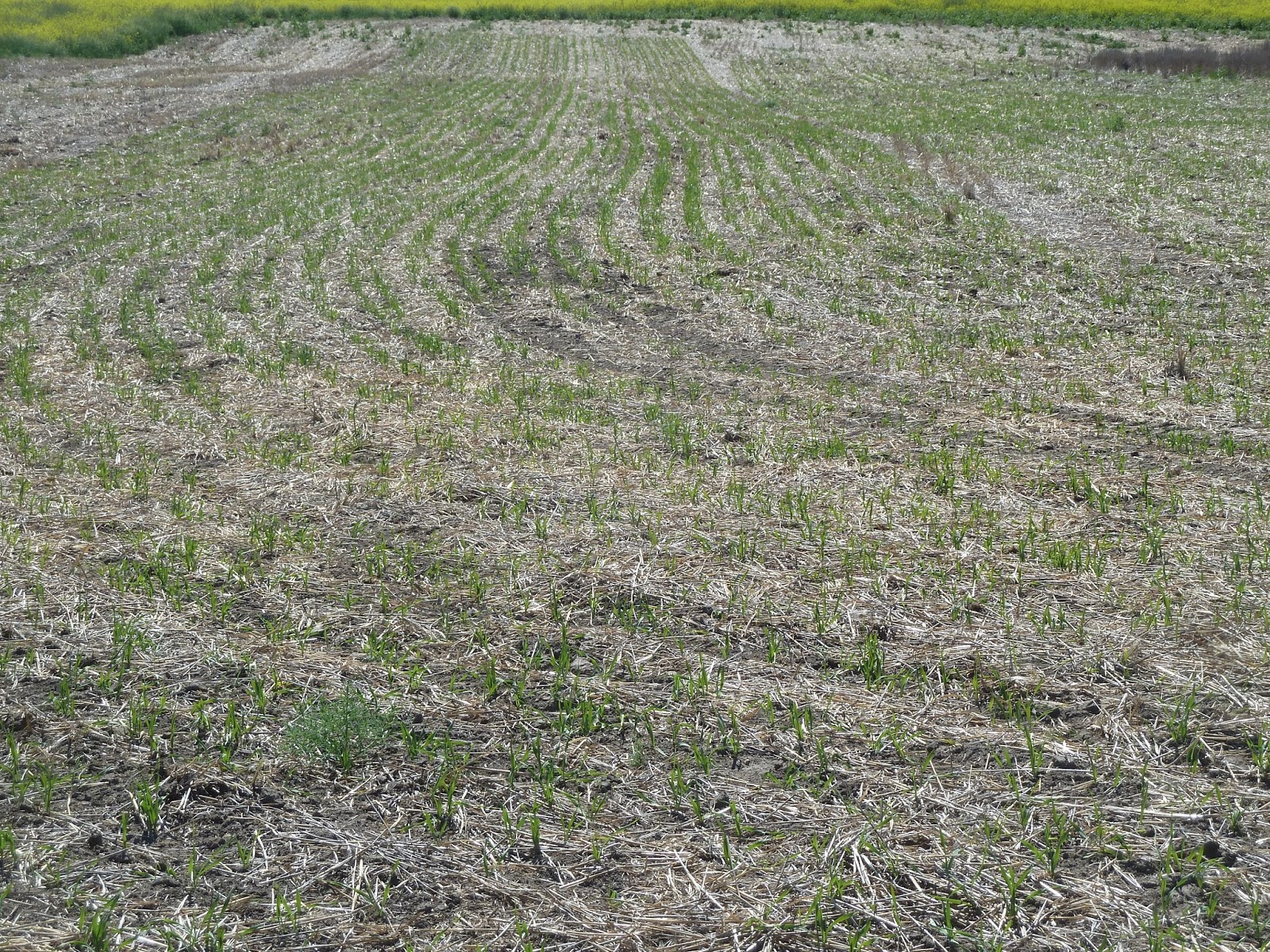
SPRING CANOLA: (hyCLASS 930 rr) The crop was timely seeded. The plant population was good. The crop was growing well, but the heat hit in early bloom (for 2016 trials, we had nearly a month of bloom). The high heat over the extended time did not let a re-bloom establish pods. In fact the spring canola continued to bloom through the beginning of 2018, although no pods set. The yield was ~ 30-40% of what we expected. Any other field would have probably done better this particular year. This field was our poorest soil, lowest elevation and all faced S and SW. It took the brunt of the heat. We are not deterred. We think that spring canola is going to be a great alternative to winter wheat. Also, it appears that we will be able to cut spring canola with the stripper header which is a big plus. This field went into winter in great shape, --good residue, standing tall with most of the plants still living. The tall canola stubble, although not thick like wheat stubble, is great for reducing wind velocity near the soil surface, and snow catch. Winter of 2017-2018 was not a big snow year like 2016 but we haven't seen any drifting in that field compared to mowed or tilled fields.
I haven't sorted out the data for any comparison between CF/winter wheat and CC/winter wheat, or our canola on ground that has had a cover crop and ground that has never had a cover crop. I may include that as an update to this post or it may take a post of it's own.
Friday, September 22, 2017
GROWING A CROP IN TALL STANDING STUBBLE
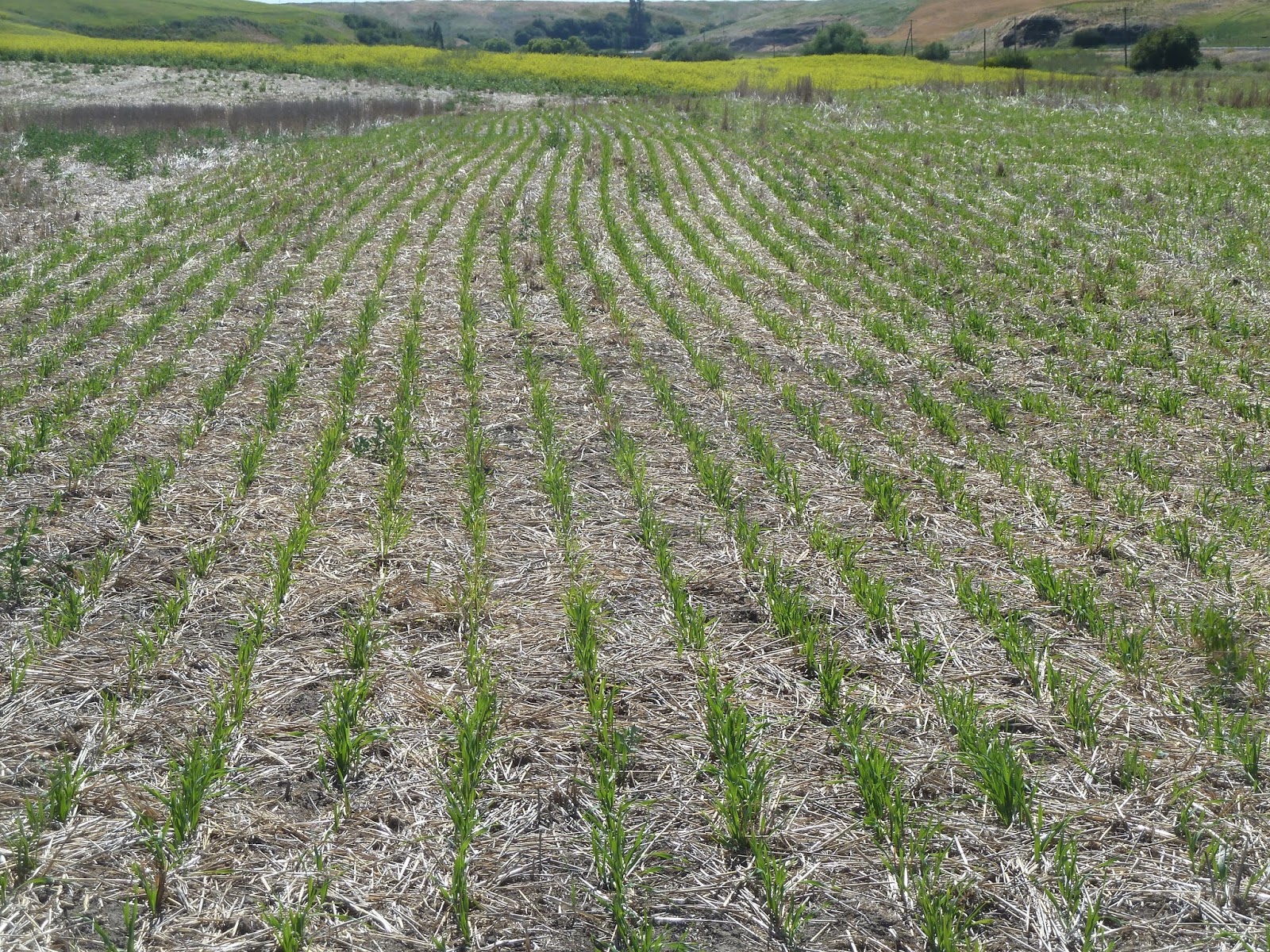
Last spring-----As I watch our spring canola grow, the question that keeps nagging at me is 'is the standing stubble interfering with the growth of the canola (and other crops). Most of the winter wheat stubble is laid flat, but there are areas where our drill leaves some stubble standing. I have observed that spring wheat growing up through winter wheat stubble appears to grow taller in the early stages and tillers less. When I mentioned this to Dwayne Beck his comment was "yes, and that's fine. I don't want tillering of spring cereals". Crop maturity is extended 7-10 days for each tiller. One or two tillers may add to the yield, but, more will likely degrade your crop. They take moisture and nutrients from the main stem if there is a shortage of either or the summer heat forces maturity.
This fall-----It appears that tall tangled residue does hinder canola branch development. Canola plants in very tall stubble with some of the stems lodged was observed with less branching and fewer and mispositioned leaves. Normal harvest height using a sickle bar appears to have little impact.
Monday, June 26, 2017
WHY WE HAVE GONE ULD
On our quest to improve our soil we have encountered many obstacles, mistakes, disappointments, questions on how to proceed, and yet, having enough success to continue the quest.
Soil EROSION, and removing fallow from our rotation was the initial driving force. Any operation that reduces soil disturbance compared to what we are doing with conventional tillage will have a positive impact on the soil. Direct seeding is a big jump in reducing soil disturbance. Past history of direct seeding shows that the soil surface is left, more or less in a state of nakedness, and channeled. Nakedness is correctable; however, I can't envision how you can 'drill' a crop and not channel, whether it be double disc, hoe, or a single disc, including the CrossSlot drill. In the Palouse channeling can be a serious erosion issue if not considered when drilling the field.
As we progressed, saving MOISTURE became the driving force. Although we still have some erosion at times it was mostly contained, --at least visually. As time passed and information gathered it became clear that we needed good soil structure, more soil organic matter, and more cover on the surface, to maximize the retention of moisture. WSU-OSU research back in the 70-80's indicated moisture was used in four ways, -----1% to deep percolation, 4% to runoff, 12% to plant transpiration, 83% lost through evaporation off the soil surface. Research is clear that a soil profile with a cool surface temperature and a calm surface, retains more moisture compared to a hot surface with air moving across it. The more we reduce soil disturbance, the more residue we keep on the surface, and the calmer we can keep the air at the surface the better our soil moisture will be. Taking these parameters to the maximum create a serious challenge for drill design.
In 2012 we moved to ULD by buying a stripper header and hiring our seeding done by a CrossSlot drill. Now, our ULD direct seed system consists of a Shelbourne stripper header, GVM 90' suspended boom self propelled sprayer and the CrossSlot drill.
Shelbourne stripper head: --maximizes vertical intercept of snow and wind. The taller the stubble the more snow catch (very effective in the winter of 2016-7), and the taller the stubble the calmer the air at the soil surface. (measurements are showing that to be very effective also. The only down side is that we can't harvest every crop type with this header.)
GVM 90' suspended boom self propelled sprayer: --it's value is in reducing tracking in the field. It's very evident that tracks of any type promote weed emergence compared to the untracked portions in a field. We regularly see this in our fallow fields.
CrossSlot drill: --the machine that makes ULD possible. The header and sprayer are the supporting cast. When we were evaluating drill technologies, and our operation, trying to match a drill to the specifications and limitations that we faced, the CrossSlot opener was the obvious choice. The CrossSlot has the ability through its depth and pressure related sensing capability to place seed in good earth at the assigned depth while passing through complex soil types and textures, residue types and amounts whether standing or laying down, without stopping for adjustments. It's a remarkable technology, and we have learned not to move unless it is all working. Until the residue became too heavy to manage, our other hoe or double disc drills, could start a good fall crop; however, we never had a very good producing spring crop because of voids left by hair pinning or clumps of residue that shed off the drill, or seed not being placed at the proper depth.
We are now set up to do ULD, and with the CrossSlot we are ready for the next stage which is building soil health. (which is becoming a whole new story)
Thursday, February 9, 2017
VALUE OF TALL STUBBLE (RESIDUE)
As, when I started direct seeding (DS) many years ago, much of the time there is nothing dramatic to see from an enhanced conservation practice, --DS compared to conventional tillage.
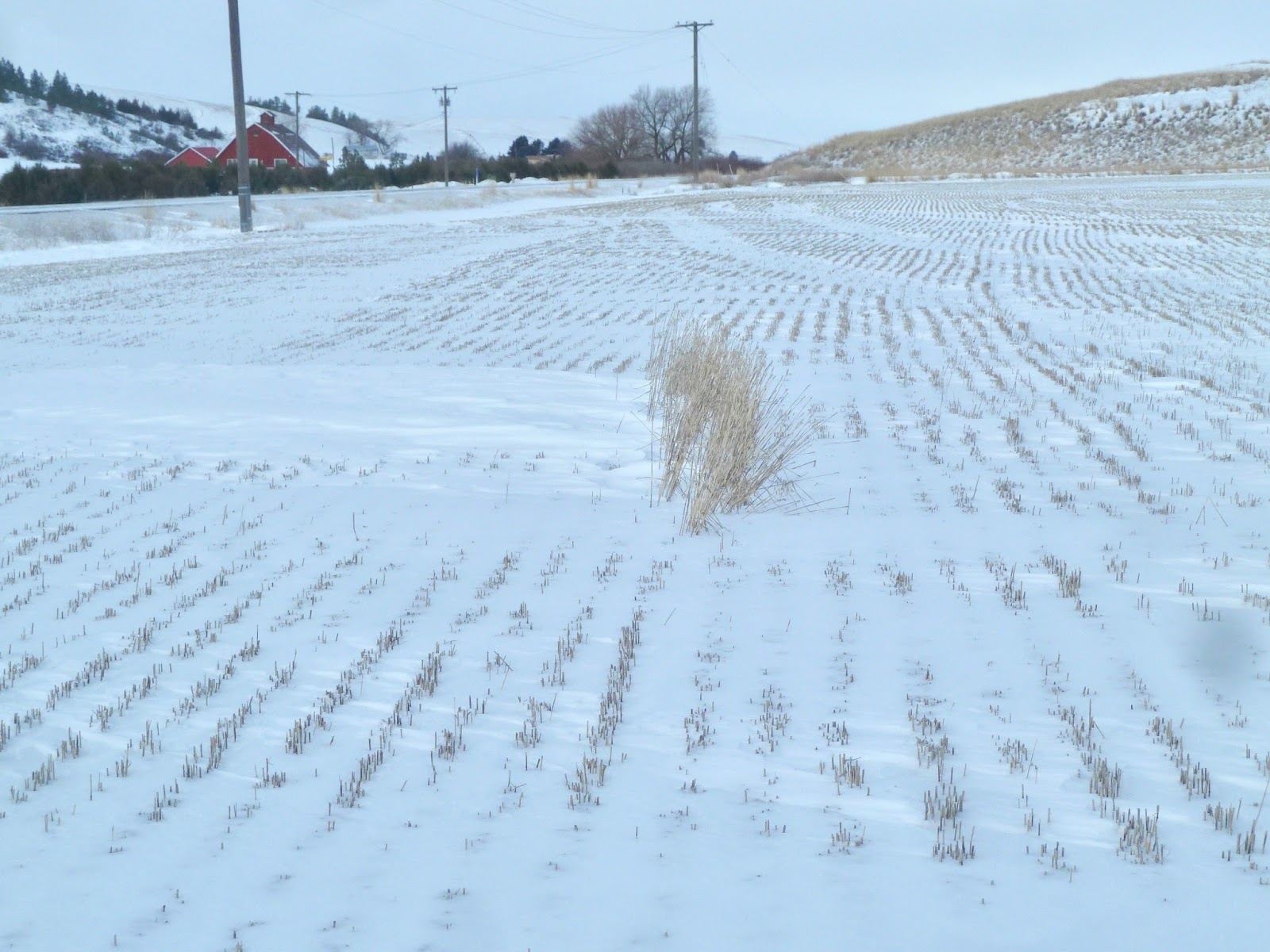
But, there are exceptions, and this winter is one of them. This winter is a showcase for what tall residue left by the stripper header can mean for the coming crop.
The two pictures, above, show two fields seeded to winter wheat. On the left is seeded into a 9 cultivar CC. The vertical blockage is relatively sparse, but still having an effect. The snow cover is not as even as in the more dense stripper headed wheat and barley stubble, but snow displacement is significantly less than WW fields with no vertical blockage. We have radish in this field. The radishes have deteriorated, leaving holes through the frost layer. We expect to retain all the moisture available from the snow for that crop. On the right is WW seeded on spring pea ground. The crop was seeded into heavy residue (SP plus past WW residue); however, that residue provides no vertical blockage. There are noticeable snow drifts, indicating that we have large areas in this field where the crop is missing more than 2" of potential moisture. In this field we will be dependent on thawing conditions. If the thaw is gradual, we'll retain the moisture in the field although it's distribution will be uneven. If the thaw is accelerated, we'll lose a lot of this moisture, similar to 2014.
I'm not sure what part snow cover has played in frost depth at this point in time.
I think the field shown above is frozen fairly deep but has developed a better soil structure over the years using DS and now has a lower bulk density. This should allow moisture to enter the soil profile faster than the other two fields that were conventionally tilled.
Sunday, January 15, 2017
PHOTOGRAPHERS PARADISE
It has been two weeks since we have been above freezing temperatures. Temperatures have been ranging from (-4) to (18). If we could tell, I think we have ≈16" of snow. The days with 15-25mph winds have moved everything around where there isn't sufficient vertical blockage.
The stripper headed crops are showing their value with the snow catch. Snow catch is huge.
It's predicted that in about three days we will have temperatures in the 40's and a lot of rain. If that comes about, erosion of unprotected fields will be devastating. Our fields are well protected. The question is, --will our WW seeded into covercrop (a lot of radish plants) allow the water to enter the frozen ground.
Sunday, June 26, 2016
2016 - PRLCD - Drill Demonstation Video
The test area was WW from the 2015 crop that had ≈100bu stubble, but not grain. Approximately 300 feet of residue was left standing from a 32' Shelbourne Stripper Header. At Each end, ≈100ft of stubble was mowed cross ways to the header travel with a 26 foot Schultz mower. Between harvest, spraying and mowing, there were a lot of tracks that laid down the tall stubble. There was basically solid ground cover prior to any mowing. Conditions were tough for any drill regardless of disc or hoe.
The smoke is from a Case 4994 WT with an inexperienced operator not releasing the parking brake. There was fire dropping onto the residue that was quickly extinguished along with fire on the oil/dirt deposits around the brake. Unfortunate, but that is part of life at these events on occasion.
![]() |
| Horsch Anderson (all mowed area) |
![]() |
| CrossSlot Drill (both areas) |
![]() |
| JD 1890 (two pass in both areas) |
![]() |
| Case 400 w 2280 cart (both areas) |
![]() |
| AgPro with Bourgault point (both areas) |
Tuesday, June 14, 2016
THE LONG & SHORT OF THE STRIPPER HEADER
Fact: --there is a layer at the soil surface, even though it looks dry, that is at 100% humidity. This layer may be only 1-2micro's thick. This layer is maintained until the soil profile can no longer draw on it's reserves. How you manage this soil surface environment has a big impact on evaporation and the moisture available for the crop.
Fact: --residue modifies soil temperature. Soils are warmer through the winter and cooler during the summer with surface residue either standing or flat.
83% of rainfall over a two year wheat/fallow rotation is lost off the soil surface through evaporation. (see post of 9/19/2012)-- conclusion was to keep soils as cool as possible and air velocity across the soil surface as low as possible. This translates to, --maintain as much cover as possible over the soil, and keep the cover as tall as possible, for as long as possible, to maximize moisture available for crop production.
Our observations over 4 years indicates considerably fewer weed cultivars germinate and compete with the crop on ground that is not disturbed. The more residue, the less disturbance, including disturbance from tracks/wheels, the better.
THE LONG:
1-- Removing the straw row of a poor residue managing combine, is a major plus. It gives new life to older machines and increases capacity by 10-20%.
---There is much less material being processed. This has resulted in significant savings for us in combine repairs.
2--Potential increase in moisture available to the crop by:
---increasing snow catch (when we get it) over the standard cut or mowed height. This resists snow drifting, leaving more even snow (water) distribution over the field.
---Accompanied with solar energy which warms the stems, the snow melts and enters the soil at the base of the plants in a slow controlled manner.
---reduced weed competition when used as part of the ULD system. Fewer weeds, leaves more moisture for the crop. Less surface disturbance including wheel tracks, the fewer the weeds.
---reducing air velocity over soil surface. Studies are showing reduced evaporation from tall stubble. This means more moisture for the crop.
---reducing soil temperatures in the warm season. Several studies, including our own measurements with HOBO sensors show significant drop in summer surface temperatures compared to bare soil. Studies concur, that lower soil temperatures conserves moisture for the crop.
3--Modifies winter soil temperatures. Our HOBO sensors are showing that tall stubble insulates the soil, not only in the summer to reduced soil temperatures, but also insulates the soil from the cold winter temperatures.
4--The Shelbourne is a low maintenance header for us.
5--The Shelbourne, being a sealed unit, reduces harvest dust around the combine cab.
THE SHORT:
1--Is not useable for all the crops we grow.
---spring standup peas: grade reduction from cracked/skinned seed coats.
--mustard/canola: problematic if stems carry seed pods extending more than 24 inches along the plants vertical axis.
---crops with seeds forming around a central stem like sorghum.
2--Not all drills will successfully seed behind the stripper header. Type and density of residue needs to be considered.
Monday, June 13, 2016
Stripper Header - Drill Demonstration
Where we strive for maximum moisture retention through low disturbance and residue, my bias of course, favors the CrossSlot, so, expectedly, it did the best, --at holding depth, consistent seeding without plugs or drags, and features a one pass system to maintain the ULD status that we strive for in our operation.
The JD didn't hold depth in the mowed area which was the hardest for both it and the CS. Too much variation in seeding conditions for spring loaded down pressure systems. Also, the JD moves more dirt than the CS, and being set up as a two pass system, there is additional soil disturbance.
All of the hoe type drill entries, were able to make it through the course, with more or less plugging and dragging. Neither mowed nor standing stubble, with all the wheel tracks, was ideal for a hoe drill. Even 30" stubble, when laid crossways to the line of travel spans across multiple opener widths. Much of the time, coulters will cut through the mat in front of the hoe --but not all the time. When a hoe passes among standing stalks, they tip and can become an obstacle to the next line of openers.
Although I didn't watch any of the fertilizer applicators navigate the course, I could see from all the straw hanging, that the Great Plains NP40 struggled. I didn't notice how the Fast 8200 faired, but my guess is that it was much the same. With this type of application, where solution is directed towards a slot through a surface air gap, I have to wonder how much loss of N takes place. The JD 1890 fertilizer unit, like the drill version, probably suffered from depth control.
Sorry to say, I was distracted, and completely neglected to make a presentation about the stripper header and it's value to our operation, and the moisture it helps save. I'll write two more posts that relate to: -- 1) the long and short of the stripper header, and 2) moisture saved with the stripper header in the near future. I have yet to analysis the HOBO data gathered since September on soil temperatures under different residue scenarios .
All done, and equipment gone. The site was completely used, but didn't need to go into the mustard. We'll follow the site for awhile, then destroy it before weeds become a problem.
Wednesday, May 4, 2016
Residue & Wind
This field started out with good standing cover of stripper headed spring barley that was chem fallowed, and seeded to WW around September 20th of 2015. We missed the moisture so much of the field did not emerge until late October or early November. This is a scene similar to what I experienced 30 years ago, in this same field, when I mistakenly thought that it was good to mow standing stubble early in the season for ground cover. it didn't take a lot of wind to deposit residue drifts up to a foot deep on our NE facing slopes at the time. Only once did I make that mistake. After that, I mowed a short time prior to seeding, leaving standing stubble most of the fallow year. We needed to shorten the stubble to minimize problems drilling.
The pic below shows where I chopped a hole in the packed residue drift. The drift was 4" deep and very dense packed. It was easy to cut this hole with my hand tool. Walking on this was like walking on a firm sponge. Very few WW cultivars emerge through this dense, deep mat. As may be expected the soil surface was very damp. Soil was cool but not cold, --probably in the low 60's.
Hopefully, we won't have a repeat of these wind events for years to come. One event in late November dropped our cast iron flag pole my grandfather put up over 100 years ago. Winds topped 50mph. Very little damage was noted except for the flag pole.
Monday, February 1, 2016
Our Farms Historic Rainfall
---14.67" is what it turns out to be our average yearly rainfall over the years, --with 9 years at or above, and 10 years at or below. (one point was counted in both, above/below). The graph indicates our Ewan/St.John farm is in the 13-16" rainfall zone, instead of the 15-17" as most maps have us. (Is this a real change from 1940-1970's)???
---Our lowest rainfall total was in 2002 with 10.31 inches.
---Our highest rainfall total was in 2006 with 18.35 inches
---Two years, 2015 & 2003, June received a trace, or no rain. June is a benchmark for us. Good rains normally translate to good yields, little rain translates to not so good yields.
---Six years, July received no rain.
---Five years, August had a trace, or no rain.
---June with more than 1.5 inches were (2014, 2013, 2012, 2010, 2005 ). These were great crop years, or, had the potential had not other climatic forces become involved, --for example, Nov. of 2013 had an event where high winds accompanied by a sudden drop in temperature severely damaged the 2014 winter wheat through out the Palouse. Most people had patches of good wheat, but the general yield was down approximately 25-30%,
---Our ULD system that incorporates the Shelbourne header and the CrossSlot drill is an attempt to lessen dependency on good June rains by reducing moisture loss through runoff and evaporation. 2014 was a great year to test the theory, but alas, the June 12 freeze ruined the potential of all our crops, both winter and spring. All surviving crops were delayed in maturity, and the unusually high heat of July & August caused further damage. The CrossSlot did all it was advertised to do, and the crops got a great start, but circumstances beyond our, or it's control lowered yields.
---Our rainfall tends to cycle up for three years, then, down for three years. (+/- ?)
---If that pattern holds we may rise through the average precipitation line in 2016, and give us, depending on the June rains, a good crop, both winter and spring.
---The charts below use the same data, but the lines attempt to show three different aspects: June rain, total rain received, average monthly rain received.
Friday, January 8, 2016
StripperHeader - snow catch 2
Wednesday, January 6, 2016
StripperHeader-snow catch
Thanks to a reader looking for an update on snow catch with the stripper head, I checked out Thornton where we have standing stripper headed sbly stubble, --and more snow. It was a timely look as our snow is being effected by this beautiful 48 degree day. Hard to imagine that a couple of days ago we were in the highs of upper 20's, and New Years eve we were at -2 degrees. There is some frost in the ground.
In December, while St. John/Ewan area was getting a mixture of snow/rain, Thornton received all snow with winds that blew both from the NE and SW during these snow deposits. This left drifts on both sides of the hills on vulnerable land.
The drought of 2015 reduced the stubble height to ≈19" and barley being relatively weak straw, didn't stand very well after experiencing some weather events (wind, rain). However, I could see a significant difference in snow redeposition comparing, cultivated ground and short stubble (4-5"), to our stripper headed field. A new harvest technique is becoming quite popular in the region. This technique uses high capacity combines with fine chop straw processors, and 40' flexible draper heads that can follow close to the ground, and process most of the crops top growth. It has it's advantages when trying to direct seed with a hoe type drill, or when cultivating. The technique is not so great for disc type drills. This new technique does have it's down side for saving moisture by allowing snow redeposition, and air movement near the soil surface.

Thursday, November 12, 2015
No-Till Farmer Magazine
The second opportunity came as a feature item in the November edition, 2015, (volume 44, No.11), titled "Overcoming No-Till Stumbling Blocks", starting on page 22. This article was written from a telephone interview with Martha Mintz along with some material I submitted to her. Martha is listed as a Contributing Editor and regularly writes articles under the logo " What I've Learned From No-Tilling...". It came out pretty good if I do say so myself. < Eriksen interview >
While looking up what Martha Mintz contributed over the years to No-Till Farmer, I came across an article where she interviewed Guy Swanson for a piece titled "Bringing No-Till To The Palouse". Mort Swanson, Guy's father, is the name that everyone in the Palouse remembers as THE inventor-early practitioner of No-Till. This article was posted in the November edition, 201, < Bringing no-till to the Palouse >. It's a great read for someone interested in the background of no-till in the Palouse. Mort is no longer with us but Guy is hail & hearty and manufacturing/selling EXACTRIX systems for applying liquid anhydrous ammonia fertilizer.
No-Till Farmer has been around since 1972. I was a subscriber for a while in it's early days, but found that it was a midwest and east magazine that I couldn't relate too. Today, No-Till Farmer is still primarily an east of the Rocky Mountains publication but I am finding that even though we are in two different climatic zones, Continental vs our Mediterranean classification, the same problems exist. Practices and Research done east of the "divide" has concepts that apply here,--our task is to adapt that knowledge base to our climate limitations and strengths. With our Stripper Head, self propelled sprayer, and CrossSlot drill, we have all the practices available for controlling soil erosion; however, we still have water loss. Soil health has improved, and it will continue to improve to some extent; however, that improvement will be limited until we get more plant diversity, and remove fallow. Cover Crops and Interseeding crops potentially hold the answer to these questions. The trick is, how to apply.
The Koppen Climate classification model designating the Pacific Northwest as mostly Mediterranean does not fit very well. We don't fit the Continental or the Coastal either. Our climate diversity is likely to be a topic of discussion for a long time as to what classification we really fit.
Monday, September 21, 2015
2015 Harvest with Stripper Header -- Chickpeas
Things that were apparent:
-- After observing the two other operations that were in a higher rainfall, if we had not had the 28 degree night June 12th, I think we could have had a pretty decent crop. The frost devastated the low ground.
-- The 40' draper did an amazing job of getting close to the ground without picking up dirt. That big header was light on its feet, and the flex in the middle allowed it to follow the ground contours quite well. The ground was smooth and soft. The terrain was fairly consistent with few sharp slope transitions. The vines were tangled and some branching was on the ground.
-- The older 24' pea bar equipped auger header was on harder soil surface and still had difficulty with pushing dirt. It had no auto header control features. There were a lot of low pods on the vines. Many vines were not standing erect.
-- Our ground had more sharp slope transitions than the other two operations which makes for more challenge. Our ground also has a rougher surface. It has been 20+ years since we have leveled the surface with cultivation or even a harrow. Our stand population was a little less and the vines appeared to stand a little better than the other two operations, but there were many low hanging pods.
-- A 32 foot ridged stripper header is too long for this short statured crop in our hilly terrain.
-- Since pod drop was the main loss observed in all three operations, and all operations had some bare seed on the ground, I don't think the stripper head shelled and spit out seed any worse than the other two header types.
-- I don't think the stripper header processing is any harder on the chickpea seed than the other header types.
-- We were able to leave a lot of chickpea residue standing following harvest, and very little old residue was reprocessed. The other operations clipped the crop at ground level and processed all the residue, leaving a fast degradable, low carbon surface cover.
-- Our heavy residue may be a problem with other header types. A least, much more would be reprocessed. This in turn will degrade our surface cover.
-- I think a 20' Shelbourne stripper header will work just fine for this crop in our terrain, --and even better if you include the auto header control features.