Showing posts with label fertilizer. Show all posts

Tuesday, February 15, 2022

FULVIC vs HUMIC ACID

In our Biological Farming Group there has been a lot of references to Humic, Fulvic, and Folic acids for plant growth.  There is a lot of information online, and it gets very confusing.  Below I am providing a sample and possibly a summary of the past three years of meetings and internet searches boiled down to what basics I want to keep in mind about Fulvic, Humic and Folic Acids.

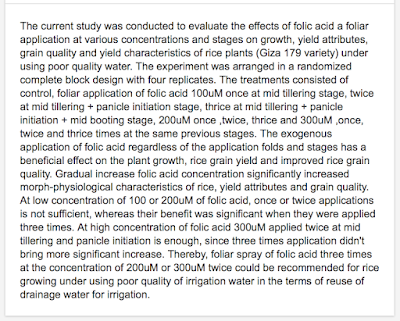
Below, --two image inserts giving information, are from Earthgreen Products.  A good synopsis of the organic acids.  More information can be obtained at < Fulvic / Humic >, and are a source for "humin" products.  Folic Acid is used for plant nutrition, but normally referred as a source of vitamin B in human health discussions.  The bottom image insert on Folic Acid is from ResearchGate. < Folic Acid / Grain >.

VERY short summary:   ---Both acids are essential for plant health.  ---All three organic acids are useful and show success in many plant growing environments.  ---Fulvics are soluble at all pH levels.  ---Humics are only soluble in alkaline solutions.  ---As stand alone products, Humics have a large molecule and are best used for soil application.  ---Fulvic has a small molecule that enters plant tissue more easily and is best used as a foliar.   ---Best performance however is with a combination of Fulvic / Humic.   ---Humic increases the permeability of cell walls, making it easier for fulvics to carry nutrients into the plant.   ---While Fulvic is the carrier for nutrients, humics make nutrients more available in the soil.   ---They also work in tandem to increase water holding capacity and stimulate root and shoot growth.  

---Folic is generally used as a foliar.  Foliar applications at several specific stages of growth showed significant plant and grain benefit; however, applications at one or two stages of growth didn't make much difference.


There are several studies at ResearchGate about Folic Acid.  I chose this one because of being done on a grain.


Tuesday, December 29, 2020

LETS BUILD HEALTHY SOILS (pt1of 2)

For the last 10 years our operation has been working on acquiring the capacity to build soil health.  We have needed knowledge on how to approach the subject, and the equipment to apply that knowledge.  Prior to 2010, we were working to stop the destruction of our soils.  We now have the pieces to improve our soils natural productivity and` make a serious attempt to reach our goal of a sustainable cropping system with reduced synthetic inputs. 
    How do we reach our goal?  My video and document search, along with our limited experience, shows that it is imperative that soil organic matter be increased.  I list several points, not necessarily prioritized, that I have found to be important.   1--manage our cropping system with an eye on ways to reduce herbicide, insecticide, and fungicide applications.   These all have components that negatively influence the development of soil organic matter.    2--we need to do minimal ground disturbance.  This minimizes soil structure damage, keeps roots intact to help hold soil in place and leave root and worm channels exposed at the soil surface.  This also minimizes loss of surface cover.  This also maximizes any mycorrhizal network we may be able to develop for a nutrient/moisture transport, and communication pathway between plants.   3--develop and maintain surface residue.  Residue protects the soil surface, reduces compaction from equipment, feeds the soil macrofauna along with some microfauna, and helps moderate the soil temperature.   4--minimize compaction.  This will help improve soil structure.  Compacted areas have poor soil structure and promote anaerobic soil conditions that increase the types of fungi and bacteria that cause plant diseases and insect predation.  Aerobic soil conditions, on the other hand, increase fungi and bacteria types that promote healthy soil organisms, and reduce pathogenic organisms that negatively impact plants     5--we need to change our fertilizer practices, to minimize the lowering of soil pH,  minimize harm to microbes, and reduce nutrient antagonism.   6--develop techniques to extend the time living roots are in the ground, --preferably all year long.    7--increase microbes and fungi, in our soil.  With our history of a monoculture wheat system, our soils are extremely bacterial.  Soils would perform better if the Bacteria to Fungi ratio was closer to 1/1.   Fungi are important to soil and plant health.  They convert nutrients into more plant available forms.  When available, mycorrhizea fungal networks are an important transporter of moisture and nutrients to plant roots.  Fungal mycellium serve as a line of defense for plant diseases.  Fungi can be promoted by doing all of the (1-6) points discussed above which boils down to, --providing fungi food for as much of the year as possible and stopping the destruction of their hyphae and mycelium.  The chart below shows the relationship between plant types and the bacteria to fungi ratio.  The chart shows there is not much on the "left" of our wheat monoculture other than weeds and rocks.

    For the past 2-3 years, I have participated with a group looking into soil and plant testing, organic forms of fertilizers, and ways to manipulate soil biology to increase soil health.  This has been a valuable experience, and there is more to learn.  
    During this time I have come to the conclusion that we can build healthy soils by proper crop management without amendments.  This requires absolute minimal tillage, keeping the soil surface covered, replacing chemical fallow with green fallow, diversifying our crop cultivars, extending the time we keep a living root in the ground, and paying attention to the synthetic inputs we apply to our crops so as to not destroy the positive gains we make from other practices employed.  The use of animals is not mandatory, but it has been shown that grazing animals speed up the positive soil health processes when properly managed.   
    I feel our operation has the equipment and basic knowledge to begin the process of building soil health.  We now need to develop management skills to make it all happen.  
    As a final note to this post:  Absolute minimal tillage by itself works well too stop erosion and establish a base from which to develop practices that will improve our soils natural productivity.  However, actual improvement of our soils natural productivity comes by managing soil biology through growing diverse plant cultivars.  The intensity, meaning the time with living roots in the ground, and the time taken to mitigate negative components to soil biology, such as synthetic amendments, sets the pace for improving our soils natural productive capacity.

Thursday, June 22, 2017

N is burning the Carbon Pool


     Two recent events have triggered this post.  I recently gave a presentation on why our operation has gone to a ULDDS (ultra-low disturbance direct seed) system along with sharing our cover crop experience (as limited as it is) to a group of NRCS trainee's from across eastern Washington, and, an article that came out in the July issue of NO-TILL Farmer, titled "Excessive 'N' Application Burning the Carbon Pool (vol. 46, #7).
      The first event had fertility on their minds as part of the general discussion on soil health.  the article authored by Richard Mulvaney, a University of Illinois fertility specialist, had specifics.  His position is based on mining documents on fertility, and data sets, going back 100 years.  His comments helped me to link pieces of a foggy puzzle about crop fertility and how it will react on soil health.  His recommendations are going to be a challenge for us to address.  The following is what I found engaging:  (most will be paraphrased)
      ---soil is an important source of N.
      ---applying N does not build organic matter.
      ---you can not bank N by adding N.   Soil microbes use it to burn the carbon they find in residues and soil organic matter.  This results in less C and less SOM.   (my thought: --this may be why we struggle to move SOM above 3%)
      ---"You can never decouple carbon and N --not on this Earth....".  Microbes use N to make enzymes so they can burn the carbon that supplies their energy.  Every enzyme has N.
      ---crop rotation is best.  Corn yields are better in rotation than with continuous corn, and done with much lower fertilizer inputs.  The data tells me that fertilizer cannot replace rotation for highest yields. (my thoughts: Follows Beck's principal, rotation-rotation-rotation)
      ---Mulvaney's best short-term option for growers would be to increase efficiency by putting more of the fertilizer N, "into the crop" when it is needed. --by:
                           ---Use tests to determine what the soil can provide.
                           ---Don't apply NH3 in the fall.  There is no crop (corn in this case), and there is a lot of microbes that will use the N.  (my thinking: --our fall wheat does not need all the N that we customarily place with it.)
                           ---Sidedress N to synchronize fertilization with crops N demand.  Ideally, shift from ammonia to nitrate fertilizers despite the greater risk of N loss through leaching and denitrification.  Mulvaney & colleagues base this idea on scientific evidence that plants have an edge in taking up nitrates, whereas microbes are better competitors for ammonium.
      ---the 1947 book, The Soil and Health by Sir Albert Howard, claims that there will never be sustainable agriculture until animals are put back on the land.  It's a cycle.  Do we need to rethink the big picture.  (my thought: --several people heavy into covers are going this route)

Monday, June 13, 2016

Stripper Header - Drill Demonstration

     Considering there were three other ag tour/events contending for peoples attention, we had over 100 people in attendance.  No media this year, --probably do to other better known events.  Interest in dealing with a stripper header is still there.  There were eight units that participated, --AgPro with Bourgault points, CrossSlot, Case 400 with Kile openers and 2280 cart, JD 1890 single disc opener that was set up as a two pass system, and the Horsch with Anderson opener.  Also three low disturbance fertilizer applicators were demonstrated.  The JD 1890 with Exactrix system where the seed boot was replaced with a fertilizer boot to deep band liquid NH3.  The Great Plains NP40 Nutri-Pro uses a coulter to cut a slot and stream liquid solution into that slot from above ground level. The Fast 8200 unit is  similar.  The drills seeded barley.  There was no solution provided for the fertilizer machines.  The area had a lot of residue.  The machinery park had the residue swathed and baled for building protection last summer.  The demonstration site had a mowed area on each end with standing (≈30") stubble in the middle.  Between harvest, spray applications, and mowing, there was a lot of wheel tracks with long stubble laid down.  Along with the fact that no leveling/smoothing operation has touched this site for over 20 years, this is a challenge for any drill to get a decent looking stand emerged.  Even though we hadn't received any appreciable moisture for 30 days, the site had good moisture levels, even in the scalped areas where the equipment is parked.  The following day, the site received 0.45" of rain.  That will eliminate any drying out the drills may have promoted.
       Where we strive for maximum moisture retention through low disturbance and residue, my bias of course, favors the CrossSlot, so, expectedly, it did the best, --at holding depth, consistent seeding without plugs or drags, and features a one pass system to maintain the ULD status that we strive for in our operation.
       The JD didn't hold depth in the mowed area which was the hardest for both it and the CS.  Too much variation in seeding conditions for spring loaded down pressure systems.  Also, the JD moves more dirt than the CS, and being set up as a two pass system, there is additional soil disturbance.
       All of the hoe type drill entries, were able to make it through the course, with more or less plugging and dragging.  Neither mowed nor standing stubble, with all the wheel tracks, was ideal for a hoe drill.  Even 30" stubble, when laid crossways to the line of travel spans across multiple opener widths.  Much of the time, coulters will cut through the mat in front of the hoe --but not all the time.  When a hoe passes among standing stalks, they tip and can become an obstacle to the next line of openers.
       Although I didn't watch any of the fertilizer applicators navigate the course, I could see from all the straw hanging, that the Great Plains NP40 struggled.  I didn't notice how the Fast 8200 faired, but my guess is that it was much the same.  With this type of application, where solution is directed towards a slot through a surface air gap, I have to wonder how much loss of N takes place. The JD 1890 fertilizer unit, like the drill version, probably suffered from depth control.
     Sorry to say, I was distracted,  and completely neglected to make a presentation about the stripper header and it's value to our operation, and the moisture it helps save.  I'll write two more posts that relate to: -- 1) the long and short of the stripper header, and 2) moisture saved with the stripper header in the near future.  I have yet to analysis the HOBO data gathered since September on soil temperatures under different residue scenarios .


All done, and equipment gone.  The site was completely used, but didn't need to go into the mustard.  We'll follow the site for awhile, then destroy it before weeds become a problem.

Monday, March 7, 2016

BROADCASTING FERTILIZER - Spring 2016

Recent conditions offered an opportunity to broadcast liquid fertilizer, --early in the season, firmed up ground, heavy residue to help support machine and product weight, and rain every other day.  March 1st, Kye put 30# phosphorous and 20# sulfur  on alfalfa (streaming ammonium poly phosphate 11-37-0, and ammonium thio sulfate 12-0-0-26.  On the 4-5th, he put 60# nitrogen and 10# sulfur on ground that will be seeded to spring mustard and canola (streaming URAN 32% and ammonium thio sulfate 12-0-0-26.
      --I'm not a fan of broadcasting fertilizer on the soil surface.  Phosphorous does not move into the soil profile well, and nitrogen sources are exposed to potential loss into the atmosphere.
              In the future we need to look at the spoke-wheel applicator from Oregon.  With it's capability of placing fertilizer four inches into the soil profile, and it's very low surface disturbance, the spoke-wheel offers a potential solution to resolve all issues related to applying fertilizer in a growing crop, or for a sensitive crop.  Currently though, spreading phosphorous, nitrogen, and sulfur during the 1" rainfall we have received the past six days, has allowed us to do the second best option with minimum loss.
               My understanding is that in our heavy residue mat, it's preferable to use dry fertilizer.  The theory is that more dry product will work through the residue to the soil surface than a liquid product.
      --I am confused about fertilizing a tap rooted plant.  Last December at the Wheat Academy, there was a presentation on fertilizing various cultivars. Pictures illustrated a serious problem with a concentrated nitrogen band below or near a cultivar with a tap root.  It appeared that a similar effect was present in cultivars with fiberous roots; however, because of the rooting type (not dependent on a tap root), the yield hit was significantly less.  
                I have attended two oil seed conferences since the December meeting, and not a word was mentioned that would indicate a concern over the proximity of concentrated nitrogen.
                In the past we have put all our N down in one pass with the mustard seed.  We have not been satisfied with our yields.  Was that due to frost damage, which we have had every year, or have we had damage from the concentrated fertilizer band?  We'll try broadcasting the fertilizer and dig roots this year.  We'll also reseed frost damaged areas instead of waiting and watching to see if the stand will recover.


Streaming N & S in the rain.  In this case it is a timely application where the rain will move the N into the soil profile, minimizing loss of a volatile product.  The ground condition supports the equipment quite well.   


OOPs!, --I watched this happen in two blinks of the eye.  Notice the track coming down over a grass patch behind the GVM.   There is no difference between residue, or rubber at the interface with soil, --if the interface is wet, it's lubricated and gravity wins.  Our soil has good surface cover and a high infiltration rate, but rolling across steep ground with a heavy machine in the rain, will send you to the bottom.  Kye had most of these steep places fertilized the day before when no rain was falling.

Thursday, December 24, 2015

TIMING NITROGEN APPLICATION

     I recently participated in discussions centering around fertilizer and timing of application.  Here are a few points that peak my interest.
1--A recent study I came across stated that our crops, on average, only utilizes 40% of the applied nitrogen.  Question? --what happened to the remaining 60%???  I don't find any excess N in my soil tests.
2--Brassica tap roots are severely damaged when deep banding nitrogen with the seed.  Roots will grow around the banded N and not through.  The remedy is to apply N prior to seeding, or after the plant is established.
3--A farm operation I am familiar with uses a CrossSlot drill, and Uran for an N source.  The soil structure of this operation is quite good with high infiltration capability.  They indicate their conventional tilling neighbors are out yielding their winter wheat.  I suspect that the neighbors use NH3 as a N source.  They further state that they, on the other hand,  dramatically out yield their conventional tilling neighbors growing spring crops.  Why? --it's speculation on my part; however, I think that possibly the uran is working against them with their winter wheat, and working for them with their spring crops.  Reasoning: --These operations are in an annual crop area and they are seeding fall wheat and banding their N into dry ground following the harvest of a spring crop.  When the rains come, the nitrate portion of uran is being driven below the roots and the wheat plant is catching what it can from the ammonia form which is not transported in the soil solution.  In effect the winter wheat is shorted nitrogen in the early development stage.   In the spring, with a large portion of the useable soil profile filled from winter moisture, the nitrate from the uran is not moving through the soil profile as fast, or as far, allowing the plant access to the full amount of applied N.
     A potential solution then for the operation mentioned above, may be to fall apply nitrogen in the ammonia form(NH3, Urea, or NH4), and apply Uran(Solution 32) to spring crops with it's half nitrate half ammonia form.
4-- Expect significant loss of N from any nitrogen source if it is surface applied in our environment.  If you have to surface apply I would do it in the rain or as close to a rain as possible.
5-- For adding additional nitrogen to a crop that is established I am thinking that the Spoke Wheel Applicator  would be something to look into.  It's been around for about 20 years, and it places liquid fertilizer up to 4" below the soil surface.  The videos I have seen places it in ULD category.

Tuesday, May 19, 2015

1st 2015 DOWNPOUR

 [Update: 5/29/15] --This past week the Palouse has had a series of thunder storms, and in scattered locations have resulted in serious damage to exposed ground.  Unstable weather is predicted to continue in the region.  When you look at the national weather events and see the extremes, one wonders when those extremes will engulf us, --either drought like California, or deluge like Texas.  World wide, weather appears to be increasing in severity.  My thought is that it will happen here, --but when and with what severity?  A Texas size storm would obliterate our land regardless of cropping practices; however, there is a lot of gradation between the Texas type storms and the little bangers we have received, which we can armor our land against.  It's as simple as eliminate loosening the soil with cultivation, keeping the soil surface covered, and keeping the soil anchored with roots (alive or dead) from the surface down.  These two things give us the best protection from unusual events whether temperature or water related.
     Saturday evening, May 16th, Thunderstorms hit eastern Whitman County with rains that did serious damage to some fields.  Fortunately the damage was limited to a narrow strip of land; however, the impact is going to be felt over a wide area.  Creeks in the effected watersheds were running thick.  They look more like mud flows than creeks.  Thousands of tons of soil along with attached fertilizer and chemistry left the farms and will end up in lakes, rivers and ocean.
    The fields I saw didn't even have the basic conservation practices applied.  They were denuded of residue, cultivated and seeded vertically, and the surface worked to a fine texture.  We are living in the age of 500+ horsepower tractors and the environment and ground is paying the price.
    An event in February, 2014, showed me that even fields with good armor and soil structure are subject to runoff; however, in our case the water loss was clear.  (see post of 2/27/14)
     Operations that abuse the ground, and there are many in the Palouse, will not be held accountable as past experience proves; however, they are big contributors to the publics attitude towards farmers and their out cry for for more regulations and restrictions that effect all of us.  If the appropriate regulators would target gross abusers and work with them to clean up their act we would all be better off.

Friday, February 28, 2014

VALUE OF ORGANIC MATTER

      Organic Matter and it's value in crop production was the topic of a recent Direct Seed meeting.  I've known about OM since my school days of long ago.  I didn't take it seriously until well after the Horse Escaped the Barn -- if any readers are old enough to remember that phrase.  Current research puts a little different twist to what I remember from 1960.  Organic Matter can now be divided into two basic types -- Stable OM where it is highly decomposed with very little biological activity, and Active OM that is being used, and worked on, by living plants, animals and microbes.  Food to feed these communities associated with Active OM needs to be continual and not intermittent.  Good soil is alive and needs nourishment.  I'm starting to think that production from these soils have the potential for sustainability without costly inputs.  Bad soil is dead dirt.  These soils will always require massive inputs of fertilizer and chemistry to raise a crop.  I use to poo-poo organic farming, but not anymore.  Thanks to those people, research on our micro-biological soil life and how to develop and exploit sustainable farming has taken off.  Speaking of dead dirt -- is there anything deader than fallow, and we do this intentionally.  We need to give more thought to this subject.
      When the Palouse Prairie was first put under the plow it was roughly 20% of Stable OM and 80% Active OM.  Nutrients were manufactured, and recycled by organisms in the Active OM.  Some plants are capable of tapping into a variety of nutrients deep in the soil profile and transport them to the surface where other plants can use them. Today, after a 100 years of cultivation the Active OM and the Stable OM are reversed.  The Active OM has been lost primarily through cultivation from two factors.  1)--Cultivation stokes the fire of mineralization.  By mixing air, moisture, and residue(fuel), organic matter is converts to nitrogen and carbon dioxide.  Nitrogen is released and growing plants use it for food, and Carbon Dioxide is released into the atmosphere.  Does Carbon Sequestration and Global Warming strike a bell?  Our farming practices are taking us in the wrong direction on these subjects.  I include our commonly accepted DS techniques in this statement.   2)--Every cultivation pass breaks down soil structure into ever decreasing particle size.  This results in less residue to protect the soil surface, allows soils to seal off when it rains, and increases compaction, and starves the biological communities in the soil.  One visual symptom is droughty high ground and waterlogged low ground.  There are numerous visual examples east of State Highway 195.  Should we lose the technology of fertilizer and chemistry either by availability or price, all our operations would be at risk.  In the past, civilizations have disappeared when their political and cultural practices destroyed the soil.  Professor, Jared Diamond has written three books on the subject.  The book "Collapse" is an interesting read, and a bit sobering.
      Where do we go from here?  First, move away from farming practices that deplete the soil.  A careless practice can cost you an inch of soil in one major weather event.  It takes nature approximately 1000 years to replace that one inch.  This happened in a major production area in Australia about 20 years ago.  Starting with 7"of productive soil, these farmers made a quick change.  One year they were tillage based farmers, and the next year, and since, they are DS.
       Second, start incorporating practices that will build soil structure and reestablish the soil biological communities.  There is a lot of good research on the subject and more in the pipeline.  Land Grant Universities and private laboratories are ramping up programs to meet the need.
        Third, it appears that we need to get out of fallow.  Current research by Oregon State indicates that one fallow year loses more than we gain in the two crop years of a three year rotation.  That was a real downer for me.  For years I thought I was building soil by DS.  A better understanding of soil biology and  interaction from/with different crop cultivars is going to be necessary to break traditional mind sets.

Sunday, May 5, 2013

Self propelled Sprayers

[Update: 12/3/14]-- The new location for the auto boom height sensors is a success.  There are limitations that were mentioned below.  We have been able to spray at 9-11mph without problem.  You just have to be ready to react when the rare situation presents itself.  The 275hp engine is adequate  with 1500gal load in our hills at 5-7mph; however, above that speed you can have issues.  The system safety sensors kick the transmission into neutral when over loaded.  Not nifty when climbing a 40% slope -- so, be aware of your terrain and how you approach it.  We have noticed that the transmission is finicky.  It goes to neutral if it senses a jerk or overload, and maybe other things.  We have less issues as we become familiar with the machine.  I run in cruise control all the time, including roading.  The system isn't tolerant of throttle hopping.  The cab is quiet at 1800rpm; however, in the hills, we need to keep the engine at 2000-2200rpm for the power --the fan for cooling the engine and hydraulics is a roar at high engine rpm.
[5/24/14 update:]-- Life on the sprayer has become more boring with less to do -- but we are doing a better job with less damage to crop and machine.  In the past, we placed the autoboom sensors at the joint where the outer wing boom flips over.  The center section has been lower than the wings giving a shallow [V] look from the front or back of the machine.  We have been using the manual outer wing switches to lift the outer boom to avoid ground strikes when transitioning from one slope to another.  Even in the "down" position the end boom of either wing seems seldom at the right height.    We got a lot of boom flare up as we traverse the ground. As the boom height is adjusted through the sensor it is magnified at the end of the boom (20+ feet farther out).  This has caused damage to neighboring crops, and in general doesn't look good spraying product and having the ends frequently 8-12 feet off the ground instead of 24-30".  The tall 40" stubble has worsened the situation since the sensors reflect from that material.  We have noticed some flop as the sensors pass from tall stubble into a wheel track.   We have changed this arrangement and I think we will like it.   
       The new autoboom arrangement:  a)--The center section has been lifted and blocked at 38" instead of  the original 28".  The blocks are for stability of the boom.   b)--the sensors have been moved out near the end of the wings.  Only two nozzles are beyond the sensors.  Those sensors are now normally set at 24-28" height instead of the earlier 32-35"height.  This has eliminated the need for manually controlling the outer boom to prevent ground strikes.  We have greatly reduced the wing flareups.  We can better judge the end of the boom  along a fence where the guidance system is inoperative.  The look from front or rear is a shallow inverted [V].  It looks better from the point of misting.  There is less need for watching and correcting height to prevent boom strikes.  We do go to the screen more frequently and adjust the sensor height.  I have run it as low as 16".  Two down sides to this arrangement:  1-- the hydraulics won't keep up with significant terrain change above 6mph., and 2-- if you need to manually control a wing, the auto boom has to be disabled on that side.   This normally only comes into play when you run the end of the boom (where the sensor is located) out into space over a near vertical bank.   
        We have a full year of experience now with this unit.  It is a great machine.  We like the capacity(100ac @ 15gpa).  We like the mobility (at 12' width we can move on the road without much concern, and we can go some distance for reload).  It's stable beyond any slope we will ever farm.  Our spray pack is an 02 model at 90'.  It has the rectangular box center frame instead of the newer parallel link center frame.  I think the parallel links are not as stable or as strong, and will likely be more prone to damage than the box frame in our hills.  I like the 90' boom.  We get good production, and now, with the new autoboom setup.  I think it will move around the field better with less trouble, and do a better job than the 120' booms that are making an appearance.  

[7/22/13 update:]-- We have divided the 90' boom into 9 sections with 4, 6, or 7 nozzles each.  This is better.  Even at 7 nozzles, the boom length is only 11.6 feet, so we can pick up small strips going down the center line on the GPS screen -- a lot easier than trying to guess on the screen where the end of your boom is situated.
     While spraying out a CRP field we noticed that going one direction we left a 4 foot skip in places on our hill sides.  Going the other direction we left no skip.  It turns out that we need to zero out our tilt correction that is part of the smart-steer system.  Without Smart-steer we watched the screen and tried to keep a 5-7' overlap with a setting of 100% boom width.  We had few skips and they showed accurately on the coverage map following an application.  With smart-steer I notice that it tries to keep the overlap 0.2-0.6 feet.  At this point in time the coverage map is not accurate.  When you go back to spray out the visible skips they don't show up on the application map.   It's obvious we need to adjust some settings so skips show accurately.
      Our overlap settings currently are as follows:  We have shortened up our 90' boom 20" (one nozzle), and left no overlap settings for the individual booms.  This evening I started the system up and hopefully corrected the tilt.  To do that I tapped the steering symbol on the Viper and tapped through the screens to the 3D screen and followed the directions for adjusting the tilt.

[5/21/13 update]-- We have 1000 acres sprayed with the GVM.  This is an impressive machine.  The smart-steer is responsive and holds the line very well.  The auto-boom holds the spray boom stable at the desired height.  We have 8 years experience with accu-boom (auto sectional on/off) and love it.   Although the GVM  is better than I ever imagined,  it currently has more overrun than our 100' pull sprayer with it's 7 sections controled by accu-boom.  We need to divide our current five section 90' boom into 7, at least, or maybe 9 sections.  The greatest return for the precision buck is accu-boom.  Hopefully the smart-steer will help a little to reduce overrun.  

[5/13/13 update]-- We have changed the wing cylinder lift point to give significant additional lift.  A test run through one of our sharpest "V" shaped draws indicates that we should not have any ground strikes with the sensor controlled inner portion of the wing.  The outer wing portion will need tending and that is OK.  There is no reason to grip the joy stick; so, the operators fingers can rest comfortably over the outer wing control switches on the console for quick reaction to slope change.  Monitoring, lifting, and lowering the outer wings will become second nature with a little experience.
      We have changed the fence-row tip to a TOC80 high volume tip giving an additional 30' of reach.  This tip operated at 40psi, traveling 5mph, closely matches the turbo twinjet 04's (red) on the booms at 24-25gpa.  This tip, along with the suspended boom, allows us to extend out over non-crop areas farther than in the past.  If we find that we actually need a fence row tip, we will modify the bracket too accommodate both the TOC80 and a smaller turbo twinjet 04 tip, or an 02.5 tip.

   [5/5/13]-- Past observations and concerns: --- There are several self propelled sprayer manufacturers to choose from, and more coming into the market.  --It may be a challenge to get a good job from self propelled sprayers.  A consistent height appears difficult to achieve.  Every spray job I have observed showed frequent ground strikes, and booms 6-10 feet off the ground.  --- The sprayers don't maintain a consistent speed.  They appear to be racing over the fields with booms a flopping.  ---By mounting skinny tires they do offer the potential to spray a fungicide late in the growing year as an alternative to an airplane. --- We have had five custom applications in the past 3yrs and I would classify all as failures:  three from not doing the job timely, one from a contaminated tank, and the last was from poor plant coverage.

      The decision was made to own one of these units.  The stripper header has made our pull sprayer obsolete, and the custom operators don't appear to be an option for us.  The question is -- can we find a unit we can afford.  Since we are not dealing with row crops and a mechanical drive is likely to work better in our hills than a hydraulically driven unit, a GVM Prowler is our preference.
        The Lord was with us on this project.  Although we did research GVM, self-propelled units are complex machines and there were questions we never thought of asking.  In the end, we have a late model, low hour machine with all the electronic gadgetry, for less than 25% new cost -- still a lot of money!   It all came together May 1st with our first field application.


Unit specifications:   2007 GVM chassie with a 6.7 Cummings engine developing 275hp, 10 speed Funk power shift transmission, front axle steer, four wheel drive with locking differentials.  The chassie came equipped as a combo-unit, meaning the wiring harness and hydraulic system was designed for either the spray kit or the spreader kit.  The chassie came with a 9.5 ton Fusion stainless steel two product spreader kit.  We purchased the spray kit separately. 
     The spray kit is a 2002, with a self cleaning 1500 gallon stainless steel tank, 90 foot booms equipped with nozzle bodies that have five ports, on 20" centers.  The solution pump is a hydraulically driven centrifugal that delivers up to 190gpm, and can be used to fill the tank without the aid of a transfer pump.  It also is equipped with a stainless steel inductor that allows you to introduce chemical into the system without any additional support equipment.
     The electronics include:  SmartTrax (auto-steer) by Raven, Auto-Boom (sonic height control for the 90' suspended boom) by Raven, Acu-Boom (GPS controlled on/off for a 5 section boom) by Raven, a single product node (product application rate control) by Raven, and cruise control (for maintaining a constant speed).   All control is done through a Raven Viper Pro touch screen monitor with mapping capability.


        Pic's above are from the first hour of product application.  AMAZING!!  We loaded up 1250 gals of product and started out.  All of the controls functioned as advertised.  At 7.5mph, the ride was comfortable, plenty of power for the hills, the booms stayed at the programed height and were steady (not flopping around).  The 12' width of the unit felt solid and stable on our slopes.  The back rack (which carries the booms) has no stabilizing cylinders, or shock absorbers that some of the newer units feature to control the boom flop when traversing uneven terrain at application speed.  The AutoBoom system mitigates much of the need for those features.  Field speed probably plays a major role as well.  Most of the units I have observed have been operating in the 12-15mph range when applying herbicides -- not the 7-8mph that we are currently doing.
        Most of my concerns about these self propelled, suspended boom spray units disappeared after the first day of spraying.  The only question left is the coverage?  That judgement will be left to the end of the season when we re-evaluate the system.  My early thought after watching the application on the first 500ac, is that it will be better than our pull sprayer --> more solution per acre, fewer tracks, less dust, more consistent speed.   We will do nearly all of our spraying at 12.5 gpm.  We have equipped the unit with 04 turbo-TeeJet (red) with duel spray pattern.  This looks like it will be the principal nozzle.  It's designed to operate in the range of 20-90 psi.  This gives us application rates ranging from 12.5-24.0 gpa.  We have also equipped the unit with 2.5 turbo-TeeJet (purple) duel pattern nozzles for our chem-fallow.  With these tips applying 12.5gpa, we will be traveling in the 4-6mph range for better dust control.   The unit came with two sets of air induction tips, one very fine droplet, and one very course droplet.  It's questionable whether we will use them.
     Adaptations to consider:  1--reposition the wing lift cylinder for more wing lift.  We do need to lift the wings to a greater angle for the transition between the flats and slopes in many areas of our fields.  2--possibly go from 5 to 9 boom sections for less product over-run???  3--put another AutoBoom node in to control height of the outer wing??--> we don't know it that is even possible at this time regardless of cost.  That would make this unit nearly independent from operator input as the unit follows along a line.


       This pic shows how we received the chassie with the Fusion stainless steel dry spreader box and the tinted glass from Tennessee last January.  Fortunately the glass tint was a film that came off easily.  We have not taken the time yet to check out the spreader.  It does have a two product node for GPS control through the Raven Viper Pro monitor.  It looks to be in excellent shape.  Once we find out it's condition, we will  probably offer it for sale since we currently don't have a use for it.

Wednesday, July 18, 2012

T-storm Erosion

SUMMARY:  Although most chem fallow fields had some visible erosion, some did not, including one field that experience 2.6 inches in one burst.  All of the conventional fallowed fields showed extensive damage which included combination of sheet, rill, and gulley erosion. Erosion was inverse to the amount of residue and  how fine the field was worked.  A few fields were just gutted.

More Detail:
This spring/summer we have had a number of thunderstorms that resulted in spotty downpours which has caused significant erosion in conventionally tilled fallow, and some fields in spring crop that were prepared with tillage.  Monday evening a wide band of damage was done all along the northern boundary of Whitman County from an intense thunderstorm moving from east to west. We received word that our Thornton operation received 2.6 inches of rain and all fallow ground, whether chemical fallow or conventional tilled fallow in the area was gutted.  This morning we did a drive by to assess the damage in the area and found that all the chem fallow held up well, and our fields didn't look as if they had any water move across them.  The chem fallow fields that had poor areas from past erosion did have visible erosion.  Those areas though, mostly filtered out and stopped when it encountered areas with residue.  That's not the story with cultivated fallow fields.  All of them received heavy damage, first through sheet erosion, followed by extensive rilling, and that followed by ditching.  I'm sure that many of those fields, if not all, had been fertilized, so a lot of fertilizer went down the creek along with the soil and water.  The county road crews are going to be busy, and a lot of taxpayer money will go to clean and repair the roads associated with those fields. The cost has got to be staggering when you factor in: current fertilizer loss, lost future productivity from the soil that once resided in those fields, and the cost of clean up. One operation I observed got hammered Sat. evening with damage along a quarter mile of public road.  Although they had recently cultivated that field and there wasn't any weeds, by Monday, they felt compelled to re-cultivate, and they got nailed again Monday evening.  Some people follow bad decisions with more bad decisions, and the ground pays the price.  The irritating thing about this is that if you approach them, they will explain it away as "nothing you can do with that much water coming that fast" -- and that is just bullshit!  With modern farming techniques, all the soil, and most of the water can be held in place and not lost from the field, but it requires a willingness to change farming practices.   For twenty six years (1980-2006) these water events, either summer or winter, were extremely rare.  For the last six years, (2006-2012), these events are becoming more frequent, more intense and more wide spread.  It may not happen every year but I'm guessing that the trend will continue.  My farming career was mostly during drought conditions.  My Son may have to survive in an environment with more extremes.   I haven't taken any pics yet, and don't know if I will.  It's getting boring -- same farmers, same fields year after year.  The NRCS has 75 years of pics of eroded fields. One looks just like another.  I wonder if there is another business in the US that still exists using the same practices they started with over a hundred years ago---- besides farming????
         Tomorrow I will do a walk around.  I may update this post if I find it different than expressed here.
      ------- 7/19/12 update: this morning I did walk the fields and took a few pics.  I was happy to see that our fallow field didn't look as if it had any especially hard rain; although the neighboring fields showed quite a pounding.  We surely lost some water; however, the residue didn't show dirt deposited on it.  Even the "new" chem fallow fields in the area did well.  Some severely eroded areas where there was no residue had some spiderwebbing.  You could see the streaks of dirt where it entered areas with residue and soon stopped.  Looking at the cultivated fallow fields, many areas appeared to have lost 5-10% of their surface to a depth of 3-6".  That translates to many tons (50+) per acre.  Many years of productive life left those fields.  An example is the pic above.  Recent deep cultivation, done vertically, compounded the destruction.  This pic shows one of the flaws with this old conservation practice of divided slope farming.  The crop filtered out a lot of dirt heading for the drainage ditch; however the cultivated top was hammered.  In the 70-80's this would have been a successful practice but it isn't today.  Although it shows potential water quality improvement, the sustainability of the productive capacity of the field is diminished.  Technology and practices have improved and we don't have to settle for "some success" as demonstrated above.
Above is our operations chem fallow field near the eroded field above.  Even though we drill vertically with a hoe type opener, I didn't find signs of water or dirt movement.  This is not a good practice to rely on for the future.  We could get a bigger event that may do damage.  We are replacing our hoe opener with a single disc (minimum disturbance) type opener this fall.  That should give us a higher level of protection from these weather events.

Monday, July 9, 2012

NoTill Guidlines from Dakota Lake R.C.

The Dakota Lakes research station is a great source of information that can be used to formulate your Direct Seed system.   This 30 page primer should be a "must read" for anyone considering Direct Seeding.
The caution here is:  -- keep in mind that this station is in a 14-16" rainfall zone, but most of it comes during the growing season.  When their spring "breaks", they have few cold (freeze or frost) nights that retard plant growth, where we are plagued with them.  They have very cold winters but they get a lot of heat units during the growing season.  With Direct Seeding, they have been able to bring high yielding winter wheat varieties normally grown south of I80, to north of I90.  C4 crops like corn can be successfully grown.  Prior to Direct Seeding the region was based around spring wheat.  The principals that are stated in the guide are sound, but they have to be applied with knowledge of our climate.  Don't try and shove a square peg in a round hole -- look for alternatives that follow the specific principal you are trying to achieve.  The by-word for Direct Seeding has got to be:  rotation--rotation--rotation. Successful DS starts with the combine and it's spreading of chaff and straw.  Mats are difficult to manage.   Beginning DS requires more applied N until the soil microbes adjust to the new system.  This can be years. When tillage is stopped, destruction of organic mater is drastically slowed or stopped,  which decreases N that is produced from these operations.   Weed species are associated to a specific rotation of crops.  Changes in rotation will change some weed species.  Rotations with a mixture of high residue and low residue crops will diminish seeding issues.  Chopping high residue crops creates a mat on the soil that helps hold moisture close to the soil.  The down side to that is; cold, wet soils and tough surface mat to seed into.
     (my comment: -- for us, the lack of markets and related value of the product for alternative crops have been a major stumbling block for us.  Hopefully the future will be better for crops like dry peas, canola, mustard which we would like in our rotation.  Another issue that has become clear is that everything is site-specific.  Within a field, soils vary and micro-climates exist.)
       One profound statement you will find in this guide is:  pp.13--"Grossly understated is the detrimental effect of soil erosion on soil fertility.  Preventing............................."