2015, June 23rd @ 9am, ---the the demonstration site is 5.5 miles west of St. John on SR23 to Eriksen Road, than ≈ one half mile south on Eriksen Road. All interested individuals are welcome.
Interest in the Shelbourn Stripper Header is building, but there are few opportunities to see how different drill designs will handle the heavy / tall residue. Barley will be provided for the drill participants.
The purpose of the demonstration is to give participants and onlookers, a quick and easy way to experience management issues associated with heavy and tall crop residue.
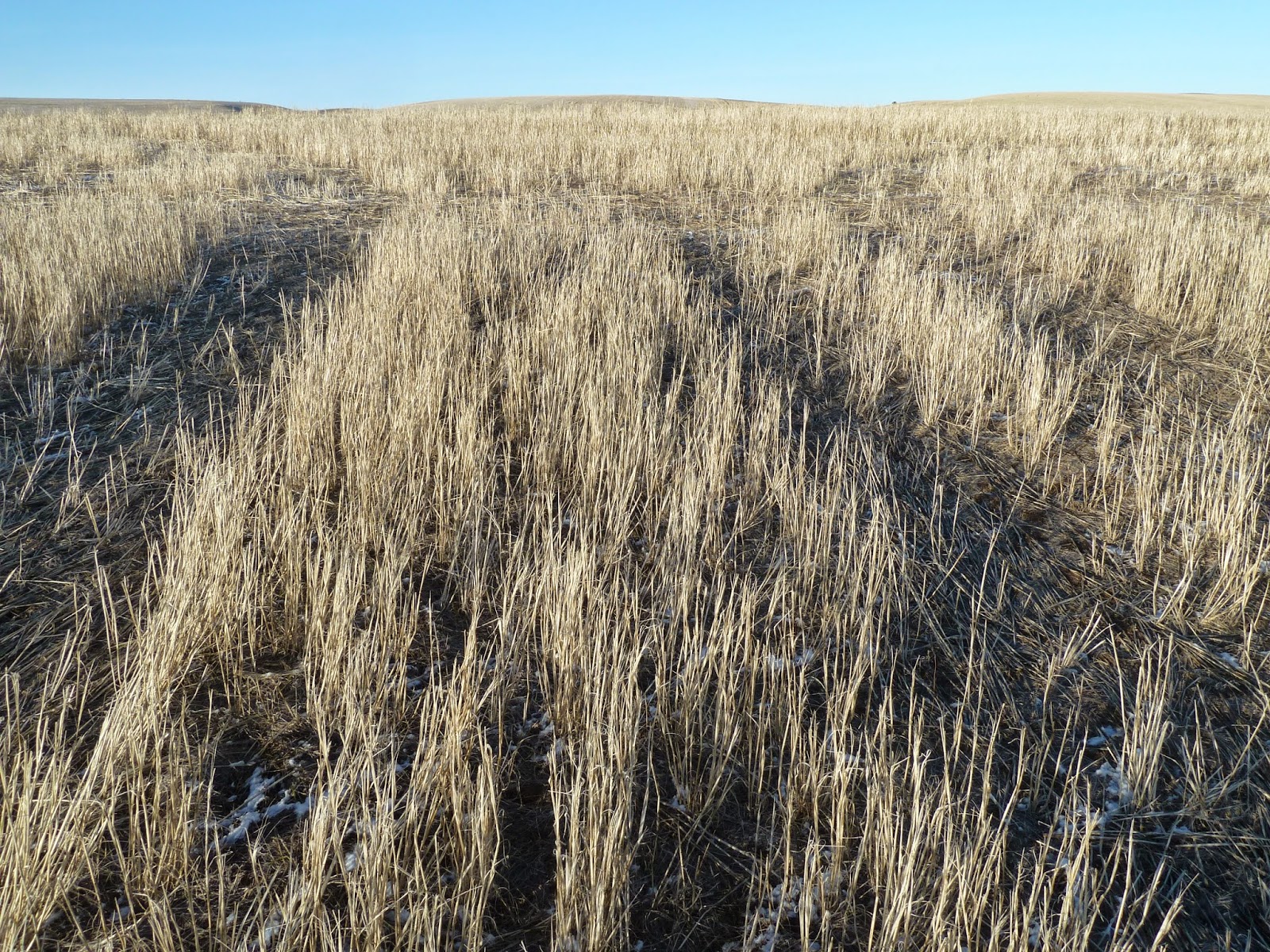
The demonstration site is on 2014 winter wheat stubble. This is not the best residue year, nor is this the best site, but it's timely and convenient. The standing residue is 26-30" tall. The yield at the location was (+/-)70 bushels, depending on specific area. The field has been direct seeded since 1992, and has not been touched by any tillage equipment including harrows. Since 2012 this field has had ULD technology applied.
We will have part of the area mowed. This will show how a rotary mower conditions the straw. Hopefully the conditioning will allow the hoe drills to operate successfully. I expected that mowing will improve conditions for the hoe drills and adversely impact the disc drills.
Drills currently scheduled for the demonstration:
---CrossSlot (single disc) (single pass)
---Horsch (hoe) (single pass)
---AgPro (hoe) (single pass)
---Palouse Zero-Till (double disc) (single pass)
---John Deere 750 (single disc) (single pass)
---Great Plains w Exactrix (double disc) (two pass)
---The Shelbourn Stripper Head will be on display
---The Schulte 26' rotary mower will demonstrate it's effectiveness on tall stubble.
--- A flail mower will demonstrate it's effectiveness on tall stubble.
There are several other brands of drills that are promoted as direct seeders. The ones listed represent most of the drill types available, ---narrow hoe, wide hoe, double disc, offset single disc, straight single disc.
Wednesday, May 13, 2015

Friday, February 6, 2015
SPOKANE'S AG EXPO & FARM FORUM 2015
Art Douglas (Ph.D, Professor Emeritus, Creighton University's Atmospheric Science Department) gave his prediction for the growing season in the Pacific Northwest. Douglas has been a regular at this event since the mid 70's. The short version:
-----In general, it's a coin toss. El Nino is not acting in normal pattern. The models are all over the board. His conclusion, with no real confidence, is that El Nino will build slightly over the spring and early summer, and then start fading.
----We likely will not have any more arctic breakouts that will effect our region this year.
----We can expect a dryer and warmer February than is normal (whatever that is). Best chance for rain will be in April (could be problematic for seeding). August may see active weather pattern (not good for harvest around here).
----Fall may be dry again (not good for seeding). Weather pattern may revert to more "normal" in late fall and winter.
----California is going to get a lot of rain, from now through early spring, and we will get some. It appears California will have another year of flooding, sliding, and burning.
----Temperatures will be warmer in general although we may have a cool spring.
The auditorium was full, and I would guess that there is more than one interpretation of Douglas' forecast. The micro-climates associated with these hills will probably play big this year. We will not want to squander opportunity to plant and harvest, in what is likely going to be a volatile weather year.
Douglas explains climate change in terms of sunspot activity, cycles, earth's tilt and position with the sun, and ocean temperature. It's all integrated and complex relationships. He states that human activity has added CO2, but I get the impression that it's not the driver in climate change. Some tid-bits I gleaned:
----It was recently broadcast that CO2 levels have never been as high as they are today. Douglas showed a chart that went back 400,000 years that shows several periods with twice as much CO2 in the atmosphere. We live is such a micro moment of time.
----The earth tilt ranges approximately 5 degrees. This angle, along with the earths position in the orbit around the sun impacts where and what intensity, energy strikes the earths atmosphere.
----Sun flare intensity is lessening. Less energy reaching the earth will have a cooling effect.
----We have been in a warming phase for a long time. It appears we are peaking out and may be preparing for a long term cooling trend.
----The volume of ice has not changed much since the 1890's. Possibly a slight increase in the total. The northern hemisphere has been losing, while the southern hemisphere is gaining.
----When the ocean warms it gives up CO2 to the atmosphere. When the ocean cools it will take up CO2 from the atmosphere. The ocean has a huge amount of CO2.
Lessons learned for our operation: Nothing! STAY THE COURSE of investigating and applying soil building practices as quickly as feasible. This will trend to buffering climate extremes. These will translate into better moisture holding capacity that produces better crops with less erosion in a fickle environment. Hopefully these practices will evolve into less herbicide and fertilizer inputs as well.
The remainder of the Expo was a spent talking to seed company representatives about cover crop cultivars and their availability. Everything I heard sounded as if supplies were adequate locally, with maybe a weeks delay for cultivars not stocked. I'm getting closer to what I think we need for cultivars in our spring 2015 planting attempt. We may or may not get our small seed box mounted this spring. Although it would be handier with a separate small seed box, our main box is set up to handle the separation of large and small seed cultivars.
-----In general, it's a coin toss. El Nino is not acting in normal pattern. The models are all over the board. His conclusion, with no real confidence, is that El Nino will build slightly over the spring and early summer, and then start fading.
----We likely will not have any more arctic breakouts that will effect our region this year.
----We can expect a dryer and warmer February than is normal (whatever that is). Best chance for rain will be in April (could be problematic for seeding). August may see active weather pattern (not good for harvest around here).
----Fall may be dry again (not good for seeding). Weather pattern may revert to more "normal" in late fall and winter.
----California is going to get a lot of rain, from now through early spring, and we will get some. It appears California will have another year of flooding, sliding, and burning.
----Temperatures will be warmer in general although we may have a cool spring.
The auditorium was full, and I would guess that there is more than one interpretation of Douglas' forecast. The micro-climates associated with these hills will probably play big this year. We will not want to squander opportunity to plant and harvest, in what is likely going to be a volatile weather year.
Douglas explains climate change in terms of sunspot activity, cycles, earth's tilt and position with the sun, and ocean temperature. It's all integrated and complex relationships. He states that human activity has added CO2, but I get the impression that it's not the driver in climate change. Some tid-bits I gleaned:
----It was recently broadcast that CO2 levels have never been as high as they are today. Douglas showed a chart that went back 400,000 years that shows several periods with twice as much CO2 in the atmosphere. We live is such a micro moment of time.
----The earth tilt ranges approximately 5 degrees. This angle, along with the earths position in the orbit around the sun impacts where and what intensity, energy strikes the earths atmosphere.
----Sun flare intensity is lessening. Less energy reaching the earth will have a cooling effect.
----We have been in a warming phase for a long time. It appears we are peaking out and may be preparing for a long term cooling trend.
----The volume of ice has not changed much since the 1890's. Possibly a slight increase in the total. The northern hemisphere has been losing, while the southern hemisphere is gaining.
----When the ocean warms it gives up CO2 to the atmosphere. When the ocean cools it will take up CO2 from the atmosphere. The ocean has a huge amount of CO2.
Lessons learned for our operation: Nothing! STAY THE COURSE of investigating and applying soil building practices as quickly as feasible. This will trend to buffering climate extremes. These will translate into better moisture holding capacity that produces better crops with less erosion in a fickle environment. Hopefully these practices will evolve into less herbicide and fertilizer inputs as well.
The remainder of the Expo was a spent talking to seed company representatives about cover crop cultivars and their availability. Everything I heard sounded as if supplies were adequate locally, with maybe a weeks delay for cultivars not stocked. I'm getting closer to what I think we need for cultivars in our spring 2015 planting attempt. We may or may not get our small seed box mounted this spring. Although it would be handier with a separate small seed box, our main box is set up to handle the separation of large and small seed cultivars.
Friday, January 23, 2015
PNW Direct Seed / Oil Seed Conference 2015
Kennewick, WA. January 2015: Over 500 pre-registered.
This location is a great venue, with plenty of lodging, good food, and a meeting facility that is particularly suited with exhibit areas, breakout rooms and main meeting room. The organizers do an excellent job of weaving formal presentations, informal presentations, and break time where producers can get together with other producers, and researchers to clarify points given in the presentations or pick up information specific to their operations
The meeting consisted of updated information by growers and researchers on raising oil crops on soil health, and about cover crops. Most of the presentations on cover crops included a livestock component. As informative as they are, managing livestock does not address my reason for introducing cover crops into our cash crop rotation. I want to know how to use the cover crops to build the nutrient base, increase SOM, feed the soil biological life, and maintain seed zone moisture for successful emergence of a fall planted winter wheat crop. There were bits and pieces that I gleaned from the presentations that I found helpful.
Some salient points that I gleaned from the conference:
---The closer the growing point of canola is to the soil surface the better the winter survivability. That is a challenge for us that are working to build a mat of residue on the soil surface. Our CrossSlot will slice through a heavy mat. Will the slot clearance be adequate to establish the growing point near the soil surface?
---Canola needs 300 GDD going into winter. (A good number to have for reference.)
---Highest survival comes from successful emergence of a mid to late August planting.
---Planting the first week of August seems to provide best emergence of canola in eastern Wa.
---Canola will die if the ground is frozen 4" deep and there are single digit temperatures? Some say definitely yes, and some say not necessarily.
---Semi-dwarf canola cultivars are becoming available. (Will they yield similar to the tall varieties and be short enough for our stripper header to cut?)
--- Cover crops use moisture similar to what fallow loses through evaporation --until flowering. (There are caveat's to this, so don't take at face value!)
--- To maximize the biological activity in the soil, live roots need to be present at all times of the year. (The green bridge has kind of fallen off the radar. The last three years we have had two opportunities for "green bridge" to bite us and it hasn't -- what's happening?)
--- We harvest light energy, so holes in the crop canopy causes losses.
--- 75% humidity is threshold for rapid decay of residue. (Our region is well below that level, even under irrigation except for the time water is being applied.)
--- Cover crops will raise humidity level and increase decomposition of stalk and stems.
--- 18 pounds of pelleted compost from Royal Organics LLC (wheat grain size) added to seed row showed significant yield increase in wheat and canola. (maybe some potential here? Their compost apparently is dead not very dead since their claiming active biological activity. I'm thinking it's holding a little more moisture(?))
--- In general, crops utilizes only 2% of the soil profile. (?) (We need to improve the rooting of our plants to occupy more of the profile and harvest more of the moisture and nutrients that are available.)
--- The first 4" of moisture builds the plant. Every inch above that has yield potential.
--- water efficiencies (bu/in) have been measured in the range of 3-12 bushels of wheat per inch of moisture. Most efficiencies are in the 5-8 bushels per inch. A high management level is required to approach the 12 bushels per inch, and higher inputs will be required.
This location is a great venue, with plenty of lodging, good food, and a meeting facility that is particularly suited with exhibit areas, breakout rooms and main meeting room. The organizers do an excellent job of weaving formal presentations, informal presentations, and break time where producers can get together with other producers, and researchers to clarify points given in the presentations or pick up information specific to their operations
The meeting consisted of updated information by growers and researchers on raising oil crops on soil health, and about cover crops. Most of the presentations on cover crops included a livestock component. As informative as they are, managing livestock does not address my reason for introducing cover crops into our cash crop rotation. I want to know how to use the cover crops to build the nutrient base, increase SOM, feed the soil biological life, and maintain seed zone moisture for successful emergence of a fall planted winter wheat crop. There were bits and pieces that I gleaned from the presentations that I found helpful.
Some salient points that I gleaned from the conference:
---The closer the growing point of canola is to the soil surface the better the winter survivability. That is a challenge for us that are working to build a mat of residue on the soil surface. Our CrossSlot will slice through a heavy mat. Will the slot clearance be adequate to establish the growing point near the soil surface?
---Canola needs 300 GDD going into winter. (A good number to have for reference.)
---Highest survival comes from successful emergence of a mid to late August planting.
---Planting the first week of August seems to provide best emergence of canola in eastern Wa.
---Canola will die if the ground is frozen 4" deep and there are single digit temperatures? Some say definitely yes, and some say not necessarily.
---Semi-dwarf canola cultivars are becoming available. (Will they yield similar to the tall varieties and be short enough for our stripper header to cut?)
--- Cover crops use moisture similar to what fallow loses through evaporation --until flowering. (There are caveat's to this, so don't take at face value!)
--- To maximize the biological activity in the soil, live roots need to be present at all times of the year. (The green bridge has kind of fallen off the radar. The last three years we have had two opportunities for "green bridge" to bite us and it hasn't -- what's happening?)
--- We harvest light energy, so holes in the crop canopy causes losses.
--- 75% humidity is threshold for rapid decay of residue. (Our region is well below that level, even under irrigation except for the time water is being applied.)
--- Cover crops will raise humidity level and increase decomposition of stalk and stems.
--- 18 pounds of pelleted compost from Royal Organics LLC (wheat grain size) added to seed row showed significant yield increase in wheat and canola. (maybe some potential here? Their compost apparently is dead not very dead since their claiming active biological activity. I'm thinking it's holding a little more moisture(?))
--- In general, crops utilizes only 2% of the soil profile. (?) (We need to improve the rooting of our plants to occupy more of the profile and harvest more of the moisture and nutrients that are available.)
--- The first 4" of moisture builds the plant. Every inch above that has yield potential.
--- water efficiencies (bu/in) have been measured in the range of 3-12 bushels of wheat per inch of moisture. Most efficiencies are in the 5-8 bushels per inch. A high management level is required to approach the 12 bushels per inch, and higher inputs will be required.
Friday, December 19, 2014
SOIL HEALTH
[Update--12/29/14]----A clarifying point for me: Compost is a great product to add to our cropland for increasing O.M. However, it is termed "very dead"meaning that it will not support the biological life in our soils. It enters our soils as "humus" and supports soil structure and, hence, water holding capacity of the soil. That's logical when you think about it. All the energy is burned out in the composting process, making the "dead" into the "very dead". Interesting terminology for plant and animal material -- living, dead, and very dead.
"BUILDING SOIL for BETTER CROPS". One needs to study this as a bible for soil health. It is the best and most concise publication I have seen in relatively easy to understand language. This is not a "HOW TO" direct seed book. It's more basic than that. Don't get caught up in the details. Learn the concepts. An understanding of the interrelationships of the soil fauna and flora will stimulate your thought process for designing a successful management plan to build soil, and reduce commercial fertilizer and pesticide input.
It appears evident to me that the first priority for us is to get more diversity, and more biomass on our cropland -- a lot of it. For those of us that have been direct seeding for several years and have experienced some soil improvement, the time required to improve soil health to the point of sustaining crops will be quicker, than those starting from tilled ground.
Dirt is basically dead. Soil is a live, breathing organism. For most of our lifetime we have been tilling soil to dirt (death). We have to have a "thought transplant", before our life sustaining organ (soil) completely stops providing. As our hilltops and sides lose productivity, we will be left with bottoms, until they are farmed out in another generation or two. To continue down the tillage path means that our crops will eventually be grown with 100% commercial inputs. Dirt will be for holding the plant upright in place.
You can download the pdf. file at: < http://www.google.com/search?client=safari&rls=en&q=Building+soils+for+better+crops&ie=UTF-8&oe=UTF-8 > (copy and paste the URL, or google "Building Soils for Better Crops"

Below is a pic from a soil pit at the Aeschliman farm SW of Colfax, Wa. showing Carbon strings reaching deep (3-4 feet) in the soil profile following what appears to be root channels or worm holes. To me this is amazing. [The white (washed out) area at the bottom is the surface vegetation of the near bank of the soil pit.]

Thursday, December 4, 2014
TALL RESIDUE IN THE COLD & SNOW
[SUMMARY] -- I don't comprehend much of the dynamics surrounding stubble. The literature is not consistent. This is what I am observing and will update as time offers more experience. 1--The taller the stubble the slower the air movement along the ground surface. This is more of a logical observation than measured. 2--The taller the stubble the more snow it will hold in place. Most of my life I have observed that our fields with standing stubble held snow within 4-6" of the stubble height. 3--Snow melts faster along the stem and base of the stubble compared to row middles.


---------
[DETAIL]-- Since the middle of November we have had below normal temperatures and occasionally a lot of wind. Recently we have received a little snow (≈1-2"). Today, as well as last February I have observed, while walking the fields, that snow has melted away from the stems of the tall stubble where the short stem stubble and the flattened residue is maintaining the snow.
The pic above is from last February. This is a thaw event and water is moving slowly along the ground surface. Notice that the snow is shrinking away from the base of the tall (≈36-40") winter wheat stubble more quickly than from the 10" row middles. Most of the ground surface has a solid mat of residue.
This shows the snow having been swept off the winter wheat crop and redeposited in the tall grass of the CRP strip. Our crop is obviously not able to utilize the moisture contained in this snow bank.
The pic above is part of the thaw event of 2/14. This shows snow relocated following a wind event leaving drifts. In this case the drift is melting, adding to the fast moving water in the shallow valley. Even though we have good armor on the field this is causing a rill to develop. Our crop is also being denied moisture through redeposition and runoff. Having standing stubble would have helped I'm sure.
The pic above was taken 12/3/14. It shows a thin layer of snow (≈1") where there is short stubble in the fore ground and the far background. The middle area has stripper headed spring barley stubble (≈18"tall). There is little or no snow left on the ground surface under the taller stubble.
The pic shows a sample of the middle area in the pic above of the stripper headed barley. There is very little snow left on the ground surface compared to an area a few feet to the left that had the stubble cut at near ground level. Is this good or bad? Is the tall stubble moderating the soil temperature? Even the blackened (cultivated) fields show more snow retention than the pic above. I would say that the ground surface shown is warmer than those surfaces of the short stubble, flat residue, or no residue covered fields. Within this post you can find a contradiction and I can't explain why with more than a guess.
Saturday, November 15, 2014
ULTRA-LOW-DISTURBANCE [ULD] IS THE FUTURE FOR OUR DRY LAND REGION !!!!
We are only three years into ULD, but going over information this fall relating to climate, soil health, moisture savings, weed control, fertility issues, and what I am seeing by using the system, I am convinced that this is the way to go, and willing to step out and say so. ULD has the potential to dramatically cut costs of fertilizer, chemical and seed. ULD at the same time has the potential to maximize yields through better crop emergence and savings in moisture that normally would evaporate off the soil surface. Any ULD system will have to incorporate a sophisticated seed depth control system to maximize it's effectiveness in the variable environment of soils and residue. My reasoning for ULD is as follows, --by topic.
CLIMATE: Can anyone deny that the climate is dynamic and changing. I have seen plenty of change in my 60+ years working in the field, swinging from cold winters with lots of snow and summers with thunderstorms and down pours, to milder winters with little snow and no summer storms. In some ways I'm seeing events that appear to be reverting back to the 40's & 50's. In other ways I'm seeing more extreme events, not only in intensity, but also timing.
Several years ago I sat in on a UW and USGS presentation on expectations for Washington Climate in 50-80 years. There was a presentation on what would happen to grain crops with a 2 degree average temperature rise. As it turned out we have recent experience with that condition. One year in the early 2000's, there was a persistent high pressure cell stationed over France that raised the average temperature in that region for the year, 2 degrees. This temperature increase either created or was in conjunction with a shift in seasons which resulted in a disaster for small grains. This shift caught much of the small grain crop blooming with high temperatures, leaving blank heads. As farmers we have to adapt our operation, where we can, to accommodate this changing climate. It may include extreme temperature, rainfall and wind events, shift in seasons, dry seeding conditions, and insects, and diseases that express themselves in cultivars under stress. GMO and GE cultivars will likely play a role in plant growth habits, drought resistance, insect and disease resistance, but we as growers have to prepare our ground and protect our moisture as best we can.
Climate change prediction for Washington State includes: --2 degree average temperature increase. --total moisture amount about the same. --little or no snow pack in the Cascade mountains. --rivers will peak one month earlier. --winter wheat will be the crop in eastern Washington. Nothing stated about moisture or season shift.
RESIDUE--CROP AND OTHER: Residue has a lot to offer. The biomass helps support the soil fauna and decomposing roots leave channels for water infiltration. Residue laying on the surface protects the surface from the destructive energy of falling rain drops. (see "Links" page for Rain Drop) Residue is also an insulating blanket moderating soil temperature, and reducing the drying effect of air moving across the surface. Surface residue is food for the vertical boring (nightcrawler) worms. It's important that sufficient residue lay on the surface so that dirt is not visible. Dirt showing will erode, and moisture loss will accelerate through evaporation. Leave residue standing as tall as possible. The taller the residue the less air movement along the soil surface. Any cultivation, including direct seeding, destroys residue. ULD minimizes this loss. I don't think you can get too much residue. The trick is to seed into/through it!
COVER CROPS: Cover crops may be needed to supplement crop residue during fallow periods. Seed depth moisture is an obvious concern any time cover crops are mentioned. The fact that growing crops only transpire 12% of the available moisture (see earlier post on moisture, 8/19/12), different crops draw their high moisture use from different depths at different times, and timing for cover crop destruction can be variable, the seed depth moisture loss may not be the problem perceived. It's not well understood, but there is a syngeneic effect from planting multi-specie cover crop helping all cultivars thrive in a drought compared to single species planting. Will it work to interplant the cash crop?
SOIL HEALTH: Most farmers, including myself have shallow knowledge of soil health and it's real value. This section will be statements with few comments. Mostly things to ponder!
---- One frequently hears that the quantity living organisms living below the soil surface on an acre basis is staggering. The healthier the soil the more organisms there are to feed.
----- Both, aerobic and anaerobic organisms are found in the soil profile.
----- Anaerobic organisms thrive under poorly aerated soil and cause many of the negative plant health issues.
---- Soils with good structure have low levels of anaerobic organisms. There structure supports proper relationship of water and air for aerobic organism processes.
---- The higher the OM, the better the soil.
---- The improving OM also indicates that structure is improving. Improving structure however, doesn't necessarily indicate improving OM.
---- Soils with good structure and high OM can manufacture and make available most fertility elements necessary for plant growth.
---- From what I am reading the capacity of OM to provide most of the nutrients for plants, if managed for that purpose, starts at 3% and above.
---- OM is slow to build. It is easier to save than build.
---- Eroded soils are slow to recover OM because there is so little left of the soil biology to start up the rebuilding process.
---- Eroded soils erode faster. As OM and structure collapses, soils seal allowing moisture to run off.
---- All cultivation, from any operation, degrades soils by collapsing structure, burning OM. It's the nature of cultivation.
---- Recent designated categories for OM are "active" and "mature". Active OM means it is biologically active. Mature OM means it has little biological activity associated with it. The crop residues we see are more of a pre-OM state termed litter.
---- Every year that our soils deteriorate puts us more than another year away from recovery.
---- Plants under stress are more prone for insect attack.
---- Insects that attack crop cultivars are color sensitive.
SEEDING:
---- Less soil disturbance creates the condition for less weed germination.
---- Seed laying on residue struggle to germinate and compete with a growing crop. The thicker the mat the better.
---- Seed planted in soil thrives, but seed planted in residue struggles.
----My opinion: -->any two pass is better than conventional tillage, any one pass is better than two pass, and any single disc opener is better than a hoe. Currently the CrossSlot is the best technology today in single disc drills for our dryland, low moisture environment.
CLIMATE: Can anyone deny that the climate is dynamic and changing. I have seen plenty of change in my 60+ years working in the field, swinging from cold winters with lots of snow and summers with thunderstorms and down pours, to milder winters with little snow and no summer storms. In some ways I'm seeing events that appear to be reverting back to the 40's & 50's. In other ways I'm seeing more extreme events, not only in intensity, but also timing.
Several years ago I sat in on a UW and USGS presentation on expectations for Washington Climate in 50-80 years. There was a presentation on what would happen to grain crops with a 2 degree average temperature rise. As it turned out we have recent experience with that condition. One year in the early 2000's, there was a persistent high pressure cell stationed over France that raised the average temperature in that region for the year, 2 degrees. This temperature increase either created or was in conjunction with a shift in seasons which resulted in a disaster for small grains. This shift caught much of the small grain crop blooming with high temperatures, leaving blank heads. As farmers we have to adapt our operation, where we can, to accommodate this changing climate. It may include extreme temperature, rainfall and wind events, shift in seasons, dry seeding conditions, and insects, and diseases that express themselves in cultivars under stress. GMO and GE cultivars will likely play a role in plant growth habits, drought resistance, insect and disease resistance, but we as growers have to prepare our ground and protect our moisture as best we can.
Climate change prediction for Washington State includes: --2 degree average temperature increase. --total moisture amount about the same. --little or no snow pack in the Cascade mountains. --rivers will peak one month earlier. --winter wheat will be the crop in eastern Washington. Nothing stated about moisture or season shift.
RESIDUE--CROP AND OTHER: Residue has a lot to offer. The biomass helps support the soil fauna and decomposing roots leave channels for water infiltration. Residue laying on the surface protects the surface from the destructive energy of falling rain drops. (see "Links" page for Rain Drop) Residue is also an insulating blanket moderating soil temperature, and reducing the drying effect of air moving across the surface. Surface residue is food for the vertical boring (nightcrawler) worms. It's important that sufficient residue lay on the surface so that dirt is not visible. Dirt showing will erode, and moisture loss will accelerate through evaporation. Leave residue standing as tall as possible. The taller the residue the less air movement along the soil surface. Any cultivation, including direct seeding, destroys residue. ULD minimizes this loss. I don't think you can get too much residue. The trick is to seed into/through it!
COVER CROPS: Cover crops may be needed to supplement crop residue during fallow periods. Seed depth moisture is an obvious concern any time cover crops are mentioned. The fact that growing crops only transpire 12% of the available moisture (see earlier post on moisture, 8/19/12), different crops draw their high moisture use from different depths at different times, and timing for cover crop destruction can be variable, the seed depth moisture loss may not be the problem perceived. It's not well understood, but there is a syngeneic effect from planting multi-specie cover crop helping all cultivars thrive in a drought compared to single species planting. Will it work to interplant the cash crop?
---- One frequently hears that the quantity living organisms living below the soil surface on an acre basis is staggering. The healthier the soil the more organisms there are to feed.
----- Both, aerobic and anaerobic organisms are found in the soil profile.
----- Anaerobic organisms thrive under poorly aerated soil and cause many of the negative plant health issues.
---- Soils with good structure have low levels of anaerobic organisms. There structure supports proper relationship of water and air for aerobic organism processes.
---- The higher the OM, the better the soil.
---- The improving OM also indicates that structure is improving. Improving structure however, doesn't necessarily indicate improving OM.
---- Soils with good structure and high OM can manufacture and make available most fertility elements necessary for plant growth.
---- From what I am reading the capacity of OM to provide most of the nutrients for plants, if managed for that purpose, starts at 3% and above.
---- OM is slow to build. It is easier to save than build.
---- Eroded soils are slow to recover OM because there is so little left of the soil biology to start up the rebuilding process.
---- Eroded soils erode faster. As OM and structure collapses, soils seal allowing moisture to run off.
---- All cultivation, from any operation, degrades soils by collapsing structure, burning OM. It's the nature of cultivation.
---- Recent designated categories for OM are "active" and "mature". Active OM means it is biologically active. Mature OM means it has little biological activity associated with it. The crop residues we see are more of a pre-OM state termed litter.
---- Every year that our soils deteriorate puts us more than another year away from recovery.
---- Plants under stress are more prone for insect attack.
---- Insects that attack crop cultivars are color sensitive.
SEEDING:
---- Less soil disturbance creates the condition for less weed germination.
---- Seed laying on residue struggle to germinate and compete with a growing crop. The thicker the mat the better.
---- Seed planted in soil thrives, but seed planted in residue struggles.
----My opinion: -->any two pass is better than conventional tillage, any one pass is better than two pass, and any single disc opener is better than a hoe. Currently the CrossSlot is the best technology today in single disc drills for our dryland, low moisture environment.
Thursday, November 13, 2014
2014 FALL SEEDING with CROSS-SLOT
[Update 3/23/15] --All of our winter canola winter killed--big(timely emerged), little(emerged at freeze down), thin residue or very heavy residue. We have just sprayed the canola fields in preparation of going back with DNS and some garbs. We dumped a pint of Buctril in with the Rt3 to take out the rr canola. It appeared that more of the non roundup ready canola cultivars survived than the roundup ready cultivars--like 0++ to 0+. One interesting note: --on one bare soil spot, in a truck road, on a north facing slope where the full force of the November blast hit, one row (≈50' long) of late emerged canola looks perfect. They look like soldiers in perfect alignment the size of a silver dollar. Go Figure!!??
Our winter wheat (Brundage 96) came through the winter in very good shape(99+% stand), and all big enough for Ospray or Power flex. We need to get it sprayed NOW. Several scouting trips have shown no crown, or visible root damage. Burned leaf tips are the only sign of winter and they have mostly disappeared. Later we'll see if we have diminished harvest results, like 2014.
[Update] 12 29/14---- The winter wheat is showing color improvement, and the large canola plants are also showing some activity; however, this morning we have no snow and temperatures in low 20's and wind from the ENE@ 20-35mph. In the next day or two we are expected to have lows around zero. This is the second hit on this crop. How many more before spring??? We did get a little snifter of snow in the early morning. The cultivated ground that I see from the window is bare, and it's too miserable to walk the fields to observe the effects on the crop and in the tall stubble.
[Update] 12/16/14---- The winter wheat stand no longer looks spotty. Many of the leaves are partially burned off but the crowns look good at this point in time. Compared to other stands in the area, ours looks great.
The winter canola stand is anyones guess at this point in time; however, I'm guessing that we will reseed most or all in the spring. All the large leaves are colorless and laying on the ground with the leaves of the small plants gone.
[Update] 11/13/14----Tuesday, the 11th Nov. temperatures dropped dramatically (+21F) and 12-35mph wind. We are expecting lower temperatures and more wind. These conditions are similar to the early December, 2013 event that damaged our winter crops (high winds, cold temperatures, and no snow cover). My concern is that this is even earlier and more events could follow prior to the end of February. Come spring it will be interesting to see what, if any, of the canola survives, and what damage the wheat will have. Our volume of residue should aid survival by moderating the effects of wind and cold temperatures. I wish we would have seeded some winter wheat on 20" spacing to see if the standing stubble left with that spacing would improve survivability.
The winter wheat has all emerged. The 0.25" rain received the 29th September brought up the remainder that didn't emerge when seeded. The late emerged wheat is mostly in the 3-4 leaf stage. The timely emerged wheat (seeded ≈ 6th Sept.) has many tillers.
The winter canola has mostly emerged. The late emerged canola is very small, with some still emerging. The timely emerged canola (seeded 19th Aug.) is dinner plate size. These large size canola plants nestled in and around standing stubble two too three times their height is something I want to evaluate come spring. If those plants are the only survivors, we may want to rethink tires and tracks on the combine, sprayer, and tractor to promote less stubble smash.
This post sat in the "draft box" way too long, forgotten. It still had some points that I want to remember.
Our drill with the CrossSlot opener creates very little soil disturbance. It momentarily cuts a narrow slot in the soil and deposits the seed with starter fertilizer, and also deep bands the nitrogen, then with two packer wheels mounted in a V configuration the slot is closed and firmed. In a marginal moisture situation this opener, if it's not operated in a manner that compromises the technology by leaving the slot open, can maintain a high humidity environment at the seed site. Baker Industries promotes this capability for better germination and emergence. Dr. Stewart Wuest of OSU supports this concept. He has a study titled "seed-soil contact and the role of vapor in germination". The Abstract states: ------Seed-soil contact has been assumed to be the most important factor for rapid transfer of water from soil to seed. Recent research demonstrated that seeds are capable of geminating without soil contact, and that 85% or more of the water absorbed by seeds can be directly attributed to vapor. A new appreciation for the capacity of soil atmosphere to supply water vapor to seeds will help in future efforts to improve seeding equipment.--- (See link page.)
The dry condition encountered in the fall of 2014 is what this drill was designed for. I'm sorry to say that we did not execute well. I have stated before how important the ADF (auto down force) system is to this drill design. Inconsistent soils and variations in residue across the field are conditions that challenge disc drills. We can see in many areas where the seed was placed shallow. With the ADF system out we used the manual mode which allowed us to pressure the system, but not allow the system to automatically adjust hydraulic pressure to ground conditions.
One adage we have come to rely on for successful direct seeding is to seed into moisture. With the dry conditions we are experiencing this fall, the end of the first week of September was at that limit. We should have been able to get 85-90% up. As it is we are more like 50-65% emerged. It is a lost opportunity, and something we will have to address before another year.
Our winter wheat (Brundage 96) came through the winter in very good shape(99+% stand), and all big enough for Ospray or Power flex. We need to get it sprayed NOW. Several scouting trips have shown no crown, or visible root damage. Burned leaf tips are the only sign of winter and they have mostly disappeared. Later we'll see if we have diminished harvest results, like 2014.
[Update] 12 29/14---- The winter wheat is showing color improvement, and the large canola plants are also showing some activity; however, this morning we have no snow and temperatures in low 20's and wind from the ENE@ 20-35mph. In the next day or two we are expected to have lows around zero. This is the second hit on this crop. How many more before spring??? We did get a little snifter of snow in the early morning. The cultivated ground that I see from the window is bare, and it's too miserable to walk the fields to observe the effects on the crop and in the tall stubble.
[Update] 12/16/14---- The winter wheat stand no longer looks spotty. Many of the leaves are partially burned off but the crowns look good at this point in time. Compared to other stands in the area, ours looks great.
The winter canola stand is anyones guess at this point in time; however, I'm guessing that we will reseed most or all in the spring. All the large leaves are colorless and laying on the ground with the leaves of the small plants gone.
[Update] 11/13/14----Tuesday, the 11th Nov. temperatures dropped dramatically (+21F) and 12-35mph wind. We are expecting lower temperatures and more wind. These conditions are similar to the early December, 2013 event that damaged our winter crops (high winds, cold temperatures, and no snow cover). My concern is that this is even earlier and more events could follow prior to the end of February. Come spring it will be interesting to see what, if any, of the canola survives, and what damage the wheat will have. Our volume of residue should aid survival by moderating the effects of wind and cold temperatures. I wish we would have seeded some winter wheat on 20" spacing to see if the standing stubble left with that spacing would improve survivability.
The winter wheat has all emerged. The 0.25" rain received the 29th September brought up the remainder that didn't emerge when seeded. The late emerged wheat is mostly in the 3-4 leaf stage. The timely emerged wheat (seeded ≈ 6th Sept.) has many tillers.
The winter canola has mostly emerged. The late emerged canola is very small, with some still emerging. The timely emerged canola (seeded 19th Aug.) is dinner plate size. These large size canola plants nestled in and around standing stubble two too three times their height is something I want to evaluate come spring. If those plants are the only survivors, we may want to rethink tires and tracks on the combine, sprayer, and tractor to promote less stubble smash.
This post sat in the "draft box" way too long, forgotten. It still had some points that I want to remember.
Our drill with the CrossSlot opener creates very little soil disturbance. It momentarily cuts a narrow slot in the soil and deposits the seed with starter fertilizer, and also deep bands the nitrogen, then with two packer wheels mounted in a V configuration the slot is closed and firmed. In a marginal moisture situation this opener, if it's not operated in a manner that compromises the technology by leaving the slot open, can maintain a high humidity environment at the seed site. Baker Industries promotes this capability for better germination and emergence. Dr. Stewart Wuest of OSU supports this concept. He has a study titled "seed-soil contact and the role of vapor in germination". The Abstract states: ------Seed-soil contact has been assumed to be the most important factor for rapid transfer of water from soil to seed. Recent research demonstrated that seeds are capable of geminating without soil contact, and that 85% or more of the water absorbed by seeds can be directly attributed to vapor. A new appreciation for the capacity of soil atmosphere to supply water vapor to seeds will help in future efforts to improve seeding equipment.--- (See link page.)
The dry condition encountered in the fall of 2014 is what this drill was designed for. I'm sorry to say that we did not execute well. I have stated before how important the ADF (auto down force) system is to this drill design. Inconsistent soils and variations in residue across the field are conditions that challenge disc drills. We can see in many areas where the seed was placed shallow. With the ADF system out we used the manual mode which allowed us to pressure the system, but not allow the system to automatically adjust hydraulic pressure to ground conditions.
One adage we have come to rely on for successful direct seeding is to seed into moisture. With the dry conditions we are experiencing this fall, the end of the first week of September was at that limit. We should have been able to get 85-90% up. As it is we are more like 50-65% emerged. It is a lost opportunity, and something we will have to address before another year.
Subscribe to:
Posts (Atom)