[Update: 5/29/15] --This past week the Palouse has had a series of thunder storms, and in scattered locations have resulted in serious damage to exposed ground. Unstable weather is predicted to continue in the region. When you look at the national weather events and see the extremes, one wonders when those extremes will engulf us, --either drought like California, or deluge like Texas. World wide, weather appears to be increasing in severity. My thought is that it will happen here, --but when and with what severity? A Texas size storm would obliterate our land regardless of cropping practices; however, there is a lot of gradation between the Texas type storms and the little bangers we have received, which we can armor our land against. It's as simple as eliminate loosening the soil with cultivation, keeping the soil surface covered, and keeping the soil anchored with roots (alive or dead) from the surface down. These two things give us the best protection from unusual events whether temperature or water related.
Saturday evening, May 16th, Thunderstorms hit eastern Whitman County with rains that did serious damage to some fields. Fortunately the damage was limited to a narrow strip of land; however, the impact is going to be felt over a wide area. Creeks in the effected watersheds were running thick. They look more like mud flows than creeks. Thousands of tons of soil along with attached fertilizer and chemistry left the farms and will end up in lakes, rivers and ocean.
The fields I saw didn't even have the basic conservation practices applied. They were denuded of residue, cultivated and seeded vertically, and the surface worked to a fine texture. We are living in the age of 500+ horsepower tractors and the environment and ground is paying the price.
An event in February, 2014, showed me that even fields with good armor and soil structure are subject to runoff; however, in our case the water loss was clear. (see post of 2/27/14)
Operations that abuse the ground, and there are many in the Palouse, will not be held accountable as past experience proves; however, they are big contributors to the publics attitude towards farmers and their out cry for for more regulations and restrictions that effect all of us. If the appropriate regulators would target gross abusers and work with them to clean up their act we would all be better off.
Tuesday, May 19, 2015

Friday, May 15, 2015
REDUCED WEED PRESSURE
[Update: 5/24/15] We have recently sprayed our CF and DNS. We have so few weeds in these fields that it is difficult to justify the cost of chemical, but it is to soon to cut these applications. Our agronomist advised against application to the CF, but we couldn't leave the scattered single Downy Brome plants. We put out one short load doing the draws and bordering the CRP.
The DNS has a light infestation of Downy Brome (the bane of our small grains and fallow rotation), and plants from the failed winter canola crop. We hit the crop with a fungicide, broadleaf, and grass herbicide.
When I started direct seeding, years ago, one worry I had, was --chaff rows left by the combine. Combines of any make will drop grain, and in areas, a lot of grain. Our combine is no different then anyone else's. Rains fall, seed germinates, and fields green up, but over the years ours have consistently shown less than most fields. Since 2012 when we bought the stripper head and changed from high disturbance direct seeding to ultra low disturbance direct seeding I have noticed that we have further reduced the weed pressure in our fields.
We have some theories but no validated research to support the claims.
----Leaving the seed bank on the surface hastens its destruction over planting it! For a long time I have felt that the elements (heat, cold, rain, wind, sun) would decompose seed if it were not buried. There is a lot of research stating the number of years that various seeds can remain viable in the ground.
---Seed laying on a blanket of residue germinates, dries, and dies! We think this occurs, even on bare soil. Many seeds on the surface will take up moisture and dry and die before they can get a root anchored to sustain them. It appears that the thicker the residue layer the better.
---There are a lot of critters (granivores) skittering along the ground surface (birds, invertebrates, mammals) that eat seed. The tall stubble may be protection for these granivores.
The purpose of our direct seeding from the start was the lure of saving moisture for use by our crops as mentioned in other posts (label--Moisture). As we have progressed toward that goal, the reduction of weed pressure is a welcome side benefit.
Where do we go from here? With the adoption of the stripper head, and a ULD system in the form of the CrossSlot drill, we have reached a wall (in our thinking). We have been very successful to this point. What further can we do to improve moisture saving and weed reduction techniques. COVER CROPS????
Wednesday, May 13, 2015
DRILL DEMONSTRATION IN TALL RESIDUE
2015, June 23rd @ 9am, ---the the demonstration site is 5.5 miles west of St. John on SR23 to Eriksen Road, than ≈ one half mile south on Eriksen Road. All interested individuals are welcome.
Interest in the Shelbourn Stripper Header is building, but there are few opportunities to see how different drill designs will handle the heavy / tall residue. Barley will be provided for the drill participants.
The purpose of the demonstration is to give participants and onlookers, a quick and easy way to experience management issues associated with heavy and tall crop residue.
The demonstration site is on 2014 winter wheat stubble. This is not the best residue year, nor is this the best site, but it's timely and convenient. The standing residue is 26-30" tall. The yield at the location was (+/-)70 bushels, depending on specific area. The field has been direct seeded since 1992, and has not been touched by any tillage equipment including harrows. Since 2012 this field has had ULD technology applied.
We will have part of the area mowed. This will show how a rotary mower conditions the straw. Hopefully the conditioning will allow the hoe drills to operate successfully. I expected that mowing will improve conditions for the hoe drills and adversely impact the disc drills.
Drills currently scheduled for the demonstration:
---CrossSlot (single disc) (single pass)
---Horsch (hoe) (single pass)
---AgPro (hoe) (single pass)
---Palouse Zero-Till (double disc) (single pass)
---John Deere 750 (single disc) (single pass)
---Great Plains w Exactrix (double disc) (two pass)
---The Shelbourn Stripper Head will be on display
---The Schulte 26' rotary mower will demonstrate it's effectiveness on tall stubble.
--- A flail mower will demonstrate it's effectiveness on tall stubble.
There are several other brands of drills that are promoted as direct seeders. The ones listed represent most of the drill types available, ---narrow hoe, wide hoe, double disc, offset single disc, straight single disc.
Friday, February 6, 2015
SPOKANE'S AG EXPO & FARM FORUM 2015
Art Douglas (Ph.D, Professor Emeritus, Creighton University's Atmospheric Science Department) gave his prediction for the growing season in the Pacific Northwest. Douglas has been a regular at this event since the mid 70's. The short version:
-----In general, it's a coin toss. El Nino is not acting in normal pattern. The models are all over the board. His conclusion, with no real confidence, is that El Nino will build slightly over the spring and early summer, and then start fading.
----We likely will not have any more arctic breakouts that will effect our region this year.
----We can expect a dryer and warmer February than is normal (whatever that is). Best chance for rain will be in April (could be problematic for seeding). August may see active weather pattern (not good for harvest around here).
----Fall may be dry again (not good for seeding). Weather pattern may revert to more "normal" in late fall and winter.
----California is going to get a lot of rain, from now through early spring, and we will get some. It appears California will have another year of flooding, sliding, and burning.
----Temperatures will be warmer in general although we may have a cool spring.
The auditorium was full, and I would guess that there is more than one interpretation of Douglas' forecast. The micro-climates associated with these hills will probably play big this year. We will not want to squander opportunity to plant and harvest, in what is likely going to be a volatile weather year.
Douglas explains climate change in terms of sunspot activity, cycles, earth's tilt and position with the sun, and ocean temperature. It's all integrated and complex relationships. He states that human activity has added CO2, but I get the impression that it's not the driver in climate change. Some tid-bits I gleaned:
----It was recently broadcast that CO2 levels have never been as high as they are today. Douglas showed a chart that went back 400,000 years that shows several periods with twice as much CO2 in the atmosphere. We live is such a micro moment of time.
----The earth tilt ranges approximately 5 degrees. This angle, along with the earths position in the orbit around the sun impacts where and what intensity, energy strikes the earths atmosphere.
----Sun flare intensity is lessening. Less energy reaching the earth will have a cooling effect.
----We have been in a warming phase for a long time. It appears we are peaking out and may be preparing for a long term cooling trend.
----The volume of ice has not changed much since the 1890's. Possibly a slight increase in the total. The northern hemisphere has been losing, while the southern hemisphere is gaining.
----When the ocean warms it gives up CO2 to the atmosphere. When the ocean cools it will take up CO2 from the atmosphere. The ocean has a huge amount of CO2.
Lessons learned for our operation: Nothing! STAY THE COURSE of investigating and applying soil building practices as quickly as feasible. This will trend to buffering climate extremes. These will translate into better moisture holding capacity that produces better crops with less erosion in a fickle environment. Hopefully these practices will evolve into less herbicide and fertilizer inputs as well.
The remainder of the Expo was a spent talking to seed company representatives about cover crop cultivars and their availability. Everything I heard sounded as if supplies were adequate locally, with maybe a weeks delay for cultivars not stocked. I'm getting closer to what I think we need for cultivars in our spring 2015 planting attempt. We may or may not get our small seed box mounted this spring. Although it would be handier with a separate small seed box, our main box is set up to handle the separation of large and small seed cultivars.
Friday, January 23, 2015
PNW Direct Seed / Oil Seed Conference 2015
Kennewick, WA. January 2015: Over 500 pre-registered.
This location is a great venue, with plenty of lodging, good food, and a meeting facility that is particularly suited with exhibit areas, breakout rooms and main meeting room. The organizers do an excellent job of weaving formal presentations, informal presentations, and break time where producers can get together with other producers, and researchers to clarify points given in the presentations or pick up information specific to their operations
The meeting consisted of updated information by growers and researchers on raising oil crops on soil health, and about cover crops. Most of the presentations on cover crops included a livestock component. As informative as they are, managing livestock does not address my reason for introducing cover crops into our cash crop rotation. I want to know how to use the cover crops to build the nutrient base, increase SOM, feed the soil biological life, and maintain seed zone moisture for successful emergence of a fall planted winter wheat crop. There were bits and pieces that I gleaned from the presentations that I found helpful.
Some salient points that I gleaned from the conference:
---The closer the growing point of canola is to the soil surface the better the winter survivability. That is a challenge for us that are working to build a mat of residue on the soil surface. Our CrossSlot will slice through a heavy mat. Will the slot clearance be adequate to establish the growing point near the soil surface?
---Canola needs 300 GDD going into winter. (A good number to have for reference.)
---Highest survival comes from successful emergence of a mid to late August planting.
---Planting the first week of August seems to provide best emergence of canola in eastern Wa.
---Canola will die if the ground is frozen 4" deep and there are single digit temperatures? Some say definitely yes, and some say not necessarily.
---Semi-dwarf canola cultivars are becoming available. (Will they yield similar to the tall varieties and be short enough for our stripper header to cut?)
--- Cover crops use moisture similar to what fallow loses through evaporation --until flowering. (There are caveat's to this, so don't take at face value!)
--- To maximize the biological activity in the soil, live roots need to be present at all times of the year. (The green bridge has kind of fallen off the radar. The last three years we have had two opportunities for "green bridge" to bite us and it hasn't -- what's happening?)
--- We harvest light energy, so holes in the crop canopy causes losses.
--- 75% humidity is threshold for rapid decay of residue. (Our region is well below that level, even under irrigation except for the time water is being applied.)
--- Cover crops will raise humidity level and increase decomposition of stalk and stems.
--- 18 pounds of pelleted compost from Royal Organics LLC (wheat grain size) added to seed row showed significant yield increase in wheat and canola. (maybe some potential here? Their compost apparently is dead not very dead since their claiming active biological activity. I'm thinking it's holding a little more moisture(?))
--- In general, crops utilizes only 2% of the soil profile. (?) (We need to improve the rooting of our plants to occupy more of the profile and harvest more of the moisture and nutrients that are available.)
--- The first 4" of moisture builds the plant. Every inch above that has yield potential.
--- water efficiencies (bu/in) have been measured in the range of 3-12 bushels of wheat per inch of moisture. Most efficiencies are in the 5-8 bushels per inch. A high management level is required to approach the 12 bushels per inch, and higher inputs will be required.
Friday, December 19, 2014
SOIL HEALTH
[Update--12/29/14]----A clarifying point for me: Compost is a great product to add to our cropland for increasing O.M. However, it is termed "very dead"meaning that it will not support the biological life in our soils. It enters our soils as "humus" and supports soil structure and, hence, water holding capacity of the soil. That's logical when you think about it. All the energy is burned out in the composting process, making the "dead" into the "very dead". Interesting terminology for plant and animal material -- living, dead, and very dead.
"BUILDING SOIL for BETTER CROPS". One needs to study this as a bible for soil health. It is the best and most concise publication I have seen in relatively easy to understand language. This is not a "HOW TO" direct seed book. It's more basic than that. Don't get caught up in the details. Learn the concepts. An understanding of the interrelationships of the soil fauna and flora will stimulate your thought process for designing a successful management plan to build soil, and reduce commercial fertilizer and pesticide input.
It appears evident to me that the first priority for us is to get more diversity, and more biomass on our cropland -- a lot of it. For those of us that have been direct seeding for several years and have experienced some soil improvement, the time required to improve soil health to the point of sustaining crops will be quicker, than those starting from tilled ground.
Dirt is basically dead. Soil is a live, breathing organism. For most of our lifetime we have been tilling soil to dirt (death). We have to have a "thought transplant", before our life sustaining organ (soil) completely stops providing. As our hilltops and sides lose productivity, we will be left with bottoms, until they are farmed out in another generation or two. To continue down the tillage path means that our crops will eventually be grown with 100% commercial inputs. Dirt will be for holding the plant upright in place.
You can download the pdf. file at: < http://www.google.com/search?client=safari&rls=en&q=Building+soils+for+better+crops&ie=UTF-8&oe=UTF-8 > (copy and paste the URL, or google "Building Soils for Better Crops"

Below is a pic from a soil pit at the Aeschliman farm SW of Colfax, Wa. showing Carbon strings reaching deep (3-4 feet) in the soil profile following what appears to be root channels or worm holes. To me this is amazing. [The white (washed out) area at the bottom is the surface vegetation of the near bank of the soil pit.]

Thursday, December 4, 2014
TALL RESIDUE IN THE COLD & SNOW
[SUMMARY] -- I don't comprehend much of the dynamics surrounding stubble. The literature is not consistent. This is what I am observing and will update as time offers more experience. 1--The taller the stubble the slower the air movement along the ground surface. This is more of a logical observation than measured. 2--The taller the stubble the more snow it will hold in place. Most of my life I have observed that our fields with standing stubble held snow within 4-6" of the stubble height. 3--Snow melts faster along the stem and base of the stubble compared to row middles.


---------
[DETAIL]-- Since the middle of November we have had below normal temperatures and occasionally a lot of wind. Recently we have received a little snow (≈1-2"). Today, as well as last February I have observed, while walking the fields, that snow has melted away from the stems of the tall stubble where the short stem stubble and the flattened residue is maintaining the snow.
The pic above is from last February. This is a thaw event and water is moving slowly along the ground surface. Notice that the snow is shrinking away from the base of the tall (≈36-40") winter wheat stubble more quickly than from the 10" row middles. Most of the ground surface has a solid mat of residue.
This shows the snow having been swept off the winter wheat crop and redeposited in the tall grass of the CRP strip. Our crop is obviously not able to utilize the moisture contained in this snow bank.
The pic above is part of the thaw event of 2/14. This shows snow relocated following a wind event leaving drifts. In this case the drift is melting, adding to the fast moving water in the shallow valley. Even though we have good armor on the field this is causing a rill to develop. Our crop is also being denied moisture through redeposition and runoff. Having standing stubble would have helped I'm sure.
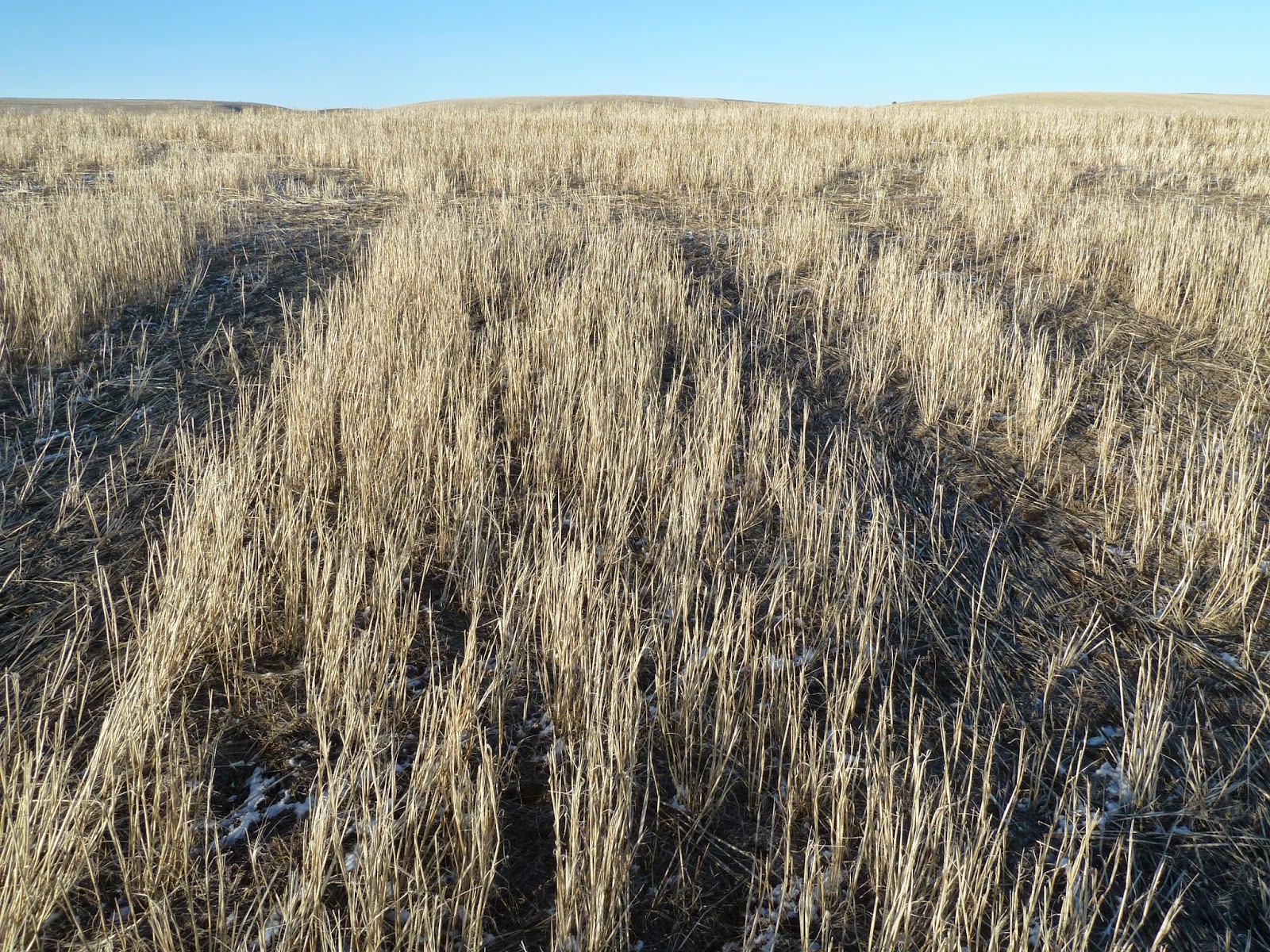
The pic above was taken 12/3/14. It shows a thin layer of snow (≈1") where there is short stubble in the fore ground and the far background. The middle area has stripper headed spring barley stubble (≈18"tall). There is little or no snow left on the ground surface under the taller stubble.
The pic shows a sample of the middle area in the pic above of the stripper headed barley. There is very little snow left on the ground surface compared to an area a few feet to the left that had the stubble cut at near ground level. Is this good or bad? Is the tall stubble moderating the soil temperature? Even the blackened (cultivated) fields show more snow retention than the pic above. I would say that the ground surface shown is warmer than those surfaces of the short stubble, flat residue, or no residue covered fields. Within this post you can find a contradiction and I can't explain why with more than a guess.
Subscribe to:
Posts (Atom)