Monday, March 2, 2020
TILLAGE vs NO TILLAGE
We have recently taken on some land with conventional fallow to seed this fall. We have not dealt with conventional fallow for 25 years, and are no longer equipped for that condition. This field has well over a 100 year history of tillage. In our area, do to the geological history, that includes the Great Missoula Floods, most fields have several soil types. [ Missoula Floods is a 3:50 minute animated video showing some history of our Palouse Hill landscape. ] By the time fall seeding takes place, a cultivated field has had several tillage operations, and it's usual to have areas that powder and flow down slope in front of an implement. It's hard to hold seed at the desired depth in that situation. The pic shows a raindrop impacting bare soil. When rain falls, soils on cultivated fields tend to seal up due to poor structure left by impacting raindrops and tillage. With these conditions, the most successful tillage systems I have observed, are those that reduce the number of tillage passes to reduce aggravating powder development, and for the last pass prior to seeding, use a spiral packer to firm up the ground for the drill opener gauge wheel.
A decision had to be made on how to get this cultivated fallow field seeded. Rather then take the time to round up equipment to prepare this field for conventional seeding practice, Kye decided to take his chances with our heavy no-till CrossSlot drill, follow it with a tine harrow, and hope for the best, --expecting to do some reseeding later. Conditions allowed the crop to emerge and reseeding was unnecessary. Sometimes it's better to be lucky than good.
Some fields, or areas within fields, may require 3-5 years of no tillage to stop the seal over effect of the soil left from years of intense cultivation. We hope with our no-till experience, we can shorten that time frame without giving our landlord a hemorrhage.
When we started no-tilling there were problems that needed to be worked out. In our early no-till years there was no path for success developed through many years of experience, as there was with the conventional tillage system. That is behind us now, and transition can be shortened by years.
Now, --what do I see as significant between the two systems (tillage - no tillage) that exist side by side sharing a 3/4 mile long border, in our Palouse Hills region. We have had only a few months to deal with the cultivated ground but a few things have stood out.
---The no-till fallow ground is firm with good armor and operations create little or no dust. There was no dust coming off the field during windy conditions.
---The tilled fallow ground has deep (2-4") soft dirt with no armor and it was very dusty from any operation performed. The exposed surface did produce dust from wind when it blew before the surface sealed.
---This mild winter, allowed us to walk all over our no-tilled field without sinking. With care, I seldom got mud up the side of my boots. That was not the case with the tilled/winter wheat field. Walking in that field always left your boots a mess and you left deep tracks where you walked.
---The no-till fallow/winter wheat ground did not seal the surface when rainfall occurs.
---The tilled fallow/winter wheat ground sealed over immediately from light rainfall. Fortunately most of the winter wheat had emerged by the time measurable rain events arrived, and what wasn't emerged, was very shallow and able to push through the thin weak crust that formed on the soil surface.
---In early February, when scouting the fields, as I walked down our steep (20-40% slopes), there was no noticeable increased squishiness in the no-till fields. Our no-till fields have a very high infiltration rate and no tillage pan to restrict water movement through the upper profile. There was noticeable squishiness as I progressed down the slope in the conventional fallow/winter wheat field. This condition is when water moves slowly under the surface, on or near the restricting tillage transition zone from high to low elevations. Surface erosion was expected, but did not show in the conventional tilled field.
There is much that I could say to support no-tilling over tillage; however, this post is to utilize the rare opportunity to compare side by side effects between no tillage and tillage as we experienced them.
Climate & Water Vapor
Throughout this past year there has been numerous reports of rainfall in excessive amounts in many different locations throughout the US. It seems like reports have come in from everywhere except the Inland Northwest, --us. In October there were reports of flooding along the Snoqualmie river in western Washington. Now it is no surprise to hear that the Snoqualmie floods. That's an annual spring event when the snow pack starts melting off the western slopes of the Cascade Mts, --but in October!!!(???), that's most unusual. Last fall I read where there were 10's of thousands acres of farmland flooded along the Missouri River this past year and that currently there are thirty thousand acres of farmland still under water and expected to stay underwater until April when the 2020 flood season normally starts. In recent years I have been watching/listening to reports of heavy rainfalls throughout the US. They use to be associated with thunder storms on the Great Plains and the areas around the southeast and the gulf hit with the occasional hurricane. Not any more. Heavy rainfall events are now being reported west of the Rockies with southern California receiving heavy rainfall events as well as along the Oregon coast and now maybe the Washington coast. West of the Cascade Mts., particularly Seattle (the Emerald City) is noted for it's rainy weather, and of coarse, the Olympic Rainforest is a historical feature of Washington, so rain is not a new phenomenon; however, the amounts and in the time received may be changing. I can't even imagine the damage to our farmland should we start receiving rains that measure in the inches per hour. These thoughts play a part for the passion I have to armor our fields and increase moisture infiltration. How long will it be before we have to endure one of these high volume rain events? There was a time that I thought our location between the Rocky and Cascade mountains would shield us from any devastating weather event, but, I'm not so sure any more.
Atmospheric rivers (of water) seem to be more prevalent around the globe. We mostly hear about what is going on in the US, but other places are getting similar weather events. In one of her presentations, Dr. Christine Jones, makes reference to the excessive atmospheric moisture, and questions why more attention is not given to that greenhouse pollutant. I did a quick google search of atmospheric pollutants and found that neither CO2 or moisture was listed as a pollutant. There are caveats, to these and other elements, depending on the authors specific mindset. The media gives us the impression that the debate is over, but what I see in the weeds, is that the debate is anything but over. There is a lot more than CO2 involved with our climate and we don't understand what that is.
Tuesday, October 15, 2019
TOO TOUGH TO SEED --(??)
What a disappointment to have this outfit on our property. The only thing good about this is that they came quickly and sucked up acres fast with three swathers and four balers. They wanted this long (stripper headed) straw. When the main field was baled, they estimated 3000#/a. We are getting $10/t, but that's about a third to a half of the value of the nutrients that we are losing through this removal process, plus the loss of carbon from the removed residue. We will have to put up with stacks of bales for 90 days while they age and ready for the mushroom industry. A constant reminder of failure.
This was an extra ordinary year in many aspects. Generally, this year, the spring crops were good to excellent for potential. The late spring start ended up with a late harvest for many operators. Even though most everyone has crop insurance, this is not going to be a good year for those that still have crop to harvest (now it is moving into the latter half of October). There are thousands of acres of garbs, spring wheat, and even some winter wheat still in the field. In my 65 years of being in the field I don't remember ever seeing harvest in this area this late. Our spring wheat crop averaged ~65b/a, with a range of 40-130b/a across the fields. Even the heavy high yielding areas, as pictured here, only produced ~ 4k#/a residue, which is nothing compared to the 20k#+/a that we had successfully drilled with the CrossSlot, the spring of 2014. We never expected to have any trouble drilling into this residue, but after several fitful days of adjustment, and even putting all new coulters on the drill, we admitted defeat and looked at alternatives, --either bale or fire. We chose bale, as the lessor of two evils. Fire, although the ground and surface residue was damp, may have caused more damage by burning into the soil where partially decayed residue resided. Cultivation was never considered due to it's lasting destructive effect on soil health. We are too far along the path to a healthy soil to revert back to that destructive practice.
WHY ARE WE HAVING THIS TROUBLE? We were convinced the CrossSlot was a foolproof drill capable of drilling any field condition where crops are grown without any field preparation? One caveat we knew was that the residue needed to be dry so the notched coulter could cut at least most of the residue it encountered. This residue appeared dry, but it was tough. My serrated clipper struggled cutting the residue at ground level, and you could ring a shock of stubble in your hands and not break it apart. Our rational then became, --we had never drilled into spring or winter wheat stubble that had not first gone through a winter, hence, some decomposition had taken place prior to any attempt to seed into the residue.
THEN CAME ANOTHER SURPRISE! The pic above is part of a 3ac, three cornered patch that was not baled. This was one of our higher yielding areas. The day after the remainder of the field was swathed and baled, Kye was able to drill this patch without any issues,--WHY??? The simple answer is: --The residue became cut-able! Time had given us enough dry days to lower humidity to the point the residue could be broke apart.
Well, we lost this years residue on these fields but it is worth the knowledge gained, being,--one, we don't necessarily have to wait for wheat stubble to deteriorate by going through a winter, and, two, it was once again shown that the CrossSlot needs dry residue to be successful.
What a whiplash this past week has been, --going from no expectation of trouble, to a revelation that we can't seed this field, and back to OK, it's seeding just fine.
Friday, September 20, 2019
MAN and CLIMATE
I have been skeptical about man being able to influence the climate, but I have become a believer. Increasing atmospheric CO2 and NO3 levels are just a part of what I see as being influenced by man. Desertification appears to me to be a bigger problem, and we, in the worldwide agricultural community, are a major part of the problem, -- along with the spatial needs generated by 7.9 billion people. (In my lifetime world population has more than tripled from 2.2b)
The earth's climate is dynamic, changing continually. Natural cycles resulting from the earth's tilt, relationship to other planets, their orbits, and earth's position to the all important sun and our moon, have powerful influence on the earth's climate. Thirty years of lecturing by Dr. Art Douglas has left no doubt in my mind on the importance of these cycles.
Our use of fossil fuels probably is contributing to CO2 buildup that so many are claiming to be the major cause of climate change. It's the goto energy source for 7.9b people with an infrastructure that gradually developed over more than a 100 years, and we probably ought to change, --but to what? I hope I'm wrong but it seems that we have taken a hiatus on working out the problems with fusion reaction, and fission waste disposal is a nasty issue. I view wind power as nothing more than a scam, a money pit that has fleeced the public. It is horribly inefficient, extremely high maintenance, and a low life expectancy (It was recently reported that 20yrs is current expectation, down from the original 50yrs), and the eventual removal of these dinosaurs will be equally expensive as when they were installed. Solar Energy holds a lot of potential. It is something that can be built into building construction, and not rely total on huge solar farms. There is also geothermal, wave action, hydrogen fuel cell technology that can be improved and brought into the mix, and, who knows what new technologies the future will hold.
Recently, all the information I access that relates to soil health makes reference to "taking cues from nature in developing farming practices", or "work with nature, not against it". In my striving to learn about soil health I ran across a presentation that was intriguing. It gave a pretty impressive picture and narrative on global desertification and it's implication. DESERTIFICATION by Allen Savory. The pic in this post is from that presentation. Notice the light colored areas contrasted with the green areas. The light colored areas are associated with "desertification". The more I watch this video the more connected I become with the message. The reasoning behind our operations move to a ULD farming system is incorporated in Allen Savory's message, but he goes farther. Being a grain producer, I'm resisting the introduction of livestock into our operation; however, I understand the reasoning, their potential, and it's possible they will show up on our operation sometime in the future.
My statement above, about agriculture worldwide being part of the problem stems from the fact that in any given year we leave a lot of ground in a nonproductive state that is radiating energy instead of capturing energy and converting it through photosynthesis to a crop. Our practice of fallowing is an example of a poor land management practice. The global increase of wild fires, along with the ever increasing number of people and their related spacial needs, are factors that influence desertification. These man caused influences are gradually changing air currents related to high and low air cells across the globe, concentrating energy. This concentrated energy is effecting the strength and location of storms. Each of us, with our relatively small farming operation think that we are insignificant, so, what we do will not have any effect on the climate. I'm beginning to realize that the mismanagement of our tiny amount of global resource combined with millions of other independent operations doing the same thing adds up to be a huge potential impact. We need to rethink our attitude on how we manage our land so as to make a positive contribution to sequestering carbon, and reducing practices that promote desertification!!
Monday, July 22, 2019
WHAT IS A SOIL AGGREGATE
This is a copy and paste posting from "Soil Matter, Get The Scoop" blog. It's informative and pretty complete on the subject of soil aggregates, their value to us in the farming game, and suggested management for developing and maintaining these aggregates. This post starts out with the question of what are soil aggregates, and the reply is by Nall I. Moonilall of Ohio State.
The ground beneath your feet might seem like a uniform material, but it’s really a mixture of soil particles, organic matter, and other mineral/organic components. For a soil to be healthy, it must have good structure. Soil is made up of a combination of primary particles - sand, silt and clay. These particles can be bound together into what soil scientists call “aggregates.”
![]()
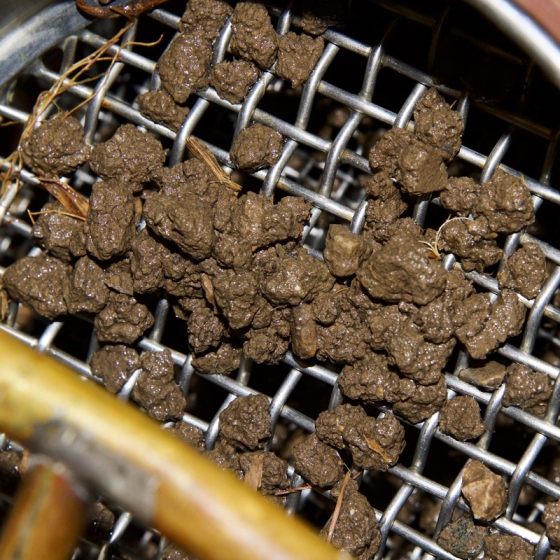
Soil aggregates retained on a 4.75 mm sieve after wet sieving experiment. Credit: Nall Moonilall
These aggregates are clumps of soil that range from the micro level (less than 0.25mm in diameter) to the macro level (greater than 0.25mm in diameter). Furthermore, they can resemble various shapes: granular, blocky, etc. These varied shapes allow for healthy soil to have pores spaces for air and water, needed for healthy plant growth.
Aggregate formation is a complex process. Soil aggregates are formed through physical, chemical and biological activity below ground. They are even influenced by human factors, like tilling, walking on the surface, or even how you fertilize your garden. Formation of aggregates begins with finer soil primary particles binding together. You may know that clay particles have a negative charge. And, the fertilizers you use include salts that have positively charged cations (things like potassium nitrate, etc.) The positively charged cations allow the negatively charged clay particles to bind together creating “floccules.” The type and amount of clay minerals in the soil often plays an influential role in aggregation formation.
![]()
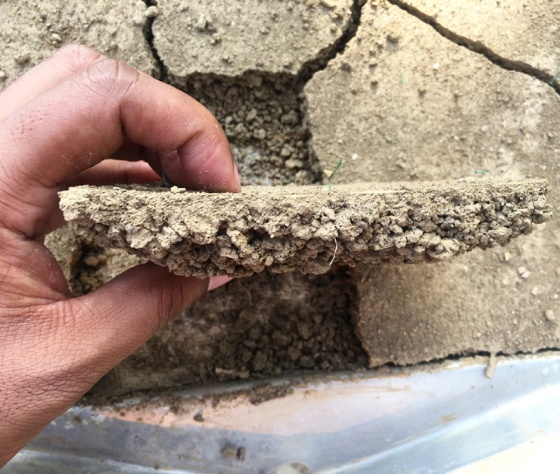
Soil crust formation on a soil exposed to simulated rainfall. You can see the crust formation on the surface of the soil as well as how deep the crust extends. (This really is soil - not cement!) Credit: Nall Moonilall
The second part of aggregate formation deals with cementation. Here, the clay floccules and other soil particles are bonded together by some type of cementing agent. (Here we mean "binding" - not cement like in concrete!) Examples of cementing agents include organic matter, and liming materials like calcium carbonate. Even types of oxides, like iron and aluminum can help cement particles together.
In the case of organic matter, it is broken down by the soil microorganisms and soil fauna (earthworms, etc.) When breakdown occurs, these organisms secrete organic compounds that are the “glue” that makes cementation occur. Plant roots also play a role in aggregate formation by secreting organic compounds called root exudates. These help bind soil together near the root zone. Fungal hyphae also contribute to aggregate formation by entangling and weaving around soil particles.
As you can see, aggregate formation is the result of many interactions and feedback loops occurring below ground.
Soil aggregates play a major role in soil structure formation and soil health. In agriculture, the stability of aggregates is critical to how well an agroecosystem will function. The pore spaces in soil influence air and water storage, and gaseous exchange. They create habitat for soil microorganisms, and allow for plant root development and penetration. They also assist in nutrient cycling and transport.
Soils that have high aggregate stability are less susceptible to erosion. They hold their shape when exposed to disruptive forces, like water, and do not easily break apart.
![]()
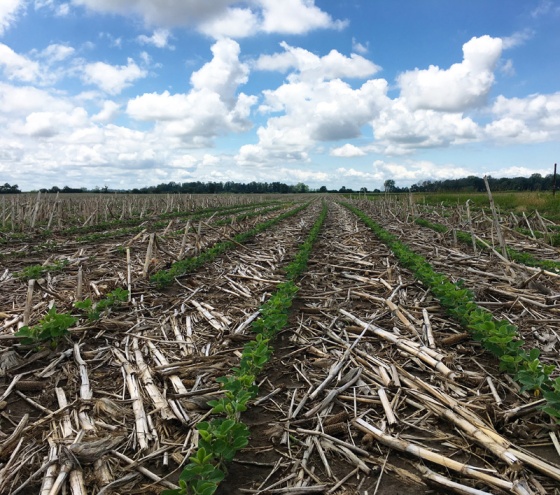
Keep soil covered! Crop residues on the soil surface help to protect soil from erosive forces. Credit: Nall Moonilall
Poorly aggregated soils disintegrate easily when exposed to erosive forces. They tend to breakdown faster, leading to soil degradation. Poor stability can lead to pore spaces being filled in and can ultimately result in the formation of soil crusts. This can lead to reduced infiltration and gaseous exchange. Poorly aggregated soils can reduce crop productivity.
Soil management often influences aggregate size, shape, and stability. Favorable practices that promote and maintain greater stability include:
To recap – soil aggregates are the building blocks that make up soil and their stability is extremely important in the long-term. Soils that are well aggregated exhibit greater soil health, ensure greater agronomic productivity, are less susceptible to soil erosion, and can play a role in carbon sequestration.
Answered by Nall I. Moonilall, Ohio State University
|
Friday, July 12, 2019
WHY EVERY PALOUSE FARMER SHOULD NO-TILL
There is a lot going on behind the scenes relating to these issues. As an example, I am part of a Washington State Department of Ecology advisory committee being used mostly as a sounding board for staff's evaluation of NRCS best management practices. The result of this is expected to be a manual for farmers to voluntarily use to reduce pollution of state waters. I see nothing good coming out of this for farmers or the environment unless it results in a massive education push to educate farmers on the value of improving soil health. Erosion from farm land is much too complicated to be resolved with a cookie cutter manual. Over the years I have discovered that farmers generally follow tradition more than science and change is verrrrrry sloooooow. Many farm operations are the same as in the day of their grandfathers except the equipment is newer, larger and faster.
So, why should farmers no-till? The simple answer is, --WE HAVE TO! Survival in the coming political climate will depend on it. No-till is not the answer in itself, but it is the base on which to build. Minimizing soil disturbance allows for management decisions that will build soil structure, build soil surface armor, build soil organic matter, build soil biology, and minimize soil displacement. Continued use of cultivation in our Palouse environment can not accomplish these needed changes. These are all critical to improving soil health and reducing environmental degradation derived from farm operations. No-till also holds potential for sinking carbon which is beneficial to the soil and atmosphere. Our soils are carbon deficient, and carbon is a driving force in the plant kingdom. No-tilling is a WIN-WIN proposition. The trick is learning to manage the no-till system to reap the benefits and avoid the pitfalls.
Minimizing soil disturbance through no-till allows management decisions that will reduce erosion too zero or near zero. As we gain a better understanding of soil biology we will control weed species and insect predation with less chemistry. As our understanding increases about how fungal networks transports information, nutrients, and water throughout the plant community, and how soil microbes extract nutrients and make them available to plants from organic matter, dirt and rocks, we will be able to manage our crops using ever lessening synthetic inputs. The more minimal the soil disturbance the better the environment for these natural processes to develop.
Many issues surrounding SOIL HEALTH are not well understood, but there is intense research going on by private and public institutions, and farmer experimentation since around 2000. I read/listen/look at a lot of material and find myself discounting information that is more than 3-5 years old. One researcher told me that if your education in soil biology was prior to 1985 it was mostly wrong. I'm long in the tooth, but find it exciting to be part of the process. The way things are progressing, I think I will be able to experience some of the fruits associated with improved soil health before I fade away. In fact, I'm already seeing some of this happening through farm test plots but it's going to be a while before the processes are understood well enough to apply field wide. Five years ago, if someone would have asked me when we would start seeing some positive results from improved soil health I would have said, maybe my children or grandchildren.
Monday, July 1, 2019
TAKING OUT CRP
This post is prompted from watching a disaster in transitioning a CRP field back to cropping. If you want to retain the soil benefits gained during the years in CRP, the takeout process is not simple. Timing for each operation, weather, CRP cultivars in the field, crop choice, and long term goal for the field are among the factors that need consideration. Cultivating the hell out of it and planting wheat as quickly as possible puts the field back nearly to conditions prior to CRP. I'm sure the initial interest of this farmer was to save the benefits that accumulated over the years of CRP by doing a no-till conversion. This property needed the CRP benefit. It contains 6 soil types, and has a lot of shallow depth soil and suffered from OM loss through many years of cultivation and associated erosion. The mistake in my opinion was wanting to seed a cash crop too quickly without sanitizing the field. It is a very common and strong emotional pull, --to get the field producing. The takeout process started with poor fall regrowth of CRP cultivars making it impossible to get good chemical uptake. The following spring the field was chemicaled and seeded to spring barley. Seeding a grass cash crop as the first crop into an unsanitized 10 year old grass field is not a good no-till practice. The second year crop was garbanzo beans. That was OK, it gave crop diversity, except CRP cultivars were still numerous, garbs are a high moisture user, and the moisture recharge was poor. The third crop is winter wheat that was seeded very late following extensive (but not whole field) discing to remove the worst of the CRP cultivars, in a moisture depleted field. The field is still contaminated in many areas with unwanted weedy cultivars growing with the sparse stand of winter wheat. The soil structure and other soil related benefits that were built up over the years in CRP has been severely damaged. People watching this field will come to one of two conclusions depending on their preconceived attitude, (1) that no-till does not work, or (2) this field was not properly prepared for no-till.
Successful long term no-tilling requires (1) patience, (2) field sanitation, (3) crop selection to fit the conditions and limitations you have at the moment, (4) crop diversity, (5) good timing for all field operations.
Since 2002 we have taken out 4 fields of CRP. Of the four, we got the last one right. That field was given the time for proper sanitation. Other than roughness, mainly do to rodent mounds built over the years, the field is in excellent shape, with normal CRP and weedy species gone. The 2" of worm castings that make up the surface layer of the soil, soil structure and most of the other benefits developed over the years of CRP are intact. The first crop, winter wheat, was planted following an extended period of chemical fallow (sanitation period). The field was seeded with the CrossSlot drill to winter wheat looked beautiful, it was clean, and had an excellent yield. We had a companion field converted at the same time, where we spring seeded a five cultivar cover crop instead of continuing with chemical fallow. The sanitation rule for successful no-tilling was not followed and we have weed and rodent issues on that field. The field yielded approximately 10bu/ac less, which in this case was still excellent at nearly 100 bu/ac. This takeout method had two problems. (1) --was a great environment for rodents with good food source and great housing and protection from predators. They harmed numerous areas during the winter that never recovered completely leaving the field looking ragged. (2) --a number of weedy cultivars grew with the crop and increased the seed bank. Other than the abundance of rattail fescue, I'm not overly concerned about the weedy cultivars. The worm castings and soil structure are still intact from the years in CRP, and we were able to keep living roots in the ground to feed the micro biology for most of the non crop time. The question is, --over time will the benefits from this cover crop outweigh the problems that remain.
[update: 9/23/19] We have found out the hard way that weeds, where it is necessary to use harsh chemicals like Tordon (Picloram), or Stinger (clopyralid), need to be removed during the time the field is in CRP. Harsh chemicals will likely limit the cultivars available for cash cropping because of plant back issues. One of these weeds is Rush Skeleton Weed. This weed has infested thousands of acres of pasture land and CRP fields. It becomes deep rooted. There are leaves only on the ground hugging rosette. While you can reduce seed production by burning off the branching tops, you will not control it by a burn down method. Cultivation breaks up the root system and increases the density and area of infestation. The key to control is timing of application so the plant will take some of the chemistry into the root, --notably in late fall after a frost. A number of chemistries will control new plants before they establish a root system. Good control of established plants will require repeated chemical applications.
Subscribe to:
Posts (Atom)