Friday, June 9, 2023

DWAYNE BECK - CROP DIVERSITY & INTENSITY

      THESE  SHOULD  BE  VIEWED  SEVERAL  TIMES  FOR  AN  UNDERSTANDING

Click on the URL for topics of  NEW AG!    ---->    D. BECK 55:34 Presentation

 No-Till Guru  (Dwayne Beck)  55:34min presentation at the 2019 National No-Till Conference is a great audio/video on making new agriculture practices profitable.  I brought this up from a December 2020 post.  Everything said in this presentation is current today, June, 2023, and more meaningful for some of us who are trying to follow the principles for successfully regenerating our soils and maintaining yields.  The first ~ 18 minutes are about South Dakota, and the Pierre Research Farm.

Click on URL for, "Cover Crop Estabishment and Grazing".  --->  D. BECK 48:08 Presentation  

        No-Till Guru (Dwayne Beck) 2017 presentation talks about Cover Crops and factors to consider when raising them like purpose, and cultivar selection.   Some repeated information in different words.  If I would have found this earlier, I would probably have done better, and be farther along with cover cropping.                                                                                


Thursday, June 8, 2023

6/6/23 WHEAT COLLEGE

    Mostly an interesting meet.  It would have been better if the venue (Palouse Empire Fair Grounds Community Bldg) had better acoustics-sound system for those of us with hearing issues.  Sound is slightly off, reverberating, making a lot of words indistinct.  
    --Ted Labun from Canada speaking on "successfully growing dryland wheat".  My main interest was his comments on canola, after his talk.  Points he made: --different hybrids with, some growing tall with narrow branching, and others growing shorter with wider branching.  The first he likes seeding in 7" rows, and the latter in 10-14" rows.  --he likes plants every 6-7" along row.  --where a clump of seed drops, only 1-2 seeds will germinate.  The others do nothing.  Spacing out seed allows for reduction in seeding rate.  Instead of 400,000spa, you can go down to 250,000spa.  --he likes the wheat-canola rotation.  --his pics showed a lot of residue (flat) on the ground.  --he likes a black slot where residue has been moved to the side for seed to emerge.  He could not tell me if there are issues with growing canola in tall standing stubble (possible light interference).  His talk indicated he was more familiar with minimum till practices, compared to no-till. 
    --Pic below:  Aaron Esser promoted his color coded crop/field chart with chemistry groups used by year.  
This is a great tool for quick one page visual reference of chemistry when endeavoring to reduce weed resistance.  The problem I see is that his colors don't show enough contrast for some crops he has assigned.  We should develop this for our operation.  He likes using Liberty Link canola instead of RR canola.  It is an opportunity to reduce one or more applications of glyphosate in the rotation. I think it is a given that most of us use too much glyphosate and should look for alternatives where possible.
    His studies show that cultivar genetics was a better tool for disease control than applying fungicides.  From my biological farming study, fungicides are particularly bad for beneficial soil fungi, so it's preferable to avoid them when improving soil health is a goal.
    A new management tool he unveiled today was charting by field weed species, ranking them by worst as they impact crop yield.  *This suggests that we should not try to kill every weed in the crop/field.  *Changing that mindset toward weed management programs will likely reduce chemical applications, reducing potential weed resistance, by targeting weeds that impact crop yield.
    --Rick Wesselman from Syngenta talked about plant roots.  Roots are the foundation for the plant.  Healthy root system makes for better yield.  Seed coatings are being developed that enhance root growth early in root development.  Our operation is looking into these type products.  This year we have applied biological material to all our seeding either by seed coat applications or in-row with the seed.
    --Rachel Wieme from WSU gave information and demonstration about soil pH and why it matters for crop production.  She showed how varied the pH is by taking readings along a 12" soil probe sample.
       Several people in the group remarked that they were introducing cultivation back into their no-till operations because of their finding soil stratification of nutrients and pH.  *From a soil health aspect this is going backwards.  In our environment, growing sufficient biomass to move the needle on soil health in a positive direction is difficult.  *No-till, in and of itself, is not sufficient.  *No-till dramatically reduces the loss of SOM, and corresponding, slows the rate of deteriorating the soils health.  *Cultivation in any form accelerates the loss of soil organic matter, surface biomass, and soil structure.  *Natures plowmen (worms) disappear with cultivation.  *They need food on the surface, and in the form of soil organic matter.  *Along with food, they need undisturbed ground for reproduction.  * Worms, both vertical borers and horizontal borers breakup soil stratification by moving material around in the soil profile.
    --A spokesman from Altitude Agri Services gave a talk, and demonstrated a T30 agriculture drone.  This is new technology to agriculture and there are a lot of questions.  He stated that a drone set up with two extra batteries, charger and generator) costs between $30-40 thousand dollars.  I didn't hear him talk about licensing.  We have been looking into this technology since January. 
  *The T40 (pictured here) became available in the fall of 2022.  Licensing for legally flying these heavy drones is a pretty straight forward process, but is time consuming and can be expensive depending on how you go about it.  *There are individuals and companies scrambling to set up training/licensing programs.

(*my thoughts interjected into the info. presented.)

Sunday, January 15, 2023

PURSANOVA - RO/S (part 2)

      The information here describes the equipment purchased, and our experience one year later.   Some of the following information will be familiar from the earlier post. 

      Why did we purchase the Pursanova system?  The short answer, --reading, listening, experience, and seeing the potential for taking a big step toward Regenerative Agriculture on the land we steward.   In February 2020, our bio group was introduced to the technology, and although outlandish, it intrigued me.  2020, I read a couple of books on water, and talked to growers back east who have used this equipment for a number of years.  Most of my contacts started out with just the (reverse osmosis) RO unit, but all gravitated to the Pursanova Disc's and Structure Tubes over time.  No one said they would quit using it.  No one could give me research data showing it's value.  Everyone had a lot of antidotal evidence supporting their use of the Pursanova water.  Most use the water year around on the farm and in the house.  Vatche' has some big fruit grower accounts, but they are secretive about it's use.   Our first experience using the Pursanova water technology, the fall of 2021, was good enough that we wanted to continue, but was concerned about getting the (Spokane Conservation District) SCD's unit when we needed it, so chose to purchase our own.  The "water structure" technology is separate from the RO equipment.  There are a lot of RO equipment outlets.  They each have their sales pitch, and it can be confusing.  We decided to stay with Vatche, and purchased his complete setup, except for the water softener equipment.  We chose a descaler by US Water Systems in place of the bulky water softening equipment.   The pic below is our unit mounted in an insulated 6x6x12' box trailer, consisting (ccw) of a 300gal supply tank, a Pursanova disc and bank of three big blue filters mounted on the wall, a 60g Pursanova water holding tank (not shown), the four tube RO unit, the 15gal tank holding the descaler mixture, an electrical panel, a recirculating pump, another Pursanova disc, and two Pursanova 40" structure tubes mounted on the trailer wall.  The RO unit is very sensitive, needing water immediately when called for.   A float controlled supply tank is preferred over a direct connection to a hose bib.   There are a total of four large blue filters, each with a different function.  The users I contacted, stated that when leaving the unit idle for lengthy periods of time, they ran Pursanova water through the system and left it full.  They found leaving the unit idle with the treated water lengthened the life of the RO membranes.  Our unit requires ≥10gpm water supply and 220V electrical service.  This size unit produces ~4-5gpm of Pursanova water and wastes ~3-4gpm for a daily total of around 5500-7000 gal/day of treated water.  The RO unit has a water recycling capability that brings the efficiency up to about 65-75%, to lower waste, but we found the feature quickly fouled the RO membranes.  Sufficient supply of Pursanova water will probably require additional storage tanks.   Minimize Pursanova water contact with metal.  Store in plastic.  Stainless steel is not as bad as iron.  How long you can store "structured" water without providing some circulation is a moving number.  Two years ago we were told 2 weeks, then 2 months, and I recently heard that the "structure" could be maintained for 5 months, and maybe indefinitely.  Stay tuned!

                  2022 Experience: 
  2022 started out looking a lot like 2021, --short on moisture and the prospect of high summer temperatures over a lengthy time.  We knew we needed to cut costs in expectation of another year of disappointing yields.   In February, 2020, when our Bio group started looking into the Pursanova technology, we were warned to reduce our chemistry rate 35% to avoid damage to the crop.  That seemed a bit far fetched at the time.  However, our experience in the fall of 2021 with reduced rates of glyphosate was encouraging.   All of our 2022 applications of chemical or fertilizer, had Pursanova water used as the carrier.  The McGregor Company is our main supplier of crop inputs, and we pay them for agronomy services.  In 2022, for most chemical applications, we took McGregor's recommendation, and cut it in half.   We were gambling that our fields were clean enough that we could survive one year if the concept proved wrong.  There were three exceptions;  (1)- Imazamox (Beyond) for goatgrass control in winter wheat.  We did a test area at half rate with Pursanova water, but the remainder of the field was at full label rate with well water (2)- Paraquat (Solera) application was used at the full label rate and 25gpa water, and (3)- Pyroxasulfone (Anthem Flex) soil application for grassy weed control in fall seeded winter wheat.   We intended, but didn't make any foliar applications, other than adding fertilizer to our normal spring chemical application.  Pursanova water was used for fertilizer dilution that went through the drill.  As the year progressed we tweeked the adjuvants used with the various chemistries.  Glyphosate was our main target chemistry, and Rattail Fescue was our main target weed.
        RESULTS:    We had no disasters, and no chemical messes from the Pursanova water.  Chemical efficacy  appeared as good, and I think better in most areas, with the half rate used in the crops.   With goat grass, imazamox has been a disappointment in the past, and was again, both, half rate using Pursanova water, and full rate with well water.  Paraquat was very good.  It took all the color out of volunteer canola quickly,  --much better than in the past with well water.  We messed up by not putting out a strip at half rate with half the water.  Rattail Fescue has become an issue on a couple of fields.  Rattail blew up on us this year.  We decided too use a new tactic, --applying multiple low rate applications in our fallow fields using Rt3@12oz & 10gpa along with one pound of granulated sugar/ac and 1oz/ac of McGregor's "conform" adjuvant.  The first application looked very good, except in the extremely dense patches where a scattering of sickly green areas remained after ~2wks.  This prompted a second application, --this looked really dead; except we could find a few tiny scattered pale green leaves in those dense patches, which prompted a third application in those areas.   We could find no hint of green following the third application.  We ended up with ~36oz/a of Rt3 over a ~8wk period, but the rattail appeared dead.  We will know by this coming fall, after harvest, how successful we were.  In the past we have used 20-32oz Rt3 with a full load of recommended adjuvants and 12-15gpa of well water, and only got to the "mostly dead looking phase".  With the Pursanova water, we have moved away from all adjuvant type chemistry and replaced them with one pound of white granulated sugar per acre and either one or two ounces per acre of "conform" depending on how droughty the weeds appear.  Conform is used primarily for drift control at 7-11oz/ac, but we are seeing it as an excellent spreader at 1-2oz/ac when using the Pursanova water.   For equipment, we are making our spray applications with Pentair's GuardianAir Twin jet nozzles, and like them very much.  Earlier, we were using TeeJet Turbo TwinJet nozzles.   Next year we are going to look at lower rates of application, --less than half the chemical rate and less than 10gpa total solution.  I see no reason to change the sugar-conform rates.  It's cheap and appears effective at this point in time.
       To keep this momentum, and maintain or increase the value of the Pursanova water, we will have to up our game of soil health and no-till practices: --reduced disturbance, soil cover, soil sanitation, crop rotation, diverse species, and keeping a living root in the ground longer.  Some of these we are currently doing, some we are not.  Assuming these gains are permanent and slacking off these principles could prove detrimental.
        CONCLUSION:        This has been a fantastic year for our operation.   Besides the good yields and reasonable commodity prices, we had a significant cost reduction of crop inputs.  We are seeing results that we never expected to see in my lifetime.  The Pursanova technology is, I think, another step to advance us down the road to yield parity with lower inputs, and improving soil health.  We have used the Pursanova water with all our fertilizer applications, but I don't have any commentary at this point in time.   From reading the books mentioned below, we gained a rudimentary understanding of some of the mechanism that may be allowing us to reduce chemistry.  The same forces will probably allow more efficient use of fertilizer, both foliar and root uptake.  I hope to address this in a year or two with some antidotal material to report.
    I don't understand WATER.   University of Washington professor Gerald Pollock's book and videos on "Exclusionary Zone (EZ) Water" is a great read and introduces one to the fact that there is more to water than meets the eye.  Yang OH and Gil Ho Kim's book the "Miracle Molecular Structure of Water" was a difficult read for me, but reenforces the fact that there is more to water than meets the eye.   Vatche' Keuftedjian's website  <www.pursanova.com > has a lot of interesting information (when you work your way through the sales portion of the website).
      I will conclude this post by stating that I am very pleased with the purchase of the Pursanova system.  It has been the best ROI (<8m) of any equipment I have purchased in my farming career. 


Wednesday, January 4, 2023

Pursanova -- RO/S Water


(This post is a year late in publishing.  Following soon will be another post with updated information on our experience with RO/S water in 2022)

     Reverse Osmosis-Structured water (RO-S)!  Is it a hoax?  Well, we are finally going to get a hands on experience to determine it's value, beyond just the printed material that's available.  It's taken about two years since the concept was originally discussed in our Bio Farming group, to reach the point where we are starting to use the water product on our operation.  The unit is designed to be set up at different operations where there is a water source (~10gpm)  and 240v, single phase, three wire electrical service.    Water enters the system through a garden hose, goes through a filter bank, a Pursanova disc, and into a 500gal holding tank which feeds the four tube reverse osmosis (RO) unit. Once the water passes through the RO unit, it passes through another Pursanova disc and through two Pursanova structure tubes, then the water proceeds to it's final destination tank.   The water being held in the destination tank can then recirculated back through the Pursanova disc and structure tubes until the treated water is used, or the unit is shut down.  The unit is ~50-60% efficient, meaning that 8-10gpm goes into the unit with 4-6g going into the storage tank and 3-5g is wasted to other purposes.  Early on we were told that we could recycle the waste for more efficiency but found that the RO membranes quickly fouled with the concentration of minerals we were removing from the water.  We are now adding a small dose of scale inhibitor to the RO unit for the purpose of extending the life of the membranes.   We were instructed to clean our equipment and holding tanks by filling them with the RO structured water and storing for 24 hours, then draining them out to remove the built up deposits, --then refill for use.  The unit has safety/float switches, so, once running it will shutoff/turn-on as water is used from the supply and holding tanks so you don't have to sit with the unit while processing.  Our net production is about 5gpm, giving ~7200g of processed water in a 24hr period.  We have been told that this processed water will hold it's "structure" for about two weeks without any circulation.  Beyond that time some small water movement should be incorporated to hold the "structure"in the destination tank.  

     Why are we even considering using this RO/S equipment.  There is ~$50K in this unit, and annual maintenance will ≥$1K.  What is the payback?  In our case we have hard water ranging 136-207mg/l, with a 7.5-8.0pH depending on which well we use.  This hardness is termed moderate to high, and the high pH can compound the problem of chemical efficacy.  The literature includes enticements of more effective weed control from half to two thirds the chemistry, along with better crop response from foliar applications.  If results even come close to the reported savings, the return on investment will be a year or less for us.  I haven't had that kind of ROI since we purchased our Raven AccuBoom system for the sprayer back in the 1990's.

    We are just starting to get too know the system.  The equipment is cleaned and we are starting our fall spraying operation under some very bad conditions of excessive heat 95-105ºF for ~ 30days, no rain for 60 days, and low humidity.  Our deep soil moisture is keeping the targeted plants growing but they are hardened off.   I have spent some time checking out our water quality, spray surfactants,  and AMS replacements, to determine the coverage we may expect.  A few things are showing some direction, (or maybe a change in direction).  

     Anateck Lab test on the RO/S sample showed non-detectable for Al, Fe, & Mg.  A low level of Ca remained.  I did not have the "hardness" test done, --a mistake!  I expect it would have been very low, but I don't have a number for comparison.

    I have a HACH Test Kit for fish farming that I use on rare occasions to check our pond water.  I found it useful for this project to get numbers for pH, and hardness.  Elements that are important for fish health were not of interest to me for this project.

     The question that does interest me though is RO/S relationship to surfactants and other additives we use to make our chemistry work.  We put a lot of money into these additives.  I mixed up various rates of M90 (surfactant) and Downrigger (a AMS replacement-plus), in well water (WW), RO/S, and RO water to see if there was a difference.  The pic to the left shows from left to right, WW, RO/S, and a light rate of Downrigger in RO/S, and a light rate of M90 in RO/S.  Enlarge this pic and you will see that the surface tension on the WW (left) is greatest and the M90-RO/S (right) has the least.  What I don't understand, is that 8oz/100g mix showed less surface tension than 32oz/100gal of M90.  I did that test 3 times with the same result.  That's weird to me.

     The pic to the left show results 20+ minutes after droplets were deposited.  Until I was doing this narrative I didn't recognize the discrepancy in labeling in the pic.  All SW should have RO attached, and Outrigger should be Downrigger.  I find the slide on the right side interesting as relates to spread and drying.  At this point, this is the only instance where I have seen a difference between RO and RO/S water.  This pic is 20min after the droplets were deposited and it shows that the M90 at 2pt/100g dried similar to M90 at 8oz/100g mix.  High magnification does show a little difference. 


Monday, December 26, 2022

Soil Microbial Life -- Human Life


     My first exposure to Dr. Elaine Ingham in 2015 was an epic event for me.  For several years I had listened to Dr. Ann Kennedy of WSU about soil microbes and how they benefit plants, but never had I ever heard that plants communicate!   Unbelievable was my first reaction.  Fascination soon followed.  The more I learn about this subject the more I see an analogy of soil microbial life to human life .  The life humans experience today is dependent on our social interactions, manufacturing, communication and transportation capabilities.  It's the same with plants, both in-species and between species.  My following statements are gross over simplifications, but the concept is correct.   Each plant competes for space, nutrients, and water.   Some plants communicate danger to the in-species community.  An example, would be an insect biting into a leaf of a specific plant.   That plant reacts instantly to this attack, sending out a pheromone that wafts through the air.  Other "like" plants receive this signal and instantly start producing a chemical protectant to discourage predation either through odor or taste.  Another example would be a plant needing a nutrient.  If the plant supports mycorrhiza fungal networks, and most do, the plant sends notice through the network that it needs a particular atom.  The mycorrhiza network will provide and exchange that atom for a carbon atom from the plant.  This was absolutely mind blowing to me a few years back.

    Comparing human experience to plant experience:        IMAGINE, ----> how well You would thrive, if your house, along with the roads that connected you to your community and businesses were regularly destroyed.  I think you would be quickly reduced to survival mode, with little ability to produce.  We most likely would rely on a lot more government handouts.         DESTRUCTION  is what we have done, and continue doing to our soil, regularly with cultivation, by applying crop protecting chemistry, and applying fertilizer.  Depending on how aggressively we till, or apply our poisons, determines the extent of the destruction we do to our plant's supporting microbial community, communication, and transportation systems year after year.  

MORE DETAIL ON DESTRUCTION:      First of all, there is a natural fire that consumes soil organic matter through normal microbial activity, resulting in a slow leakage of carbon (CO2) into the atmosphere.           Tillage is a fire accelerator, (mixing oxygen, fuel and moisture together).  Every tillage operation over the field stokes that fire by accelerating microbial activity.  WSU did an extensive study of this in the 1970's starting with the prime tillage operation (plow, disc, chisel), than the cultivator, weeder and finally a harrowing operation.  The amount of carbon emitted into the atmosphere depended of the aggressiveness of the tillage, moisture in the tilled zone, and the temperature in the tilled zone.   The result of tilling is similar to our burning fossil fuels (coal, gasoline, diesel, natural gas).       HERBICIDE applications add salts, many are chelators that tie-up specific nutrient atoms, and all react negatively with soil biology.          INSECTICIDES AND FUNGICIDES , obvious by the names, while effective on their target species,  negatively effect beneficial soil biology.  There are few pathogens compared to the number of beneficial species.           Industrial agriculture has done a good job of marketing their products, and farmers have been complicit in the development of them through their eagerness to purchase.   At the end of  WWII, around 1945,  Industry needed new markets for products originally developed for the war.  It was found that some products could be used for fertilizing plants and others would kill unwanted vegetation, insects, etc.   Industry's marketing strategy quickly convinced farmers that products in a  "jug" was easier to use than the old methods of using plant cultivars for fertility, weed and bug control.  This has resulted in the deteriorated state of our soil.   After 75 years, this destruction of natural soil productivity is being recognized and a new concept of  "REGENERATIVE AGRICULTURE"  is being developed to recover this lost soil capability.  That journey if for another post.

Tuesday, February 15, 2022

FULVIC vs HUMIC ACID

In our Biological Farming Group there has been a lot of references to Humic, Fulvic, and Folic acids for plant growth.  There is a lot of information online, and it gets very confusing.  Below I am providing a sample and possibly a summary of the past three years of meetings and internet searches boiled down to what basics I want to keep in mind about Fulvic, Humic and Folic Acids.

Below, --two image inserts giving information, are from Earthgreen Products.  A good synopsis of the organic acids.  More information can be obtained at < Fulvic / Humic >, and are a source for "humin" products.  Folic Acid is used for plant nutrition, but normally referred as a source of vitamin B in human health discussions.  The bottom image insert on Folic Acid is from ResearchGate. < Folic Acid / Grain >.

VERY short summary:   ---Both acids are essential for plant health.  ---All three organic acids are useful and show success in many plant growing environments.  ---Fulvics are soluble at all pH levels.  ---Humics are only soluble in alkaline solutions.  ---As stand alone products, Humics have a large molecule and are best used for soil application.  ---Fulvic has a small molecule that enters plant tissue more easily and is best used as a foliar.   ---Best performance however is with a combination of Fulvic / Humic.   ---Humic increases the permeability of cell walls, making it easier for fulvics to carry nutrients into the plant.   ---While Fulvic is the carrier for nutrients, humics make nutrients more available in the soil.   ---They also work in tandem to increase water holding capacity and stimulate root and shoot growth.  

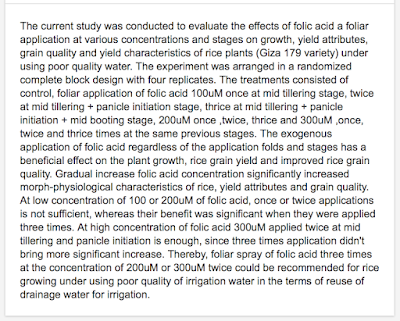
---Folic is generally used as a foliar.  Foliar applications at several specific stages of growth showed significant plant and grain benefit; however, applications at one or two stages of growth didn't make much difference.


There are several studies at ResearchGate about Folic Acid.  I chose this one because of being done on a grain.


Friday, December 24, 2021

GROUND TEMPERATURE --Cultivated vs Uncultivated ground

 I'm redoing a study I did back in 2015-2016 on temperature differences in different ground conditions.  Those earlier findings can be seen by clicking on "tests" in the labels section and scrolling to the bottom to "HOBO Temperature Sensors" posting.

This current study is starting on 12/24/21 in near freezing, snowing conditions. Temperature readings will be taken every 2hrs until we start seeding the spring crop in spring of 2022, around April.  There will be an update to this posting after seeding.  I started this study by spading and working up two areas to replicate a cultivated field with little surface residue.  I'm comparing this with field conditions where there is surface residue left undisturbed.  All the sites are within throwing distances of one another, one in long term CRP ground and the other in ultra low disturbed no-till crop ground.  We have had some variable weather ranging from freezing to thawing, and mixtures of rain and snow for the past week.  The field aspects are similar from one site to the other.  One difference showed immediately.  The worked CRP field had no sign of frost(pic upper left showing a lot of living roots), where the cropped field showed frozen soil about an inch deep (pic lower left showing some non-living roots).
These observed conditions support the idea that there is more biological activity in the CRP field where the grass roots are living, hence a warmer microclimate in the root zone, compared the the cropped field where there has not been living roots to stimulate biological activity for five months.  Biological activity creates heat.
    HOBO temperature/light sensors (model UA-002-08) will be placed on the surface and at the 2" depth in the cropland sites.  This is my primary interest, to see if there is a temperature difference between cultivated and uncultivated ground, both surface and subsurface locations.  The inclusion of CRP ground is to see how ground temperatures differ between cropped ground with it's limited time supporting living roots, and ground that continuously supports living roots. 
     Once put in place, these sensors will stay until recovery in early spring.  They don't support remote monitoring or downloading. 

The pic to the left shows a typical plot from the data collected with the HOBO (UA-002-08) sensor for temperature and light. A (HOBO) sensor and the "reader" is shown above the wireless keyboard and trackpad.