Showing posts with label weather. Show all posts

Monday, March 2, 2020

EFFECTS OF FIRE ON SOIL HEALTH


     Fire has always been controversial.  In the past I have used it, and may, in a rare circumstance use it again.   With the equipment we have available to us now, fire is an outdated, archaic practice.
     It has been obvious to me for many years that fire was destructive to soil health.  Denuding a field by any means, negatively impacts soil.  Fire not only removes the litter that, at some point in time will become part of the organic component of the soil, but it also burns some of the SOM already present.  The soil, losing its cover, is exposed to the natural elements and become warmer in the summer and colder in the winter.  Bare soil effects natural processes, some associated with temperature extremes, that impact moisture available to the soil as well as moisture in the soil.  This in turn effects the soil biota, that effects nutrient cycling, which has an effect on raising crops.  This is not linear as the statement may insinuate, but is a complex interrelationship of many elements.  We are slowing gaining the understanding that processes resulting from less tillage, and more cover is basic to improving soil health.


Wednesday, May 22, 2019

CLIMATE

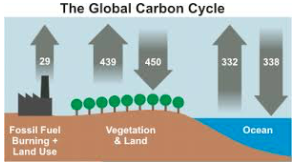
     This post is a bit off of my normal beat, but weather and how we understand it has a direct bearing on how we farm, now and in the future.   The pic shows a comparison with vegetation and land being a net carbon sink.  Agriculture has the capability to dramatically increasing carbon in the soil.   I ran into these videos featuring:
David Icke on climate change - hoax (17:38), David Icke is, along with other professions, a professional conspiracy theorist.  He comments on many issues around this juggernaut, "climate change", where I have reservations.   This is a very controversial subject with the two sides being well entrenched.  We are hammered, daily about our dependency on fossil fuels and being the cause of global climate change.  This video led me to:
Climate Change Fact/Fiction? (47:32), by Atmospheric Physicist, Richard Lindzen at MIT.  Richard Lindzen has been researching and writing opinions on climate change since 1961.  Lindzen is a very low key presenter.  In this forum he talks about temperatures, sea levels, CO2 emissions, the climate data, activists, political response.  He doesn't see anything to be alarmed about.
"Climategate"(4:59), featuring Richard A Muller, Professor of Physics at University of California at Berkeley.  This short presentation talks about climate data that a team of researchers falsified to stay in line with expectations.  Another presentation I found interesting is one by Steven F. Hayward given in 2014. 
A Funny Thing.....Climate Change (1:01:56)  Hayward is a scholar at the Institute of Governmental Studies at UC Berkeley.  He gives some background on how this phenomena developed into the political animal of today.   One other presentation that I will list here is:
How To Green the Worlds Deserts (22:19), by a researcher of Biological Science, Allan Savory.  This presentation explains that increasing desertification is playing a big part in warming the earth and causing Climate Change.  Savory's presentation lines up well with information that I have been gathering for years, and is part of my interest in replacing chemical fallow or cultivated fallow with green fallow (cover crop).
        Currently, my position is:
---I believe in "climate change".  Our world is dynamic.  Climate is continuously transitioning.
---I do believe that humans have some influence on climate.   I believe that normal farming practices of yesterday and today are a negative influence.  Tillage, with every pass, releases CO2 and moisture to the atmosphere.  This has been known for 40+ years, but early on it wasn't associated with climate change.  Human activity is denuding the earth of plant material ranging from the destruction of tropical forests to us leaving land fallow.  When vegetation is removed, the buffer is removed, so the earth warms.  Add to this, population growth and associated expansion of urban areas and the infrastructure supporting that expansion.  Allan Savory has a compelling story of concern, action and results from different land management practices.
---I do believe there are groups/organizations that influence societies behavior.   I remember a quote by Senator Lyndon Johnson (before he became President Johnson), --"in politics there are no accidents.  If something happens it is because someone wanted it to happen."  Johnson was a very powerful, and manipulative Senator at the time.   I don't remember the specific event that prompted this statement but it was my introduction to "power politics", and the ability to manage/manipulate public attitude.  So, I do see a purposeful, one sided agenda here.  The previous mentioned videos make mention of several underplayed factors.  Fossil fuels are only a part of the perceived problem and probably a minor part.   My post of March 17, 20017 titled CLIMATE CHANGE goes into much more detail on cycles and phenomena effecting the earth's climate where we have no control.  Climate activists discount these cycles and events as insignificant.  I think they don't fit the agenda.


Friday, March 17, 2017

CLIMATE CHANGE

     This is the climate portion of the PNW weather prediction given at the Spokane Farm Forum and Ag Show last February featuring Dr. Art Douglas.
     In preparation for this post I found that I needed to bolster my vocabulary and knowledge about the Milankovitch Cycle. < Milankovitch Cycle >  It's one thing to listen and get the drift of what Douglas is saying, and it's something else to restate the information without attaching a 20min recording of the presentation, --so I'm not going to try!
      I do have a better understanding of why the media doesn't report this phenomena.  It's complex with a lot of interaction and timing of various facets, and, although there is a great body of data that backs up the Milankovitch Cycle, there are two phenomena that it doesn't adequately explain so it's still considered a theory.  Hence, the only thing the media can get their teeth into, and the public can understand, is all the CO2 we are dumping into our atmosphere through burning of fossil fuels.  We are bombarded with this "fact" daily.   It's the "chicken little" syndrome that won't go away anytime soon.  My thought is that fossil fuels will be the worlds principal fuel until it becomes scarce, because of economics and infrastructure world wide.  The money that was/is being spent on inefficient wind monstrosities should have been directed to advances in scrubbing and sequestering end material from burning fossil fuel.  Unlike wind, the money spent on solar technology appears to be a good investment, with efficiency and new technology being announced on nearly a monthly basis.

    [IN SUMMARY]  What I got out of this presentation is:  Human activity is contributing to our warming planet; however, it's insignificant compared to the effects of energy supplied by "Sun Spot Activity", and factors associated with the Milankovitch Cycle.  The data is starting to show a change. Is this change a flattening out, or a move to a down trend in temperature?  It may take a decade or two for that to become clear.  [My thought] --in the short term, (40-50yr), the planet will continue to warm, with some rise in ocean levels.  This is going to be devastating for population around the world living at sea level, and will effect food production.  This will, in itself, cause a lot of political unrest.  In the media there is a lot of handwringing and support for solutions based on chasing symptoms instead of solutions based on projected outcome, --moving populations and developing water storage for instance.  GMO technology will likely keep food production ahead of our shrinking productive land base.

 [ CLIMATE CHANGE PRESENTATION ]: Dr. Art Douglas has a Master's, in SST (sea surface temperature).  Three quarters of the earth is covered by water, hence, the oceans drive our weather.  Temperature change creates ocean currents and how they act.  This in turn moves temperature differentials around the globe effecting air temperature, and rainfall and whether CO2 is released or absorbed.  The oceans are the largest source, and sink, for CO2.  A little change in ocean temperatures makes a huge difference in Atmospheric CO2.   Since a significant part of his talk this year centered around climate change I have been waiting to see what would be written in the local papers.  So far, I haven't seen a word printed on the subject.  Douglas' statement at the beginning of his presentation was "he hoped we were at the end of politicizing the changing climate".  (I don't see that happening.)
      I'll go over a few points that he made and include pic's of some of his slide presentation.
      He started with three antidotal topics to set the stage.  I found these fascinating, but way to detailed to regurgitate here.  This is a snippet of his presentation.   IN SUMMARY, THERE ARE A LOT OF PROBLEMS WITH THE DATA.  Over time each innovation has resulted in the temperature being stepped up 1-3 degrees from the previous method.  These discrepancies are enough on their own to explain the temperature rise.  The following, three sources of change/discrepancy are discussed.
        In/around his yard, he has about an 80 foot elevation difference.  He put out three thermometers, top-middle-bottom, and found several degrees difference. I have noticed that as well.  In 30 feet elevation to the hill behind my house the temperature differential ranges from 1-3 degrees compared to the house.
        The SST gained a degree when data acquisition changed.  This data collection was mandated, starting in 1860.  At intervals mariners would toss a bucket into the ocean and then put a thermometer in it.  Between WWI & WWII, the mariners started taking the SST by induction.  This is where sea water was used to cool the ship propulsion system and they put a thermometer in the induction line to the engine.  That elevated temperature over the previous method by a degree.
        The NWS (national weather service) changed out their weather stations and went to electronic remote sensing.  I believe he mentioned that this was world wide in the early 2000's.  The old stations were read by humans and placed 4.5 feet above the ground.  The new stations are placed 20 feet above ground and remotely sent to the data collection facility.  I think Douglas mentioned that this created a change of about 3 degrees difference from the old readings.  When this change out was done, Douglas was able to acquire all of the thermometers from the Nebraska weather stations.  he did studies with these and found that there was a degree difference between the highest and lowest readings of these instruments.
       You get the picture, --world wide, there is a huge data base, taken by a lot of people taken over a long span of time with different methods employed.  To me this is a perfect scenario to start a cause and have data to back it up.
       Art Douglas is a strong advocate of the power of natural phenomena that originates with the sun and the orbits of planets, specifically earth and it's relationships with the sun and planets.  He does acknowledge that human activity plays a role.  Without saying so, he left me with the impression that human activity is a minor player in the drama of climate change.   The orbit of the earth around the sun changes shape over time.  These are cyclic.   The tilt of the earth changes over time and is also cyclic. 
This graph shows that the present time is the lowest temperature and CO2 levels for the last 300 million years of earths history.  We can't take comfort in that information because a level that can be devastating for us may not even show as a bump on this graph's time frame.  It does show how fragile our hold on existence may be.
 The Milankovitch Cycles consist of earths elliptical orbit around the sun  -- The earth's tilt as it circles the sun, which changes over time --The Precession is the wobble of the earth on it's axis.  At any moment in time, these three cycles, along with sunspots, interact and produce an effect on the earth.  These forces effect the earth in totality, as well as differences in points across the earth's surface from pole to pole.
Sun spots are flares of burning gas that extend great (and varying) distances from the surface of the sun.  On rare occasions, the energy from a flare reaching the earth is so intense that it interrupts communications and has shut down a power grid in the northeast US.   Intensity and frequency of sun spots effect our atmosphere and surface temperatures.
This graph displays what has happened over the past 400 years of Sunspot observations.
These models are predicting a cooling trend for the future.  One or two years ago, Dr. Douglas mentioned that data supporting the temperature trend line was starting to show a change.  Whether that was an indication of flattening out, or moving on to trend low, I can't say.
I struggle with this chart.  What I remember being associated with it is that the current data indicates that time has been lengthened out another 50K-100K years to the next major accumulation of ice.
Dr. Douglas' presentation was ended with this statement from a team of scientists in Denmark.


Monday, March 13, 2017

2017 Spring has Sprung

I declare spring has arrived March 12th 2017.  That is the date of this pic showing the ice melt on our pond.  The morning of the 11th the pond was wall to wall ice.  By evening of the 12th the pond was ice free, --my guide that spring has arrived.  Last Tuesday, March 7th, we were slipping and sliding, with several vehicles stuck on hills or slid into ditches from falling snow and sleet.  The 11th brought 20mph wind and 55 degree sunny weather.  On the 10th we had a winter scape, on the 12th it was spring.  We expect unstable weather for the next week.  At the earliest, I predict Monday April 3rd to get the sprayer, tractor and drill in the field.
      If the old adage holds, those who cultivate won't make any real progress until after Easter, April 16th.  Those of us that DS don't worry about ground conditions, other than being too wet.  One pass and your crop is in, is a whole lot different than making multiple passes to prepare ground for conventional drilling.  The better the soil structure to drain water deep into the soil profile,and the heavier the surface residue to support the machine weight, the sooner direct seeders can get into the field.

Friday, February 17, 2017

WEATHER FORECAST 2017

      Every year one of the highlights of the Farm Forum is to hear what Dr. Art Douglas has to say about the weather, local, national, world, and how that translates into agriculture production.  He always includes some statements on the climate and what drives our weather.  This year he went into more detail about climate change and the driving forces behind it, including human contribution.  I'll address his presentation on Climate Change in another post.  
       Dr. Art Douglas is an emeritus professor of meteorology in the Atmospheric Science Department at Creighton University, and has been part of Spokane Farm Forum since 1978, except for one year.  He is the Long-Range Weather Consultant to the Mexican Government, Cattlefax and ConAgra.
           Local Forecast:   Last year's forecast was "spot on" for our operation.  El Nino appears to be coming back.  For us in the PNW that means drying and warming trend.  It's predicted that spring and summer will be a little below average rainfall and a little above average temperatures.  Our WW should be fine.  No more arctic outbreaks are expected.  Spring crops may be iffy depending on location.  Getting WW for the 2018 crop seeded timely may be challenging do to low rainfall conditions this summer and fall.  I think we will be seeding early.
           These are the conditions that we have planned for with our ULD-DS system.  Gather, and hold every drop of rain possible, using heavy ground cover,  tall residue, and minimal ground disturbance.
           It sounded like the only places in the world that may have stressed crops for 2017 will be Australia and possibly spring crops in the PNW.