Friday, March 17, 2017

CLIMATE CHANGE

     This is the climate portion of the PNW weather prediction given at the Spokane Farm Forum and Ag Show last February featuring Dr. Art Douglas.
     In preparation for this post I found that I needed to bolster my vocabulary and knowledge about the Milankovitch Cycle. < Milankovitch Cycle >  It's one thing to listen and get the drift of what Douglas is saying, and it's something else to restate the information without attaching a 20min recording of the presentation, --so I'm not going to try!
      I do have a better understanding of why the media doesn't report this phenomena.  It's complex with a lot of interaction and timing of various facets, and, although there is a great body of data that backs up the Milankovitch Cycle, there are two phenomena that it doesn't adequately explain so it's still considered a theory.  Hence, the only thing the media can get their teeth into, and the public can understand, is all the CO2 we are dumping into our atmosphere through burning of fossil fuels.  We are bombarded with this "fact" daily.   It's the "chicken little" syndrome that won't go away anytime soon.  My thought is that fossil fuels will be the worlds principal fuel until it becomes scarce, because of economics and infrastructure world wide.  The money that was/is being spent on inefficient wind monstrosities should have been directed to advances in scrubbing and sequestering end material from burning fossil fuel.  Unlike wind, the money spent on solar technology appears to be a good investment, with efficiency and new technology being announced on nearly a monthly basis.

    [IN SUMMARY]  What I got out of this presentation is:  Human activity is contributing to our warming planet; however, it's insignificant compared to the effects of energy supplied by "Sun Spot Activity", and factors associated with the Milankovitch Cycle.  The data is starting to show a change. Is this change a flattening out, or a move to a down trend in temperature?  It may take a decade or two for that to become clear.  [My thought] --in the short term, (40-50yr), the planet will continue to warm, with some rise in ocean levels.  This is going to be devastating for population around the world living at sea level, and will effect food production.  This will, in itself, cause a lot of political unrest.  In the media there is a lot of handwringing and support for solutions based on chasing symptoms instead of solutions based on projected outcome, --moving populations and developing water storage for instance.  GMO technology will likely keep food production ahead of our shrinking productive land base.

 [ CLIMATE CHANGE PRESENTATION ]: Dr. Art Douglas has a Master's, in SST (sea surface temperature).  Three quarters of the earth is covered by water, hence, the oceans drive our weather.  Temperature change creates ocean currents and how they act.  This in turn moves temperature differentials around the globe effecting air temperature, and rainfall and whether CO2 is released or absorbed.  The oceans are the largest source, and sink, for CO2.  A little change in ocean temperatures makes a huge difference in Atmospheric CO2.   Since a significant part of his talk this year centered around climate change I have been waiting to see what would be written in the local papers.  So far, I haven't seen a word printed on the subject.  Douglas' statement at the beginning of his presentation was "he hoped we were at the end of politicizing the changing climate".  (I don't see that happening.)
      I'll go over a few points that he made and include pic's of some of his slide presentation.
      He started with three antidotal topics to set the stage.  I found these fascinating, but way to detailed to regurgitate here.  This is a snippet of his presentation.   IN SUMMARY, THERE ARE A LOT OF PROBLEMS WITH THE DATA.  Over time each innovation has resulted in the temperature being stepped up 1-3 degrees from the previous method.  These discrepancies are enough on their own to explain the temperature rise.  The following, three sources of change/discrepancy are discussed.
        In/around his yard, he has about an 80 foot elevation difference.  He put out three thermometers, top-middle-bottom, and found several degrees difference. I have noticed that as well.  In 30 feet elevation to the hill behind my house the temperature differential ranges from 1-3 degrees compared to the house.
        The SST gained a degree when data acquisition changed.  This data collection was mandated, starting in 1860.  At intervals mariners would toss a bucket into the ocean and then put a thermometer in it.  Between WWI & WWII, the mariners started taking the SST by induction.  This is where sea water was used to cool the ship propulsion system and they put a thermometer in the induction line to the engine.  That elevated temperature over the previous method by a degree.
        The NWS (national weather service) changed out their weather stations and went to electronic remote sensing.  I believe he mentioned that this was world wide in the early 2000's.  The old stations were read by humans and placed 4.5 feet above the ground.  The new stations are placed 20 feet above ground and remotely sent to the data collection facility.  I think Douglas mentioned that this created a change of about 3 degrees difference from the old readings.  When this change out was done, Douglas was able to acquire all of the thermometers from the Nebraska weather stations.  he did studies with these and found that there was a degree difference between the highest and lowest readings of these instruments.
       You get the picture, --world wide, there is a huge data base, taken by a lot of people taken over a long span of time with different methods employed.  To me this is a perfect scenario to start a cause and have data to back it up.
       Art Douglas is a strong advocate of the power of natural phenomena that originates with the sun and the orbits of planets, specifically earth and it's relationships with the sun and planets.  He does acknowledge that human activity plays a role.  Without saying so, he left me with the impression that human activity is a minor player in the drama of climate change.   The orbit of the earth around the sun changes shape over time.  These are cyclic.   The tilt of the earth changes over time and is also cyclic. 
This graph shows that the present time is the lowest temperature and CO2 levels for the last 300 million years of earths history.  We can't take comfort in that information because a level that can be devastating for us may not even show as a bump on this graph's time frame.  It does show how fragile our hold on existence may be.
 The Milankovitch Cycles consist of earths elliptical orbit around the sun  -- The earth's tilt as it circles the sun, which changes over time --The Precession is the wobble of the earth on it's axis.  At any moment in time, these three cycles, along with sunspots, interact and produce an effect on the earth.  These forces effect the earth in totality, as well as differences in points across the earth's surface from pole to pole.
Sun spots are flares of burning gas that extend great (and varying) distances from the surface of the sun.  On rare occasions, the energy from a flare reaching the earth is so intense that it interrupts communications and has shut down a power grid in the northeast US.   Intensity and frequency of sun spots effect our atmosphere and surface temperatures.
This graph displays what has happened over the past 400 years of Sunspot observations.
These models are predicting a cooling trend for the future.  One or two years ago, Dr. Douglas mentioned that data supporting the temperature trend line was starting to show a change.  Whether that was an indication of flattening out, or moving on to trend low, I can't say.
I struggle with this chart.  What I remember being associated with it is that the current data indicates that time has been lengthened out another 50K-100K years to the next major accumulation of ice.
Dr. Douglas' presentation was ended with this statement from a team of scientists in Denmark.


Monday, March 13, 2017

2017 Spring has Sprung

I declare spring has arrived March 12th 2017.  That is the date of this pic showing the ice melt on our pond.  The morning of the 11th the pond was wall to wall ice.  By evening of the 12th the pond was ice free, --my guide that spring has arrived.  Last Tuesday, March 7th, we were slipping and sliding, with several vehicles stuck on hills or slid into ditches from falling snow and sleet.  The 11th brought 20mph wind and 55 degree sunny weather.  On the 10th we had a winter scape, on the 12th it was spring.  We expect unstable weather for the next week.  At the earliest, I predict Monday April 3rd to get the sprayer, tractor and drill in the field.
      If the old adage holds, those who cultivate won't make any real progress until after Easter, April 16th.  Those of us that DS don't worry about ground conditions, other than being too wet.  One pass and your crop is in, is a whole lot different than making multiple passes to prepare ground for conventional drilling.  The better the soil structure to drain water deep into the soil profile,and the heavier the surface residue to support the machine weight, the sooner direct seeders can get into the field.

Saturday, February 18, 2017

Erosion Spring 2017

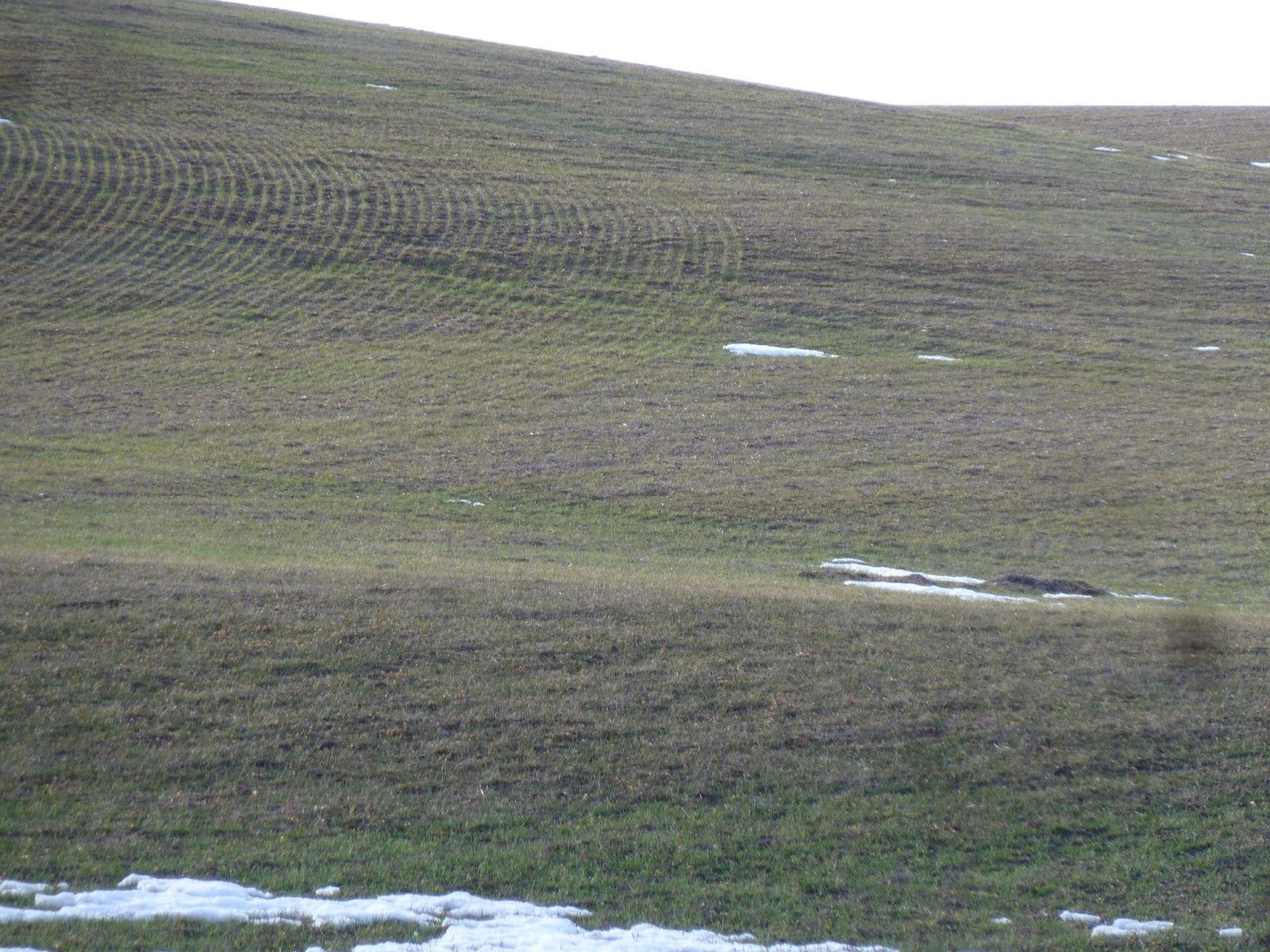
           The winter of 2016-17 has been long, windy, cold, and with significant snow.  With frozen ground, and piled up snow I was sure that we would have horrible erosion in the area.  I was sort of looking forward to how our operation handled a fast melt condition.  As it has turned out, the heavy rains predicted didn't turn up, so we had as gentle of runoff as one could hope for.  At this point in time we have lost nearly all the snow except those areas that drifted heavily.  All of the cultivated fields seeded to WW have significant sheet and rill erosion, but it could have been a lot worse.

This pic shows conventional tilled field with a long slope showing significant erosion, --pretty typical.  It's noticeably more ugly where the corner was turned and vertical seeding took place.
This pic shows our CC seeded to WW.  The WW was seeded close to freeze up so it is just emerging now.  The ground is in great shape with most of the CC dead, but the late seeding will cost us yield.  I don't see any grassy weeds at this point in time.  The radishes appear to have done their job by intercepting water and helping penetrate the frozen ground.  We were able to intercept most of my neighbors water coming off a conventionally tilled field.  The thin standing radish residue did help intercept snow.  This greatly reduced the drifting.  The snow coverage wasn't as even as in the more dense, taller grain stubble.

This pic shows erosion in our field where there is virtually no ground cover and seeded vertically.  This is WW on WP ground.

This pic is the same field (WW on WP) but in an area where the seeding was done on contour.  Even with our ULD-DS system using the CrossSlot drill, erosion will happen if you don't have good surface cover, or if you are seeding vertically.  There were no radish holes for intercepting and moving water through the frost layer.  The pic shows staining in the lower half.  You don't see the erosion tracks in the top half but they are there, --following the drill rows and breaking out, going down the slope.  The soil was redeposited down slope leaving this track, and most of the water lost had a low sediment load.  It will be a challenge to maintain adequate surface coverage when low/no residue spring crops are grown.  In this situation if we would have seeded earlier and also seeded a low rate (0.5-1.0#?) of radish with the WW, less erosion would have resulted.  I would like to see radish going into the winter about 1" diameter and ≈24" long, and ≈48" apart (it's a guess).  That's doable if seeded by first of October in our climate.  When radish freezes(dies), the tuber shrinks quickly.  I'm convinced this will be a good practice.  It's the plant population that is the unknown for me.


Friday, February 17, 2017

WEATHER FORECAST 2017

      Every year one of the highlights of the Farm Forum is to hear what Dr. Art Douglas has to say about the weather, local, national, world, and how that translates into agriculture production.  He always includes some statements on the climate and what drives our weather.  This year he went into more detail about climate change and the driving forces behind it, including human contribution.  I'll address his presentation on Climate Change in another post.  
       Dr. Art Douglas is an emeritus professor of meteorology in the Atmospheric Science Department at Creighton University, and has been part of Spokane Farm Forum since 1978, except for one year.  He is the Long-Range Weather Consultant to the Mexican Government, Cattlefax and ConAgra.
           Local Forecast:   Last year's forecast was "spot on" for our operation.  El Nino appears to be coming back.  For us in the PNW that means drying and warming trend.  It's predicted that spring and summer will be a little below average rainfall and a little above average temperatures.  Our WW should be fine.  No more arctic outbreaks are expected.  Spring crops may be iffy depending on location.  Getting WW for the 2018 crop seeded timely may be challenging do to low rainfall conditions this summer and fall.  I think we will be seeding early.
           These are the conditions that we have planned for with our ULD-DS system.  Gather, and hold every drop of rain possible, using heavy ground cover,  tall residue, and minimal ground disturbance.
           It sounded like the only places in the world that may have stressed crops for 2017 will be Australia and possibly spring crops in the PNW.


Thursday, February 16, 2017

GLYPHOSATE -- NEW STUDY


              There is a lot of internet noise about the evils of glyphosate.  Trying to figure out fact from fiction is challenging. 
              Recently I attended a meeting where a report was given by a Researcher at a local University on a recent study to determine, what, if any effects glyphosate has on soil bacteria communities.  In the past, Monsanto has put out information that glyphosate does not affect soil biota, but the old research is under attack for using bad methodology.   The Researcher feels this is a very good study, it used appropriate methodology for the task, replicated, and will be peer reviewed.  They feel the study is high enough caliber to be sent on to the National Academy of Science for further review and hopefully, publication.   Soil samples from four farms scattered over a wide area (100+ miles), with different soil types, and different annual rainfall (10”- 24”)were collected.   At each location, soil was collected from ground that had little/no history of glyphosate application along with ground that had an extensive history of glyphosate use.  In our case, we had a grass area that was once conventionally farmed, —it has never had glyphosate applied.  Bordering this area is a field that has had glyphosate  applied multiple times, every year, for 31 years.  The other 3 locations, have different, but similar stories.  The testing methodology used soil DNA and next- generation sequencing.  10,000 bacteria species were identified. 
       The RESULT:  — There was no dramatic effect on the bacterial communities identified,  —out of the 10,000 species a few showed slight decreases, and a few showed slight increases from the use of glyphosate.  The populations of most bacteria groups appeared to be unaffected.  The four locations showed differences in the bacterial communities, indicating location, soils, and rainfall did have an impact on soil bacteria communities, —more so than what was identified through use of glyphosate. [ This research team was headed up by Tim Paulitz, USDA-ARS an adjunct professor with Washington State University ]
       This is very good news for those of us in the direct seeding community.
       There are plans developing to do a similar study on what effects, if any, glyphosate has on fungi species and populations in the soil.
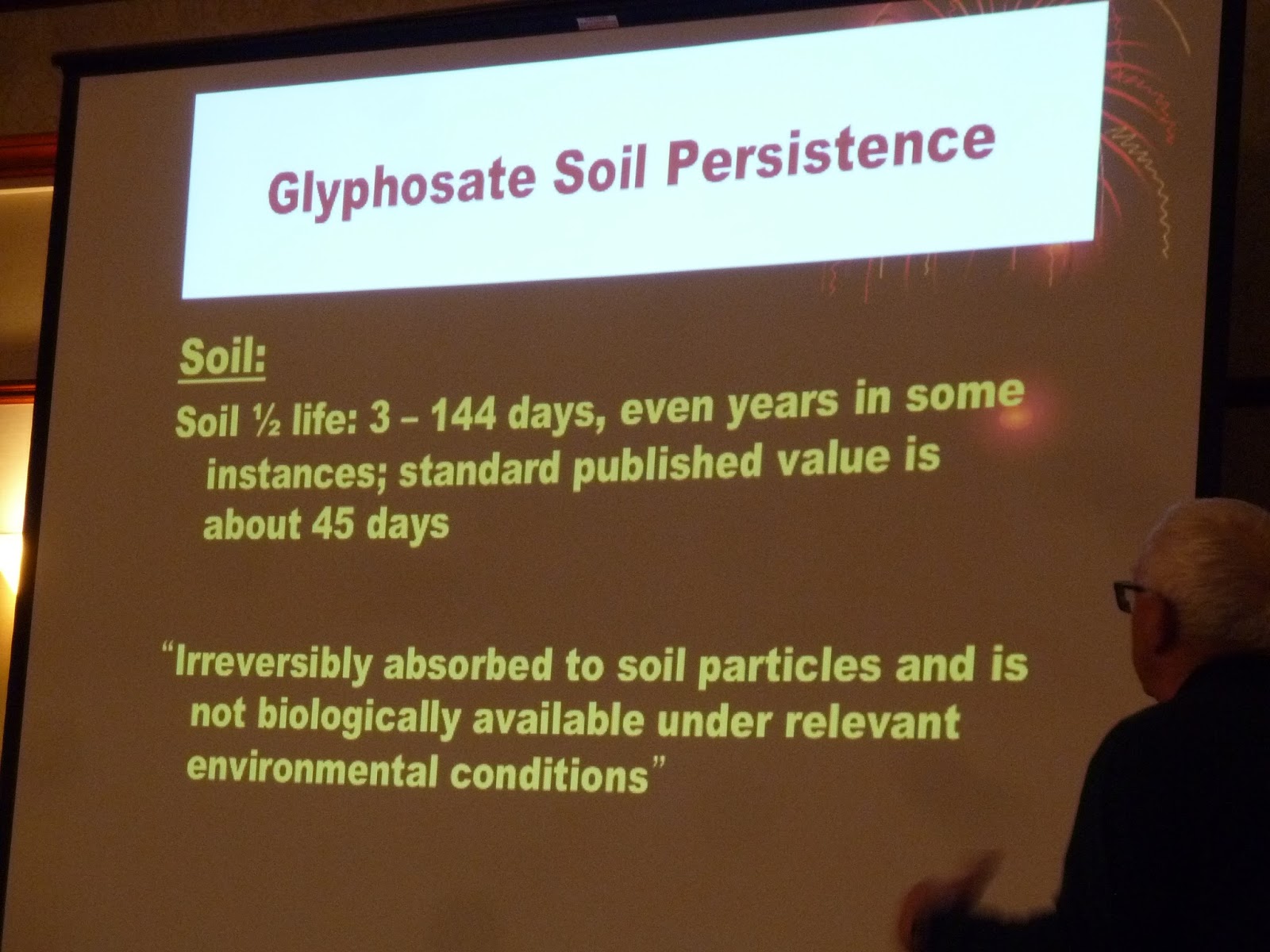
    On Another Page:   Today I attended a meeting on soil health put together by WSU extension. Part of the agenda included a presentation on Glyphosate.  Desiccating a crop has to be done within label limits or labs can find traces of the amino acid associated with glyphosate in the end product.  Whether this is a real problem or not, it leads to poor PR in the phobia climate surrounding glyphosate.  Traces of glyphosate residue, under some conditions can persist for more than a year in the soil.  This residual material can, in some rare instances be taken up and harm the crop.  These rare instances manifest themselves with a specific  pH, soil, and moisture relationship.  THE TAKE HOME MESSAGE:  Don't deviate from the label when applying glyphosate.  We have always considered the chemistry super safe and tend to be a bit flippant with it's use.

Saturday, February 11, 2017

2017 Spring Runoff --> ULD-DS vs Tillage

      This last week we have been losing our snow.  It started out with light freezing rain, turning to light rain, then, temperatures going to the mid 40's during the day and down to 29 at night.
      A couple of weeks ago, it was predicted that we were going to get 1.5-2" of rain.  I fully expected massive runoff from our fields.  It didn't happen.  We are losing some water during the latter part of the day, but no huge amounts.  The creek in front of our house has risen to < 1/2 it's capacity.
     Our ULD-DS fields are handling the thaw quite well.  Nothing seems to be displaced on our stubble ground.  We have two WW fields west of St. John.  One is seeded on CC ground that included radish, mustard, canola and other cultivars (see earlier post).  I could not determine whether we were losing water or not.  There was definitely displacement, but runoff from a cultivated field was going through our field, and I could not determine if we were adding to that flow.  It appeared that the displacement wasn't more than 20-30' before the water disappeared.  There are exceptions, --seeding vertically.  I don't think you can stop water movement seeding vertically on a slope.  Even as narrow as our slot is with the cross-slot (pic on the right).  Maybe an exception would be where stubble was plentiful enough to hairpin it into the slot to slow the velocity.  Our CC or WP ground definitely did not have that condition.  The WW on WP ground was losing some water.  There were no deep rooted, fast deteriorating radish plants in that field.
      The jar on the right was taken at our WW on WP field border.  It is nearly clear and I see no sediment showing on the bottom.   I will be sending a sample to a lab to see what polluting elements may be present.  Obviously sediment is not one of them.
      The jar on the left was taken at the outflow of a conventional tilled field, and sediment does settle out.


      At Thornton, the WW seeded into SP residue looks terrific.  Except for the drifts, which are large, the snow has pretty well disappeared.  Again, without vertical blockage snow is displaced and drifts form.   This condition is yield robbing, even if the water doesn't leave the field.  There are areas that are short ≈2"moisture, and areas that have excess moisture but losing sunlight energy.


      The pic on the left shows disappearing snow and a good WW crop exposed.  The pic on the right is Thorn Creek.  Our property is not contributing to this flow.  Our property scores very well on the Slake test which is helping us with moisture infiltration.
       I'm including a 7min (YouTube) video by Ray Archuleta explaining the Slake Test and it's meaning.

Thursday, February 9, 2017

VALUE OF TALL STUBBLE (RESIDUE)

 [SUMMARY] --The taller and more dense the standing residue, the less snow displacement takes place.
      As, when I started direct seeding (DS) many years ago, much of the time there is nothing dramatic to see from an enhanced conservation practice, --DS compared to conventional tillage.
      But, there are exceptions, and this winter is one of them.   This winter is a showcase for what tall residue left by the stripper header can mean for the coming crop.
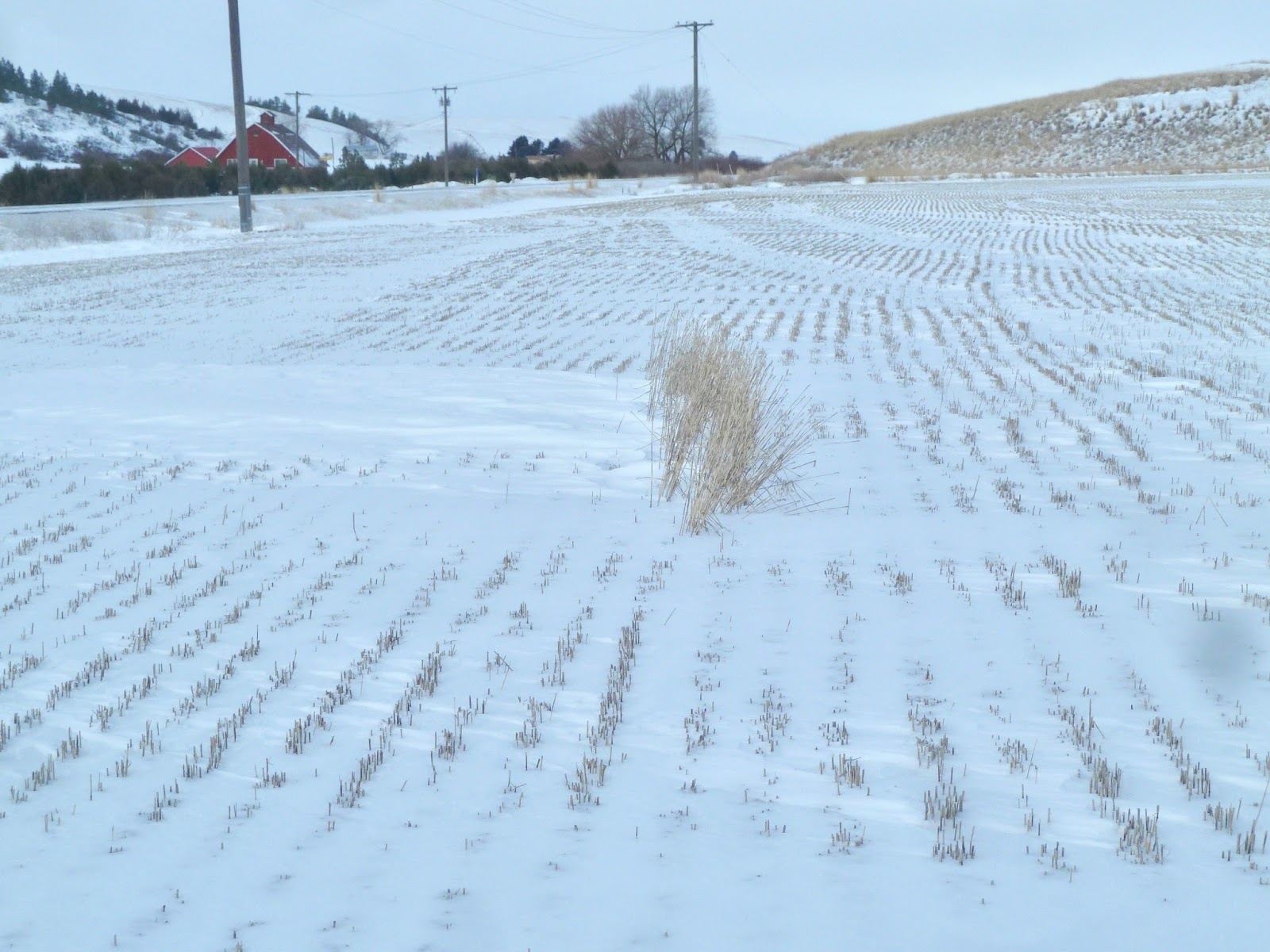
Above:  This pic shows snow accumulation of 12", fairly evenly distributed over the field of spring wheat stubble that stands ≈24" tall.  Compare this pic to the pic below.

     This pic shows accumulation of 6" in a neighboring field of mowed/harvested stubble standing 7".  Both fields experienced the same snow and wind events.  Notice the small area of standing stubble ≈16"tall and the snow that accumulated in and down wind of the clump.  Which condition provides more moisture for the coming years crop?  --Obviously the condition shown in the top pic.  In this instance with the snow bearing 0.25" moisture for every 2" of snow,  the field in the top pic has accumulated potentially 0.75" more moisture than the field in the lower pic.
       To continue this story, the pic above shows a conventionally tilled field seeded to ww.  The point here is that with no vertical blockage (tall residue), the recent 3" snow fall left the field and piled up in the usual places.  The very white areas are what is left of that 3" snow fall.  The slightly darker area is the old crusted snow  The field shown in the pic at the top of this post did hold most of that snow fall for an additional ≈0.25" of moisture.

 
The two pictures, above, show two fields seeded to winter wheat.  On the left is seeded into a 9 cultivar CC.  The vertical blockage is relatively sparse, but still having an effect.  The snow cover is not as even as in the more dense stripper headed wheat and barley stubble, but snow displacement is significantly less than WW fields with no vertical blockage.  We have radish in this field.  The radishes have deteriorated, leaving holes through the frost layer. We expect to retain all the moisture available from the snow for that crop.   On the right is WW seeded on spring pea ground.  The crop was seeded into heavy residue (SP plus past WW residue); however, that residue provides no vertical blockage.  There are noticeable snow drifts, indicating that we have large areas in this field where the crop is missing more than 2" of potential moisture.   In this field we will be dependent on thawing conditions.  If the thaw is gradual, we'll retain the moisture in the field although it's distribution will be uneven.  If the thaw is accelerated, we'll lose a lot of this moisture, similar to 2014.  
    (UPDATE:  In late February we had a Chinook,  which is when warm air suddenly moves in, and in this case a light rain accompanied it, that quickly removed the snow.  When I saw water in the ditch near our home, I geared up and walked the fields to see where the water was originating, --hoping it was all from my neighbors portion of the drainage.  It wasn't!!  First evident was my neighbors winter wheat on black fallow ground.  It showed like a mottled black/white area beyond the border of our field.   The snow, a thin layer because of previous winds, was mostly gone, and water was coursing down the hillside leaving a badly eroded hillside.  The ditch water was heavy laden with soil.  Little, if any, of that moisture was able to enter the ground.  Our winter wheat on chem fallow ground had good surface protection, but mostly flat from a year of fallow.  It caught very little additional snow compared to my neighbors.  I saw water was rolling down our hillsides the same as our neighbors.  The difference was that the water we were losing was mostly clear.   There was very little soil included in the ditch water.  The bright spot though was the field of winter wheat we seeded into the cover crop.  When I walked out of our ww on chem fallow into the field of ww on cover crop it was like night and day.  We had a lot of snow caught in the cover crop residue.  There was no movement of water down the slopes of that field.  Every drop of water entered the soil profile.  The cover crop (specifically the radish) did its job of saving the moisture.  The ground was frozen 4-6" deep, but the radish grew, died, deteriorated, and left a hole through the frozen soil surface that allowed moisture to enter the soil profile.)


Another observation:  I decided to check on the frost depth and whether the snow cover made a difference. This was a chilly morning in single digit temperatures and no wind.  By this time we have experienced a lot of cold weather including three nights of below zero temperatures.   In this field with 12" snow cover, one stab and a push by standing on the trenching shovel drove it more than a foot into the ground. That was a surprise, and pretty good.  It felt like the shovel was going through a big rice crispy treat.  In another field I found a bare ridge with ww and tried the same technique.  I stabbed repeatedly in the same spot and never got more than 2".  The third field, a flat, had 6" snow cover.  I stabbed repeatedly and eventually would have been able to get the shovel to the depth shown in the picture, but it would have been a hole instead of a slice.
      I'm not sure what part snow cover has played in frost depth at this point in time.
      I think the field shown above is frozen fairly deep but has developed a better soil structure over the years using DS and now has a lower bulk density.  This should allow moisture to enter the soil profile faster than the other two fields that were conventionally tilled.