Thursday, April 5, 2018

SOME BASICS OF SOIL HEALTH


       Soil health is such a multifaceted subject that it's easy to get lost in the rhetoric.  My intention here is to summarize what I have sifted out of a lot of material to be important for soil health, along with the reasoning for these statements.
      In general, strive to minimize erosion, and maximize soil biota.  To achieve these two goals five criteria emerge
       1 ---Manage the farm operation to maximize soil surface residue: 
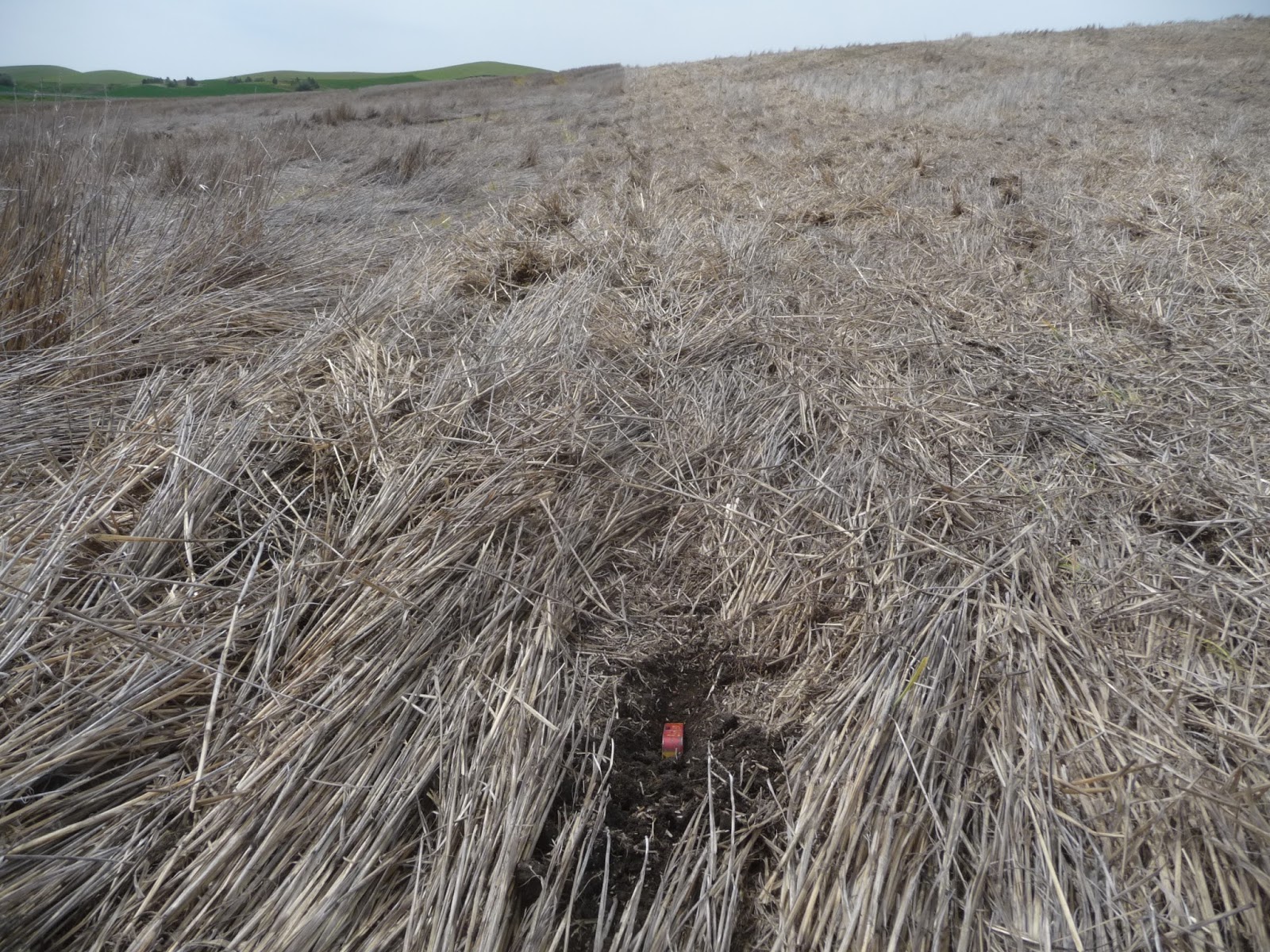
If you see dirt you are short residue!  Every primer on soil health will include a section on the need to protect the soil's surface 24/7, 365 days a year.  This means, keep it covered!  A farming operation does this with crop residue.  Residue resists erosion, feeds soil biota, moderates soil temperature, maximizes moisture capture, reduces weed emergence.
<---this pic shows cover with  >20,000#/ac.  Although this volume is preferable, rotations that include low residue crops will not likely retain this much protection.  This pic also shows seed placement of spring wheat in the lower center.

          2---Strive for less disturbance of the soil profile:
Use a ULD (ultra-low-disturbance) cropping system.  It will maximize residue retention, minimize destruction of soil aggregates, maximize retention of channels made by roots and macro soil biota for water infiltration and gas exchange, minimize weed competition by leaving weed seed high and dry.
<---this field is seeded to mustard that is starting to emerge.


          3---Develop a diverse crop rotation:
Soil biota need a diversity of plant cultivar exudates.  These exudates are derived from warm and cool season broadleaf cultivars, and warm and cool season grass cultivars.  Wheat is King in our region.  Basically we are a mono culture.   Although other crops haven't given the return like winter wheat, we need to develop crop diversity if there is any hope of recovering the natural productivity our soils.
<---pic of spring peas no-tilled into winter wheat stubble.


          4---Plant cover crops to replace fallow:
We need to replace traditional fallow with green fallow(GF). Green fallow is the opportunity to increase cultivar diversity beyond the normal crop diversity.  Research is pretty clear that, in our region, fallow is counter productive to building soil health. More SOM is lost during the fallow year than is gained during the cropping period.
<---pic shows a GF field seeded with 9 cultivars, including three radish, one cabbage, one triticale, one pea, two mustard, one winter canola.

        5---Measuring progress:

Testing is obvious, but what tests?   Unless you understand each test's limitations, they can be quite misleading.  There are a number of tests available to measure progress, --chemical soil tests, leaf tests, biological tests using soil, Haney, or Solvita, and also microscopy.  Rely on leaf tests to discover crop deficiencies.  Every five years or so sample for a soil biological test to determine long term changes.  These tests are expensive and also limited to information for a very small area.  Because our soils vary greatly from one footstep to another, analyzing any soil sample has limited value.  Chemical analysis of soil is good at determining the total quantity of a nutrient but not so good about determining the plant availability of that nutrient.  Frequently, leaf tests will show a deficiency when the chemical analysis of the soil shows an abundance of that particular nutrient.  As the agricultural industry learns more about plant nutrition, more elements are needing to be tested.

    In recent years I have become aware of the importance of soil biology.  Soil biology sounds like a very old discipline, and it is; however, the first comprehensive publication on the subject was not printed until the mid 1980's (that absolutely astounded me).  Since then we have learned that plants communicate, and that symbiotic systems can develop in the soil that interact with plants.  Although a novice, I am convinced that we can rebuild the natural productivity our soils once contained.  To do this, we will need multiple field checks to determine what organisms are present, or may need to be added, and food (plant cultivars grown, or amendments applied) provided to grow their population.  That is the purpose for buying a microscope, and online classes to learn the basics of soil biology.  Armed with these tools one can identify and manage for the different soil biota at a relatively low cost.  My equipment and education cost the equivalent of six biological tests.  These six tests would give me detailed information on six small areas of a field, and takes a week or two for the results.  With the microscope, I can get a general idea of conditions, and get that information in a half hour allowing the opportunity to correct a deficiency in a timely manner.

         STILL UNANSWERED TO MY SATISFACTION:  The following two subjects have a lot of literature expressing diverse opinions.
--What depth should you draw your sample for biological and chemical tests?  In the literature I discover no consistency on depth from which to pull a sample, when it is even mentioned.  It comes down to what you have a question about.  An example would be, do you want the nutrient analysis in the top 2" or the top 12"???  So, since most of the plant roots are in the top 12-18", and most of my sampling in the past has been done at 12", I'm going to continue using 12" depth for sampling and comparison.  At least I will be able to salvage some useful data from the past.  Any real gain in SOM will have to reflect more than 3" profile, so, 12" it is.
This pic shows a soil pit from the Aeschliman farm south of Colfax, WA.  The top of the pic just catches the soil surface.  The bottom of the pic shows the washed out color of residue on the near bank of the pit.  Notice the dark streaks going down into the pit which is ≥ 6' deep.  These dark streaks are carbon enriched soils that are left behind in the root channels and worm burrows. As can be seen, these channel sources are important in moving carbon deep into the soil profile.  The color variation in this pic goes a long ways in explaining the potential for variability of our soil.  Think about coring down a dark area and then a foot or two away coring down a light area.  Is the chemical or biological analysis going to come out the same, --no way!

--What species and number of cultivars should be included in a cover crop?   The most consistent advise I hear is, plant cultivars that support your "goal", or needs of the cash crop that follows, --such as, will you need N, or do you need more biomass, or do you need to improve soil structure?  My thinking follows along the line of:   Include as many different cultivars as economically possible in the cc mix, --at least five with one of them being a radish, and another a legume (unless the next crop is a legume). Radish are good bio-drillers, and the taproot (not the tuber) goes deep and scavenges nutrients, bringing them back near the surface. Caution:--make sure all brassica's in the cc mix is certified disease free.  Canola is going to be an important crop for us and we want to avoid  bringing in soil borne diseases on brassica seed stock.  Another caution is to not include a cultivar that will be hard to remove from the following crop.

      WHAT THE FUTURE HOLDS:
Our farming methods will change to more closely mirror nature, simply because the forces that impact agriculture will move the industry in that direction.  Input costs of equipment, chemistry, and plant nutrition along with increasing regulation and legal liability associated with farming will force agriculture to be more holistic in nature.  I fully expect, not too long in the future there will be a requirement to be "licensed" to farm.  With the world political, and climate change implications, food security issues will draw more political attention. I expect this to be a slow transition that will come through the metamorphosis of the current required "private applicators license".   All it would take is a tweak in the current law to include current soil conservation and biology information.  If this becomes the trend of the future I heartily support it.  Farmers need to be a highly trained professionals, and that requires a continuing education program.  Those of us that regularly attend university research seminars, and direct seed conferences are already exceeding any probable requirement that a law would require.
       As a Sanskrit text written in about 1500BC noted: “Upon this handful of soil our survival depends. Husband it and it will grow our food, our fuel and our shelter and surround us with beauty. Abuse it and the soil will collapse and die, taking humanity with it.”
 
    The No-Till Farmer features an article:  < Building Resilient Soil System >


Sunday, March 25, 2018

IS IT ORGANIC ?

    
organic produce
In the past few years I have noticed that the major food retailers that I patronize have increased their product line to include a remarkable amount of organic food.  Being naturally suspicious of the organic industry and knowing how difficult it is to grow quality and quantity in organic food I have wondered how this dramatic increase in supply can be.  Although the science and art of growing organic is on a fast track, actually producing the volume of products that have the same visual appeal of non organic food seem ahead of it's time.  Are these products US grown?  I question the labeling of US grown products, so I would never consider any foreign country label as being anything other than being fake with the intent to capitalize on the inflated price  supported by a gullible consumer.  Although my goal is reduce or eliminate commercial inputs on our operation,  I don't see how this can be developed in any significant scale for many years to come.  Organic sources of crop nutrients and the current need of labor are two giant obstacles.  Until we rebuild our degraded soils to the point they are self sustaining, any thought of producing massive volumes of organic produce is a pipe dream, other than for Yuppies and the well healed that live on ideology more than practicality.  Those would be the ones that believe in celery labeled as "gluten free".  I recently came upon an article from an organic oriented organization that I think is a partial answer to my question.  The link to that article is --->   Problem with organic designation  > .

Monday, March 5, 2018

2017 HARVEST UPDATE


The 2017 crop year was a record breaker.  Never in my lifetime have we received 20.4" of rain/snow in a crop year at our SJ/Ewan operation.  Also, we have had near record or record breaking temperatures for the 2017 crop year.  That sounds like it should be a banner year with plenty of moisture and heat.  Well, not for us.  Timing of the rain and heat trumped everything.  The harvest of 2017 was mostly disappointing.
WINTER WHEAT:   (Brundage 96)  All of our winter wheat was seeded on pea ground (no ww on fallow ground).  The ground was dry, which meant we didn't consider seeding until after Oct. 1st, --a bad decision this year.  October was extremely wet all month.  Lesson learned?! --Seed in September regardless of dryness, and seed it deep (1.5-2") so it takes a significant rain to start it.  Had we done that, the Thornton winter wheat crop would have probably been 100-110% of average, and the less forgiving SJ/Ewan area winter wheat crop would have been in the range of 90-100% of average.  As it was, Thornton was ~90% of average, and SJ/Ewan was ~50% of average.
SPRING WHEAT (DNS):  (Glee)  The season started out with great soil moisture, and timely seeding, that developed into a very nice looking stand of spring wheat.  The unusual heat wave (~ three weeks ± 100 degrees) damaged the bloom and seed development.  Our quality was remarkably good, --the meshes were just blanked out.  Test weight was good and shriveled kernels were few, and protein was just under 14%.  Our yield was ~ 90% of average.
[Update 6/28/18] --Meetings held during the winter and spring on Canola have emphasized the importance of proper timing for chemical applications.  There will be a yield loss to the crop if chemical is applied after bolting commences.  We didn't get to the in-crop application until bolting started showing, along with some flowering, --this is probably why we were ~200#/a below a neighbors yield although we had a better stand and population.  The neighbors field was a couple of hundred feet higher, and that may have been a factor as well in terms of heat effect.
SPRING CANOLA:  (hyCLASS 930 rr) The crop was timely seeded.  The plant population was good.  The crop was growing well, but the heat hit in early bloom (for 2016 trials, we had nearly a month of bloom).  The high heat over the extended time did not let a re-bloom establish pods.  In fact the spring canola continued to bloom through the beginning of 2018, although no pods set.  The yield was ~ 30-40% of what we expected.  Any other field would have probably done better this particular year.  This field was our poorest soil, lowest elevation and all faced S and SW.  It took the brunt of the heat.  We are not deterred.  We think that spring canola is going to be a great alternative to winter wheat.  Also, it appears that we will be able to cut spring canola with the stripper header which is a big plus.  This field went into winter in great shape, --good residue, standing tall with most of the plants still living.   The tall canola stubble, although not thick like wheat stubble, is great for reducing wind velocity near the soil surface, and snow catch.  Winter of 2017-2018 was not a big snow year like 2016 but we haven't seen any drifting in that field compared to mowed or tilled fields.
      I haven't sorted out the data for any comparison between CF/winter wheat and CC/winter wheat, or our canola on ground that has had a cover crop and ground that has never had a cover crop.  I may include that as an update to this post or it may take a post of it's own.

Wednesday, February 28, 2018

STEWARDING OUR SOILS

This post is an update on our progress to improve the health of the soils we steward.
      Ten years ago we were still trying to stop water erosion after nearly 20 years of actively working the problem, and soil health was a general term without specifics.  Today, we have stopped ~95% of erosion by water, and have an idea on how to stop another ~4%, --I'm leaving ~1% as uncontrollable at this point.  We are now hearing more of a consensus of what Soil Health means, --it turns out to be multi-faceted.  For us, Soil Health breaks down too four basic elements, --1) maintain surface residue, 2) minimize soil disturbance,  3) diversify crops, 4) keep a live root growing as long as possible during the year.  Working to maximize these four elements will hopefully remove soil erosion, build soil structure, feed the biota, build SOM that will result in improved soil health.
                                                 WHERE ARE WE TODAY:


 The pic on the left:  --2006 WW seeded on CF following SB.  We were using a high disturbance hoe drill, and you can see a lot of exposed soil.  Along with WW we were inadvertently planting weed seed that existed as well.  With the exposed soil and impressions left by the hoe, the field was vulnerable to soil erosion going into winter. 


 The pic on the left:  --2015 WW seeded on SP stubble.  We have progressed from high disturbance no-till to ultra-low disturbance(ULD) no-till through the use of the stripper header and the CrossSlot drill.  We have enough residue on the ground that you see no dirt.  In our environment with high summer temperatures, freezing winter temperatures, and most of our moisture coming during the winter(~15"), it's important to conserve as much of our rainfall as possible by increasing percolation and moderating our near surface soil temperatures.  The ULD system does this better than any other system out there.  The system also reduces erosion from the common forces of wind, water and tillage to near zero.
 More detail on the four basic elements mentioned above:
        --RESIDUE:   The need to maintain 100%+ surface cover (a good gauge is that if you see dirt you need more residue).  Unfortunately our most vulnerable ground still has some dirt exposed.  Residue protects the soil surface from the destructive forces of the raindrop which helps prevent surface sealing, and slows water movement. Surface residue moderates soil temperature.  In the summer we have measured ≥20 degrees cooler temperatures under the residue compared to bare soil. This is a definite moisture saver.  It slows the replacement rate of the boundary layer (the 100% humidity zone at the soil surface).  In the winter, soils remain 2-4 degrees warmer than bare soil.  When we do our spring seeding, seed zone temperature lags about three days behind bare cultivated soil.  We find that insignificant when compared to the benefits. 
         --TILLAGE:  We have decreased soil surface disturbance to the absolute minimum.  This maximizes residue retention, and maximizes channeling from worm activity, and decayed root structure, which continue to build over time.  Those channels help reduce the time our soils stay in a water saturated (anaerobic) state, and that in turn, reduces the buildup of various pathogens, and conditions that negatively impact our cash crops.


  ---Another benefit from maximizing residue retention and minimizing soil disturbance is less weed pressure.  Minimum soil disturbance combined with heavy residue leaves a very hostile environment for any cultivar to get a start.  If you enlarge the pic at the left you can clearly see that disturbed ground, even if it is only a wheel track encourages weed growth. The undisturbed areas do have some growing cultivars, but the number is significantly less and tend to be spots with the least or no residue.   Also, maximizing residue retention and minimizing soil disturbance makes for faster water percolation into the lower soil profile.  This drys the soil surface faster reducing compaction from heavy equipment during early spring seeding.    
      --CROP DIVERSITY:  We have started to stretch our cropping system to include winter wheat, spring wheat, spring  barley, billy beans,mustard, canola, winter and spring peas.  The rotation is dynamic (meaning no particular crop following a particular crop).  More crops may be added to the mix in the future like soybeans, sunflower, millet, and sorghum.  Crop diversity along with a dynamic rotation is being used  to address weed and disease issues as they become evident.  A mono-culture crop promotes certain weed types, --downy brome in winter wheat is an example.  Crop diversity allows us to use herbicides with different modes of action.  This will lengthen the useful life of the chemistry available to us by lengthening out the time when weed species develop resistance to a specific herbicide.  Keep in mind that we haven't had a herbicide with a new "mode of action" marketed for 30 years, and there is none currently in the pipeline.  Crop diversity helps improve soil health through the root exudes.  The more variety of cultivars we can get into the rotation the better for the soil biota as well.
       --LIVING ROOTS:  The biggest challenge for us will be lengthening the time we keep living roots in the soil during the year.  Research is showing this to be a major factor in feeding soil biota and increasing SOM.  Currently we use CF in front of our WW.  In our arid environment that has to change to make a positive increase in SOM.  Currently we are bumbling along, doing a variety of things that are not well understood or coordinated.  Last spring we attempted to establish a ~30ac perma-cover with White Dutch Clover.  That has failed, but we will try again this fall.   We do have a ~70ac field that we have replaced CF with green fallow (GF).  This spring we will be seeding the GF which will include lentils, forage peas, forage oats, and radish and dutch white clover.  This is the second rotation of GF on this field.  Unlike the past we plan to terminate the CC at the high N production cycle instead of letting the cover continue through maturity.  How we terminate is yet to be decided.  This fall (2018) we will seed this field to WW.
      --Soil Biota:  In 2015 we took soil samples of the 70ac field and sent them to Earthfort Labs in Corvallis, OR.  We plan to retake those tests in 2020 for comparison. The early tests (more detailed in an earlier post) showed we were very high in bacteria, very low in fungi, flagellates, ameba, and beneficial nematodes.  Fortunately we were also low in ciliates, and harmful nematodes.  The low fungi count along with the high bacteria count is the natural occurrence from a history of raising only  grass cultivars, which are bacteria dominate.  I'm reading where healthy soils have a Fungi/Bacteria ration ~1/1 which requires raising higher secession plants.  We are no where near that ratio.  There is no history of higher cessation plants like brassicas or pulses, that support fungi on that ground.  The Earthfort report summary stated that the biota needed food.  We have to figure out whether we can buildup the fungi numbers from the remanent we have or whether we need to add inoculant of fungi and support them with higher cessation plants.  Also, can we successfully feed the biota with biological amendments, --there are several available from a variety of sources.  Currently we are riding a train that is accelerating down the track in the use of commercial inputs.  The only hope to reverse this trend is to increase our knowledge of what makes a healthy soil, and apply that knowledge.  There is evidence that this can be done.  How do WE do it in our specific climate/environment is the question.

Saturday, February 24, 2018

GOOD SCIENCE, NOT IDEOLOGY

[Update 3/6/18] How Do You Assess if a Chemical Causes Cancer?  This is a good read, written by Dr. Guy-Andre Pelouze as published in the digital magazine "SLATE".  He is a thoracic and cardiovascular surgeon who did cancer research during his training, and lung cancer treatment during his practice.  Five things stuck in my mind from this article: --He states that when scientists and policymakers carelessly substitute risk for hazard, flawed conclusions are drawn. --there was a study of 89,000 farmers in Iowa and North Carolina showing no raised health risk.  --IARC being taken to task for publishing findings not consistent with their research.  --Benefit-risk ratio is important when it comes to regulatory action.  --Glyphosate is less toxic to humans than common chemicals like aspirin.
     At the recent Direct Seed Conference in Kennewick, Washington, one of the speaker presentations dealt with the anti-GMO, Glyphosate campaign that is gaining public acceptance world wide. Advocacy groups are driven by ideology, --good science be damned.  They are quite comfortable in substituting "it's possible" or "it probably is", for, "it does", and hype it "as fact", when it means nothing of the sort.  A lot of the public is gullible and  Laws are being written and products band or boycotted as a result of this hype.
      As near as I can determine, this demonizing of glyphosate and GMO's originates from the Organic Farming Industry.
      This is nothing more than a tug-of-war between holding on to the ways of the past, and moving on with new ways of the future.  Like everything else we encounter in life, we have to muddle through it.                              
                               ---  SCIENCE OVER ADVOCACY ---
       Below I'm including two websites that support science over advocacy.  The first is "Biology Fortified" < Biology Fortified >.   The second is the "Genetic Literacy Project" <  Science Not Ideology >
       I've also included two of the 501(c)(3) organizations that fund much, if not most, of the tirade against Monsanto and GMO's.  They are the Rodale Institute, and The Sustainable Food Alliance Inc.
                        _________________________________________________________

Biology Fortified explains the science behind GMO's and exposes the pseudo-science propaganda that shows up in the media.  < Biology Fortified >

Genetic Literacy Project (GLP), advocates “Science, not Ideology”.   Information about GLP can be obtained at:  < https://geneticliteracyproject.org/glp-board/ >  
I have pulled parts of the profiles of the individuals named below from the GLP website.  They are names that many of us recognize in the anti-GMO campaign. 
_____________________________________________________________________

ABOUT RODALE INSTITUTE
Rodale Institute is a 501(c)(3) nonprofit dedicated to pioneering organic farming through research and outreach. For over seventy years, the Institute has been researching the best practices of organic agriculture and sharing findings with farmers and scientists throughout the world, advocating for policies that support farmers, and educating consumers about how going organic is the healthiest option for people and the planet. Learn more at www.rodaleInstitute.org.


The Sustainable Food Alliance, Inc. (SFA) is a 501(c)(3) non-profit organization, EIN 33-1123944 registered in the state of Delaware.

The aim of the SFA is to act as a catalyst to encourage collaborative engagement between individuals and organizations working in the field of sustainable agriculture.
Our mission is to accelerate the transition to more sustainable food and farming systems.
The SFA’s programs of work are delivered primarily by working in partnership with other organizations. We fundraise for and make grants to organizations working in the field of sustainable food and agriculture. We work alongside the Sustainable Food Trust, a UK-based charity that works internationally to advance our shared mission. The link to the summary article of: The Hidden Cost of UK Food .  I found this an interesting short read.  They include a lot of different elements into "the cost".  I can't disagree with what they are saying, but, (they don't lay out the details for feeding the world population)  I can't get my mind around replacing our high capacity production with "Organic Farming".

                             ______________________________________________

Judy Carman: Activist researcher promotes GMO scare studies in fringe journals?
Updated on November 29, 2017 | [wpv-post-taxonomy type="glp-types

PROFILE DETAILS
Judy Carman (born January 31, 1964) is an academic and anti-GMO activist. Her vanity site—GMO Judy Carman—was established by Henry Rowlands, the cybermaster behind GMO Seralini and the pro-organic website SustainablePulse, which promotes claims that genetically modified foods are unsafe despite the findings of every major independent science organizations that they are as safe or safer than other conventional or organic foods.

______________________________________________

Jeffrey Smith: Former flying yogic instructor now 'most trusted source' for anti-GMO advocacy
Updated on November 29, 2017 
PROFILE DETAILS
Jeffrey M. Smith (born 1956) is a self-published American author, independent film producer, professional dance instructor and former politician known for his work in transcendental meditation and yogic flying, Lindy Hop swing dance and activism in opposition to genetically modified organisms (GMOs).
Smith ran for the U.S. Congress as a candidate for the Natural Law Party (United_States), has authored several self-published books, DVDs and a movie on the dangers of genetic engineering,[1] serves on the Genetic Engineering Committee of the Sierra Club, and is a frequent conference speaker at advocacy, alternative health, organic and natural products conferences and his work is promoted on such nationally syndicated television programs as The Dr. Oz Show. Smith claims to have a background in communications and marketing,[2] has served as an occasional contributor to his local newspaper[3] and attended school at the Maharishi Institute of Management in Fairfield, Iowa where he resides.
______________________________________

Gilles-Éric Séralini: Activist professor and face of anti-GMO industry
Updated on November 29, 2017 
PROFILE DETAILS
      Gilles-Éric Séralini is a French scientist who has been a professor of molecular biology at the University of Caen since 1991. He is known for his controversial research concluding that genetically modified food and the pesticide glyphosate are unsafe for human consumption.
      Séralini was born August 23, 1960 in Annaba, Algeria, then known as Bône. He is president and chairman of the board of CRIIGEN (Committee of Independent Research and Information. He has published multiple studies alleging health risks associated with plant biotechnology which have been called flawed and biased by various regulatory and academic groups.
      A professor of Molecular Biology at the University of Caen, Laboratory of Biochemistry and Molecular Biology, I.B.F.A., Esplanade de la Paix, 14032 Caen Cedex, France. Séralini studied in Nice and became a Doctor in biochemistry and molecular biology at the University of Montpellier in 1987. He left then for North America to carry out fundamental research for four years, at the University of Western Ontario and Laval University Medical Center, doing research on corticosteroid-binding globulin. Qualified to supervise research, he passed, at the age of 30, the French national competitive exam for University Professors.
       Séralini chose to focus on the interface of cancer research and endocrinology at the University of Caen, where he was appointed professor in June 1991, a position he has held ever since. He has written about 100 scientific articles and conference papers for international specialist symposiums. He assumes several roles in the Commissions of the University of Caen, where he leads a research team associated to CNRS (French National Centre for Scientific Research) and INRA."

       Funding for much of Séralini's research has come directly from the alternative health and organic industries, and in particular by various organizations tied to the Rodale Institute, that bills itself as "advocating for policies that support farmers, and educating consumers about how going organic is the healthiest option for people and the planet."  Anthony Rodale–chairman emeritus of Rodale’s Organic and grandson of the founder, is a vocal supporter of Séralini's work.
       The funds are funneled to the French scientist through the Sustainable Food Alliance (SFA), headed by Patrick Holden, former director of the UK Soil Association--Britain's organic industry trade group--which is a "charity campaigning for planet-friendly organic practices" and "healthy, humane and sustainable food, farming and land use”.  A study released in December 2016 claiming GM corn is not "substantially equilvent" to non-GMO varieties was financed by SFA.


__________________________________
Don Huber: Science still looking for Purdue professor's GMO pathogen time bomb
Updated on November 29, 2017 
PROFILE DETAILS
Don M. Huber (born 1935) is a former Purdue University professor who goes on publicity tours sponsored by organic[1], alternative health[2] and anti-GMO interest groups[3] claiming glyphosate and herbicide tolerant GM crops are causing health problems in people and animals. He also claims he discovered years ago a novel pathogenic microbe caused by agricultural genetic engineering–a GMO time bomb that is wreaking havoc on humans and animals.
    Huber maintains glyphosate and GMO herbicide tolerant crops are linked to human and animal health risks. He says animals fed GM crops are dying in record numbers and that their is a correlation between GM soy and GM corn with inflammatory bowel disease in humans in the United States. He alleges glyphosate is linked to alzheimer's disease, gout, diabetes, Parkinson's, allergies and fertility issues.  To support his claims, he cites research by a Maharishi movement expert in yogic flying Jeffrey M. Smith, and the debunked activist researcher Gilles-Eric Séralini.[5]
Huber has collaborated with anti-GMO activist researchers Judy Carman and Jack Heinemann in support of anti-GMO claims sponsored by extreme organic and biodynamic food and farming products company president Howard Vlieger.


Monday, February 5, 2018

EARTH WORMS and RESIDUE

   
     It is becoming more common to see articles and presentations referencing the presence of earth worms as an indicator of soil health.  Does that mean you have reached the goal of returning the ground back to it's original self sustaining condition that was present prior to man's intervention?  NO, --it is one of many indicators!  The compaction layers, low pH, low SOM, and high erosion can be present and still have a significant population of earth worms, both horizontal movers and vertical movers.  I'm not convinced that every acre of ground has a native population of earth worms, --they either were never there, or conditions became so bad over time that they disappeared.  I am convinced that earth worms will move into an area if conditions change that will allow them to survive.  I have always been able to find earth worms in the early spring in the low areas where moisture was plentiful, even prior to no-tilling, --just not very many.  I soon learned as a kid that it took a lot of spading in the crop ground to find enough worms for a day of fishing, where, if I went to an area that had a lot of residue and was pretty wet, it only took a few spade full of dirt to fill my needs.
       What will encourage earth worms to inhabit cropped fields?  They need food, and shelter just like any other living thing.  If their homes and food are not destroyed on a regular basis they will be there or move there.
       The recent No-Till Farmer magazine had an insert titled "12 UNRIVALED BENEFITS OF EARTHWORM ACTIVITY IN YOUR SOILS".  When I first read them, several seemed to be repetitive, but they were different, but had similarities.  These 12 points come from various university studies throughout the US.  I'm going to paraphrase a two page article to shorten this post.  1--Improve Water infiltration:  Pencil thin burrows allow rainwater to penetrate deep into and throughout the soil profile.  2--Improve Soil Aeration:  Burrows are conduits for air moving into the soil profile and CO2 movement out to stimulate plant growth.  3--Increased Hardpan Penetration:  Earthworm tunnels once bored through the hardpans stay and improve root access.  4--Reduced Soil Compaction:  Burrows both vertical and horizontal encourage root growth, which helps breakup compacted areas.  5--Mix Surface Residue Into Soil:  Some species pull residue into the soil.  63000 worms per acre will make about 18 tons of castings.  In ten years they are capable of complete renewal of 2" of topsoil.  6--Release Of Crop Growth Stimulants:  Earthworms break down crop growth inhibitors, phenols and formaldehyde from decaying residue and lace the material with growth stimulants, auxins and cytokinins.  7--Bring Minerals Up From Subsoil:  Earthworm castings contain 5-10 times the soluble plant nutrients of the original soil.  8--Neutralization of Soil PH:  Earthworm processed soil is always closer to neutral pH.  9--Rapid Growth Of Beneficial Microbes:  Earthworms carry around and deposit beneficial microbes as they go.  These thrive and help decompose residue.  10-- Improve Soil Tilth:  Earthworm castings contain sugars and enzymes which help build soil aggregates.  Fields bulk up being more sponge like.   Fields with high worm populations have 4 times infiltration rate of fields without earthworms.  11-Improved Nematode Control:  Earthworms eat harmful nematodes and leave  soil conditions that limit nematode numbers.  12-- Increase Micronutrient Chelation:  Earthworms link micronutrients, such as zinc and boron to other nutrients for easier uptake by plant roots.  13--Reduce Erosion:  I'll add this one to the list.  The surface residue required for the listed benefits above, along with the earthworm tunneling to the surface slows water loss, hence, reduces erosion.
      Earth worms are truly natures plows, only they do a much better job by leaving a less erosive soil, cycling minerals through the soil, and improving moisture infiltration.  The higher the population the better.  Earth worms are a great indicator of which direction your soil is headed, --to a healthier state or to DIRT.
      The Take Home Message Here Is:  DON'T TILL AND DON'T REMOVE RESIDUE!
   

Thursday, December 14, 2017

ROUNDUP -- (Good or Bad ??)

UPDATE 2/24/18:  I recently received a critique on the book "Whitewash", a bash piece on GMO's and Glyphosate by Carey Gillam.  The timing and purpose of the book was to educate the public on the cancer causing effects of glyphosate and pressure the EU to not re-register glyphosate for use last fall.  The critique by Karl Haro von Mogal shreds the book and shows how, through the misuse of data,  and using partial truths, the anti-glyphosate crowd is misleading the public for the benefit of the "Organic" movement.  It's a bit difficult to read.  Because of the mirth employed, I had to read it twice to get the straight of the message.  The critique can be read at: < "Whitewash" is hogwash>
    Glyphosate was introduced to the public in 1974 following it's discovery by Monsanto chemist John E Franz in 1970.  Since it's discovery, Glyphosate has been under constant scrutiny with research trying to prove what glyphosate does or does not do.  What we do know is that it has been a very effective herbicide.  We also know that there are some resistant cultivars, and more will become resistant to the effects of glyphosate.  There is no revelation here, all our chemistry has developed resistant cultivars, --it's merely a matter of time.
     Our operation has used a lot of glyphosate and we have been comfortable with knowing that research proved over and over that it is safe for humans and animals.  At times we seem to bathe in the stuff.  We try not to ingest the chemical, but that has probably happened as well.  The first real concern over safety I'm aware of came around 2010, when Purdue professor emeritus, Dr. Don Huber dropped a bomb, stating that Glyphosate and GMO's are harming human, animal and earth's health.  The research that he based his conclusions on has never been duplicated.  With his continual repeating the claim, and the inability to duplicate the results at Purdue and other universities, Purdue disavowed him.  He is the darling of the anti-GMO crowd and continues to lecture world wide on the evils of glyphosate and GMO's.  The next big hit on glyphosate was when the World Health Organization (WHO) through the International Agency for Research on Cancers (IARC) published a statement that glyphosate "probably" is a Group 2a carcinogen.  The label "probably" can be used on a lot of chemistry and preservatives used for growing and processing our food.  Forty three years of research should be able to determine yes or no, --not a "probable".   However, if you want it to be a carcinogen but can't prove it then the next best thing is to damn it with the adverb "probably".   In fact,  Reuters has an investigative arm.  They state that the IARC research conclusions were changed from no evidence of being a carcinogen in the draft version, to a neutral or positive conclusion of being a carcinogen in the final published version.   The < Glyphosate Battle > is an interesting read.   Reuters has been stonewalled by both WHO and the researchers of the IARC on the reasoning for changing their position, --it wasn't apparently the science.   Since WHO's pronouncement, anti-Monsanto/Roundup/GMO activists, using all available media upped the public concern to the point where several countries are considering removing glyphosate from the register of approved herbicides, along with the State of California.
      In the November 2017 edition of No-Till Farmer there is an article on glyphosate titled,  Is Glyphosate Harming Your No-Till Soils?  The article states that the glyphosate molecule is hanging around longer than anticipated.  Glyphosate is negatively effecting some soil microbe communities.  Glyphosate is encouraging some plant diseases.  Glyphosate is interfering with nutrient uptake.  And, glyphosate is effecting mycorrhiza.  Some serious stated findings.
       I have been working with WSU researcher, Tim Paulitz, for several years on glyphosate interaction with soil biota, --principally bacteria and fungi.  Over the years I have gained a lot of respect and confidence in his work and knowledge of glyphosate.  He heads up a lot of glyphosate research and reads journal entries about glyphosate research worldwide.  His own research projects have found no statistical difference in either the bacteria or fungi communities, between ground that has never had glyphosate applied, and ground that has had a lot of glyphosate applied.  He is doing this study over a wide area of the Palouse and is working in three rainfall zones, ---high, medium, low.  I asked him why this study was in conflict with his findings.  His response:
       Tracy, ---- I looked over the No-Till article.  There is nothing new in this article, except the work from Cornell. The rest of the article refers to old work by Robert Kremer. As I mentioned before, he did not have the molecular tools to really address the questions about microbial communities.  He was only working with the small fraction of fungi and bacteria that can be cultured-  less than 1% of what is out there.  Kind of like trying to paint a picture of the world by only looking through a small narrow slit. Rather than trying to rebut his work, I think it is more useful to look at the new work we have done.
        But I will comment on the article from Cornell by Aristilde.  By the way, this article was reviewed by Kremer.  First of all, the No-Till article was misleading in talking about this work, when it said that “beneficial Pseudomonas… decreased when glyphosate seeped into the surface soil layer by leaching or release from glyphosate treated plants”.  In the Cornell paper, they did not work in the soil, or with plants.  All their work was done in the lab in culture. There may have been other work that they did in soil, but I could not find it published.  They took 4 biocontrol strains of the bacterium Pseudomonas and tested them in culture to see how sensitive they were to glyphosate.  Three were relatively insensitive, but one was completely inhibited at 5 mM.  It was also slightly inhibited at 0.5 mM. This is well known- some bacteria have a form of the enzyme that is sensitive to glyphosate, others are insensitive.  Nothing new here. In fact, the original gene that was used in Roundup Ready crops came from a bacterium, Agrobacterium.  But when I converted the molar concentrations into ppm, it came out to 84 ppm and 845 ppm.  Bacteria in the soil environment will never be exposed to these concentrations, unless there is a chemical spill on the soil. So I would say that this study is not really relevant to the real world.  Many things we do in the lab are useful to develop theories and basic understanding, but the key question is, --does this really happen in the real world? If you hit just about any microbe with a high enough concentration of a chemical in culture, growth will be inhibited.  Also remember that bacteria and fungi may behave in culture very differently from in the soil.   In the study they used high tech state of the art metabolomics to show that the shikimic acid pathway and aromatic amino acids were inhibited.  This has been known for 40 years.  These are the target of glyphosate, --an enzyme in the shikimate pathway that plants, bacteria and fungi use to make aromatic amino acids, which are essential.  They also showed you could supply these amino acids to the bacteria and overcome the growth inhibition. Again, this is nothing new.
         Let me address a few other points in the article. The work on Roundup ready soybean and Fusarium was not done with isogenic lines, so the difference could have been inherent differences in the genetic background of the two lines, There is a picture  of petri dishes with bacteria in the article, and says he can tell by looking at them that there are mostly non-beneficials in the glyphosate treatment.  You cannot tell by looking at cultures.  He talks about gene issues, and having transgenic DNA in the soil, --DNA is quickly broken down in the soil, and there is no evidence of these genes being transferred to other bacteria.  He talks about nutrient complications, --again, a non-issue for us since we do not have GMO wheat, --and others from Purdue have rebutted this argument.  The amount of glyphosate in the environment is so small, it does not play a role in chelating nutrients in the soil, which are in much larger concentrations.  He also cites a study on his farm of taking out fescue and then planting soybean, and noted higher levels of fungus on the roots of soybean in the glyphosate take out.  This is classic green bridge effect, and we have known about this risk for 30 years.  
        So, in summary, I think the main risks of glyphosate that our farmers in the PNW have to worry about is the green bridge effect of carrying over root pathogens to a new crop (and we have known this for 30 years) and the risk of developing glyphosate resistant weeds by overuse, --as has happened in the Midwest.  In the end, farmers have to weigh risks with benefits.
        Timothy Paulitz,USDA-ARS,Wheat Health,Genetics and Quality Research Unit,Washington State University, Pullman, WA, Phone- 509 335-7077, 
email: timothy.paulitz@ars.usda.gov

      The Green bridge referenced by Tim P. was discovered and studied by Dr. Jim Cook of WSU.  Root diseases can be carried over from one cultivar to another when planted into a  dying cultivar.  The recommendation is to not plant within 20 days of a Roundup application. Time is part of the recipe for sanitizing a field along with cultivar rotation and cultivar diversity.
HOW DO I SEE THE FUTURE!
         Regardless of  glyphosate or any other chemistry's fate, --they are all under attack, we have to get smarter about raising crops with fewer chemical inputs.  That means we have to learn how to manage cover crops for the purpose of suppressing weed competition and supplying nutrients to our cash crops.  This is a challenge, and the "How-To Book" is just starting to be written for the Inland Pacific Northwest.